'Seoul Center' Historic Significance... Leveraging Geographical Strengths Near Business and Shopping
Post-COVID Hotel Usage Changes... "Stay-Type Content is Key"
Hotels Strengthen Competitiveness with Unique Luxury and Differentiated Content
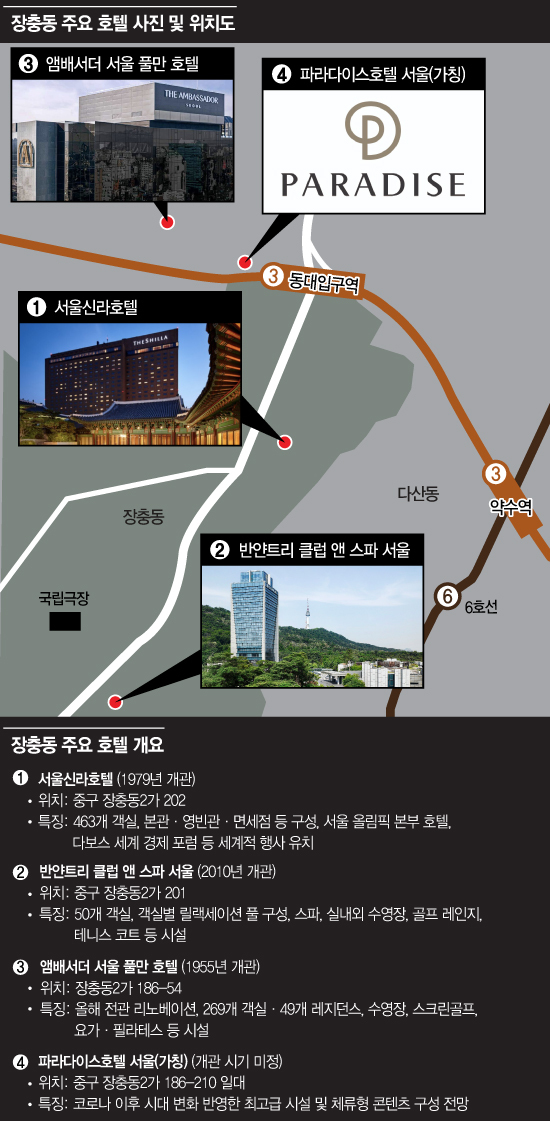
[Asia Economy Reporter Yuri Kim] With Paradise joining the competition, Jangchung-dong in Jung-gu, Seoul has rapidly emerged as a battleground for luxury hotels. Already home to the Seoul Shilla Hotel, Banyan Tree Club & Spa Seoul, Ambassador Seoul Pullman Hotel, and others, each hotel is strengthening its competitiveness through unique luxury and differentiated content.
◆Central Seoul’s Historical Significance…Geographical Advantage Near Business and Shopping
When thinking of luxury hotels in the Jangchung-dong area, the first that comes to mind is the Seoul Shilla Hotel. Located diagonally across the intersection where Dongho-ro and Jangchungdan-ro meet, on the site of the future Paradise Hotel Seoul (tentative name), the Seoul Shilla Hotel opened in 1979. Since then, it has established itself as a leading domestic hotel by hosting global events such as the Seoul Olympic Headquarters Hotel, the IOC Seoul General Assembly, FIFA official VIP hotel, and the Davos World Economic Forum. The hotel consists of the main building, guesthouse, and duty-free shop, with a total of 463 rooms. The outdoor swimming pool 'Urban Island,' where guests can enjoy water activities while overlooking Namsan, and 'The Parkview' restaurant, considered one of Seoul’s top three hotel buffets, are very popular among domestic guests seeking a hotel staycation.
To the left of the Paradise site stands the country’s first private hotel, which began as the Geumsujang Hotel in 1955. Earlier this year, after a full renovation of the hotel’s exterior, rooms, restaurants, and bars, it reopened as the Ambassador Seoul Pullman Hotel. It features 269 rooms, 49 residences, an indoor swimming pool, fitness center, and screen golf facilities.
Heading south along Jangchungdan-ro from the Seoul Shilla Hotel, you will find the Banyan Tree Club & Spa Seoul. Opened in 2010, this hotel is the first urban resort of the Banyan Tree Hotel & Resort Group, themed around relaxation amidst the greenery of Namsan. It has 50 rooms, each equipped with a 'relaxation pool.' The spa is renowned, and the hotel also emphasizes activity facilities such as indoor and outdoor swimming pools, a golf range, and tennis courts. To the north of Jangchung-dong are the Novotel Ambassador Seoul Dongdaemun and JW Marriott Dongdaemun Square Seoul.
Jangchung-dong is adjacent to Namsan. These hotels boast 'mountain views,' which allows them to emphasize 'rest in nature within the city.' Guests can enjoy views of Seoul’s iconic Namsan N Tower and stroll along the Seoul Hanyangdoseong Trail that runs alongside Namsan, experiencing Seoul’s historical significance. The area is also close to other Seoul landmarks such as Gyeongbokgung Palace and the popular shopping district Myeongdong. Being near Seoul Station and centrally located, it offers easy access to major business hubs like Gwanghwamun, Euljiro, and Gangnam. These locational advantages have helped Jangchung-dong emerge as a battleground for luxury hotels.
◆Changes in Hotel Usage Post-COVID-19: "Stay-type Content is Key to Competitiveness"
During the COVID-19 pandemic, the flow of overseas business travelers, who were the main customers of luxury hotels in downtown Seoul, stopped, while domestic customers, unable to travel abroad, sparked a boom in hotel staycations. With increased liquidity in the market and changing leisure consumption patterns, luxury hotels have focused on developing content that encourages guests to stay longer. Major hotels in Jangchung-dong have joined this trend. They are strengthening a two-track strategy targeting both overseas business clients and domestic staycation guests.
The Seoul Shilla Hotel has expanded its popular outdoor swimming pool packages, known for their exotic city views, and has refurbished English education programs and kids’ lounges to appeal to domestic families with children, operating these regularly. Banyan Tree Club & Spa Seoul is also enhancing personalized services based on its 50-room small-scale accommodation and premium service.
Paradise is expected to leverage Jangchung-dong’s locational advantages and reflect changes in how domestic and international customers enjoy hotels post-COVID-19 by focusing on top-tier facilities and stay-type content. There is also a possibility of applying differentiated content experiences such as the spa Cimer, indoor theme park Wonderbox, and art space exhibiting artworks, which were showcased at Paradise City in Incheon, to the Jangchung-dong hotel concept.
An industry insider said, "If luxury hotels have traditionally focused on overseas business and banquet-centered services, they are now competing by focusing on differentiated content that also considers domestic customers amid post-COVID changes," adding, "Given its location with the content of being 'central Seoul adjacent to Namsan,' Jangchung-dong hotels are becoming a battleground for luxury hotels, which is expected to have a positive effect as domestic and international travelers pay more attention to Jangchung-dong."
© The Asia Business Daily(www.asiae.co.kr). All rights reserved.

















