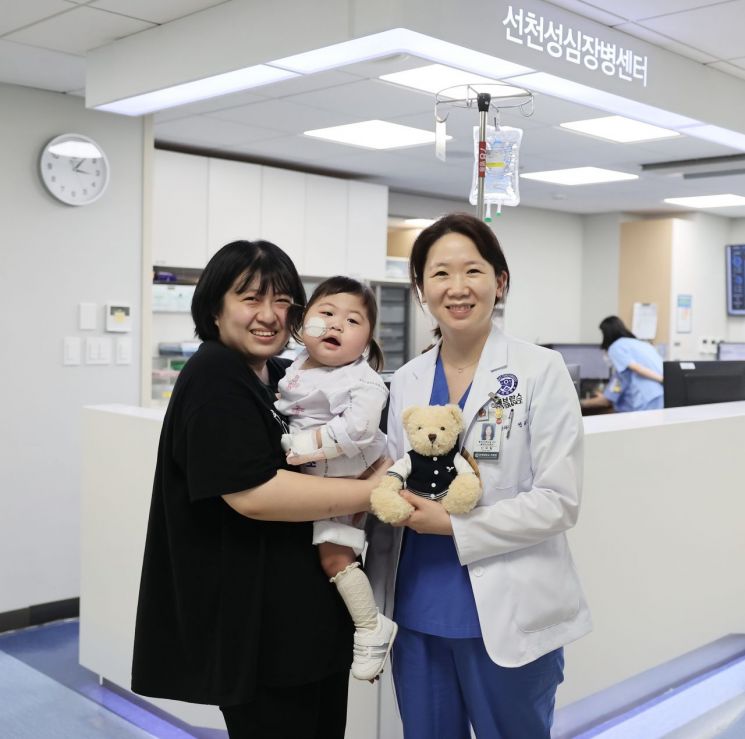
 Yook Su-jin (3), who had an artificial heart for 16 months, safely underwent a heart transplant surgery and was discharged. She is taking a commemorative photo with Professor Shin Yu-rim of the Severance Hospital Congenital Heart Disease Center.
[Asia Economy Reporter Lee Gwan-ju] A pediatric patient who had an "artificial heart" for the longest period in Korea, 16 months, successfully underwent a heart transplant surgery and returned home with their family.
According to Severance Hospital on the 8th, Yuk Su-jin (3 years old) experienced cardiac arrest at 6 weeks after birth in 2020. After cardiopulmonary resuscitation, consciousness was regained and she was diagnosed with hypertrophic cardiomyopathy. Hypertrophic cardiomyopathy is a rare and intractable heart disease occurring in about 1 in 100,000 children, where the heart muscle hardens, preventing proper blood circulation. If it worsens, the heart can suddenly stop, causing sudden death.
The team of Professors Shin Yu-rim (Cardiovascular Surgery) and Jeong Se-yong (Pediatric Cardiology) at Severance Hospital’s Congenital Heart Disease Center administered medication to Yuk, but symptoms of heart failure such as breathing difficulties continued. Even after two rounds of ECMO (extracorporeal membrane oxygenation) treatment to maintain normal heart function, there was no improvement. Ultimately, the medical team decided to implant a ventricular assist device (VAD), known as an artificial heart, for Su-jin.
The VAD attached to the heart helps the heart pump blood effectively throughout the body. Unlike adults, who have the device implanted inside the heart, pediatric patients with smaller bodies have the ventricular assist device’s cannula inserted into the heart and passed outside the body to connect to an external pump. Adult patients with internal devices can be discharged and live daily life, but pediatric patients require meticulous care, with dedicated medical staff monitoring more than 10 times a day, 24 hours a day, so they remain hospitalized. Because the device is connected externally, the pump’s operation and blood clot formation must be checked, along with skin disinfection, antibiotic administration, and rehabilitation to support the child’s development.
Yuk was maintaining life with the VAD in end-stage heart failure, so a heart transplant was necessary. Finding a suitable donor heart for pediatric patients is more difficult than for adults. There are fewer cases of brain-dead heart donors, and the donor heart size is important due to the small body size of pediatric patients. Above all, maintaining the pediatric patient’s heart function in optimal condition until a donor appears is critical.
The medical team systematically managed Su-jin’s heart health until a transplantable heart was found. The multidisciplinary care system, where the Pediatric Cardiac Critical Care Unit (PCCU) at Severance Hospital and various departments’ medical staff stand by and respond jointly for severe pediatric patients, was helpful. Fortunately, the medical team was able to find a donor heart suitable for Yuk, and the heart transplant was successfully performed.
Professor Shin said, “When I first met Su-jin at 6 weeks old, suffering from hypertrophic cardiomyopathy, we did not lose hope through medication, ECMO treatment, and long-term VAD treatment. I am happy that the heart transplant surgery was completed safely and that Su-jin has returned home with her family. I am proud of Su-jin for enduring such a long time well.”
© The Asia Business Daily(www.asiae.co.kr). All rights reserved.

















