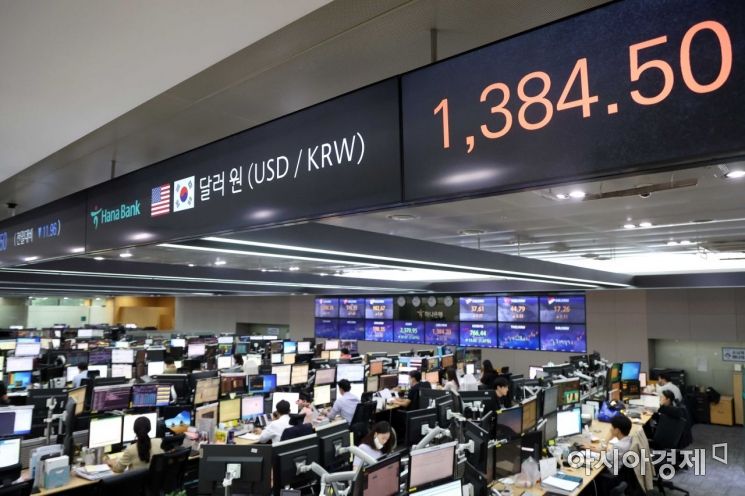
 On the 7th, when the won-dollar exchange rate surpassed 1,380 won for the first time in 13 years and 5 months, dealers were working in the dealing room of Hana Bank in Euljiro, Seoul. Photo by Moon Honam munonam@
[Asia Economy Reporter Ji Yeon-jin] The domestic stock market closed lower on the 7th due to the soaring exchange rate. Amid growing caution over the Federal Reserve's (Fed) tightening scheduled for mid-month, concerns over the worsening European energy crisis and the resulting global economic recession fueled the dollar's strength. Additionally, the risk of a twin deficit (current account and fiscal deficit) in South Korea, combined with China's economic slowdown, pushed the won-dollar exchange rate to the psychological resistance level of 1400.
On this day, the KOSPI index closed at 2376.48, down 33.54 points (1.39%) from the previous day. The index started slightly down by 0.6%, and during the session, it fell more than 1.8% due to increased selling by foreigners, but the decline narrowed slightly thanks to buying by individual investors toward the end of the trading day.
Foreigners expanded their selling amid the dollar's surge during the session. Following the previous day's decline in the U.S. stock market due to rising Treasury yields, foreigners showed a selling bias from early in the session, and the accumulation of these sell orders dragged the index close to its yearly low. This year, the KOSPI fell to 2292.01 on July 6, when international oil prices surged and foreigners continued to sell.
In the Seoul foreign exchange market, the won-dollar exchange rate soared to 1387 won during the morning session, surpassing 1380 won for the first time in 13 years and 5 months since the 2009 financial crisis. The exchange rate closed at 1384.2 won, up 12.5 won (0.91%), as the decline narrowed somewhat in the afternoon.
Amid growing caution ahead of the Federal Open Market Committee (FOMC) rate hike scheduled for mid-month, concerns over a recession caused by the European energy crisis boosted the value of the dollar as a safe-haven asset. The export-import data from China released during the session fell short of expectations, and South Korea's twin deficit risk also is pointed out to have fueled the won's weakness.
Sharp decline in semiconductor-centered ICT business cycle is a burdensome sign for won value
Park Sang-hyun, a researcher at Hi Investment & Securities, said, "The goods balance recorded a deficit of $1.18 billion in August, reducing the current account surplus in July to $1.09 billion." He added, "If the current account shows a deficit due to the goods balance deficit in August, it would be the first current account deficit since early 2012. Since the current account trend is a major factor affecting the won exchange rate, this could further increase downward pressure on the won." He also explained, "The sharp decline in the ICT business cycle centered on semiconductors is also a burdensome sign for the won's value."
Samsung Electronics closed at 50,600 won, down 1.93%, hitting its lowest point in two months. SK Hynix (-1.53%), Samsung SDI (-1.07%), and NAVER (-1.49%) also recorded declines exceeding 1%. Kakao fell 3.16% to 67,500 won. On the other hand, LG Energy Solution closed up 0.93%, and Kia rose 1.11%. Hyundai Motor (0.50%) and LG Chem (0.65%), which had been falling during the session, managed to rebound.
At the same time, the KOSDAQ index fell 11.27 points (1.45%) to 768.19. While individuals net bought 96.6 billion won worth, foreigners and institutions net sold approximately 51 billion won and 48.1 billion won, respectively.
EcoPro surged 9.45% as foreigners and institutions jointly bought shares following news of a supply contract for lithium hydroxide for electric vehicle batteries with AMG Lithium the previous day. EcoPro BM (0.48%) and L&F (0.57%) closed slightly higher, and HLB (0.11%) rebounded toward the end of the session thanks to individual buying. However, Kakao Games and Pearl Abyss closed down 4.27% and 4.67%, respectively, while Celltrion Pharm (2.29%) and Alteogen (2.70%) also declined. JYP Entertainment showed weakness during the session but closed slightly higher.
On this day, Korea Information & Communication, Gold & S, and Yesun Tech closed at the upper limit. Meanwhile, BHI, F&Republic, Prostemics, Ilseung, Ilseong Pharmaceutical, DNA Link, Medicox, and Nano CMS all closed down more than 10%.
Kim Seok-hwan, a researcher at Mirae Asset Securities, explained, "The acceleration of the Fed's tightening outlook caused a sharp rise in the 10-year Treasury yield, leading to continued weakness in major indices, with both KOSPI and KOSDAQ falling more than 1%. The August China export-import data released during the session also fell short of expectations, expanding concerns over a continued trade deficit with China and further widening the intraday decline. The exchange rate approached 1390 won, prompting foreigners to increase their selling."
© The Asia Business Daily(www.asiae.co.kr). All rights reserved.


















