Discovered Driving Method 'FIRE Mode' Enhancing Stability and Performance
Published in International Journal 'Nature', Attracting Global Attention
Focus on Whether Fusion Ion Temperature of 100 Million Degrees Leads to Extended Duration
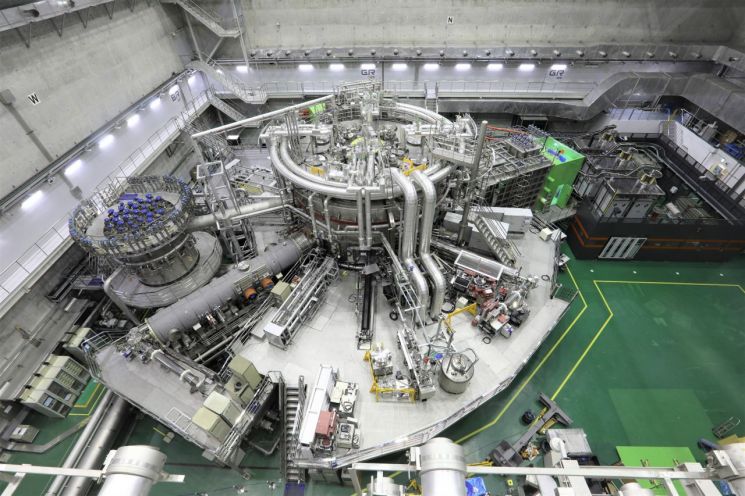
[Asia Economy Reporter Kim Bong-su] Korea has made another advancement in nuclear fusion research, which is gaining attention as the next-generation clean energy source.
According to the Ministry of Science and ICT on the 8th, a joint research team from the Korea Institute of Fusion Energy and Seoul National University analyzed the ultra-high temperature nuclear fusion plasma operation performance of the superconducting fusion research device (KSTAR) and discovered a new nuclear fusion plasma operation mode. This finding was published in the international academic journal Nature on the same day.
Nuclear fusion research aims to generate energy through nuclear fusion reactions like those in the sun on Earth. The core technology is to stably confine ultra-high temperature and high-density plasma in a fusion reactor for a long time. The most representative plasma operation method is the high-performance plasma operation mode called H-mode (High Confinement mode). It is the basic nuclear fusion plasma operation method for commercial reactor operation and serves as a benchmark for developing next-generation operation methods.
The problem with H-mode is that it utilizes a barrier formed at the plasma edge, causing the edge pressure to exceed a critical threshold, which leads to plasma edge localized mode (ELM) instabilities that burst like balloons and can damage the inner walls of the fusion reactor. Therefore, nuclear fusion researchers are studying ways to control ELMs while also striving to find more stable plasma operation modes.
Professor Nayongsoo of Seoul National University and Dr. Han Hyunseon of the Korea Institute of Fusion Energy, among others, found the key. The research team discovered through analysis of operation data and simulation verification of the superconducting fusion research device (KSTAR) currently operated by the Korea Institute of Fusion Energy that fast ions (high-energy particles) generated during plasma heating stabilize turbulence inside the plasma, sharply increasing the plasma temperature. They named this new operation mode the ‘FIRE (Fast Ion Regulated Enhancement) mode.’
Compared to the existing H-mode, it improves plasma performance while avoiding the edge localized mode (ELM) instability, a drawback of H-mode, and also allows easier operation control.
The research team stated, "We have opened new possibilities for securing plasma operation technology for future commercial fusion reactors," and added, "It is significant that the originality of the ultra-high temperature plasma long-duration operation achievements at KSTAR over the past few years has been recognized by the general academic community."
Last year, the Korea Institute of Fusion Energy set a world record by successfully operating ultra-high temperature plasma at an ion temperature of 100 million degrees Celsius continuously for 30 seconds. The discovery of the FIRE mode by the research team is expected to contribute to the development of operation technologies for the International Thermonuclear Experimental Reactor (ITER) and fusion demonstration reactors based on the physical understanding of fast ions.
The research team said, “The FIRE mode was a creative result newly obtained while analyzing failed experimental results where experiments did not proceed as predicted,” and added, “Through additional research on the FIRE mode and fast ions, it is expected that the 100 million degree ultra-high temperature plasma operation performance and duration of the superconducting fusion research device (KSTAR) can be further improved.”
© The Asia Business Daily(www.asiae.co.kr). All rights reserved.
![Clutching a Stolen Dior Bag, Saying "I Hate Being Poor but Real"... The Grotesque Con of a "Human Knockoff" [Slate]](https://cwcontent.asiae.co.kr/asiaresize/183/2026021902243444107_1771435474.jpg)
















