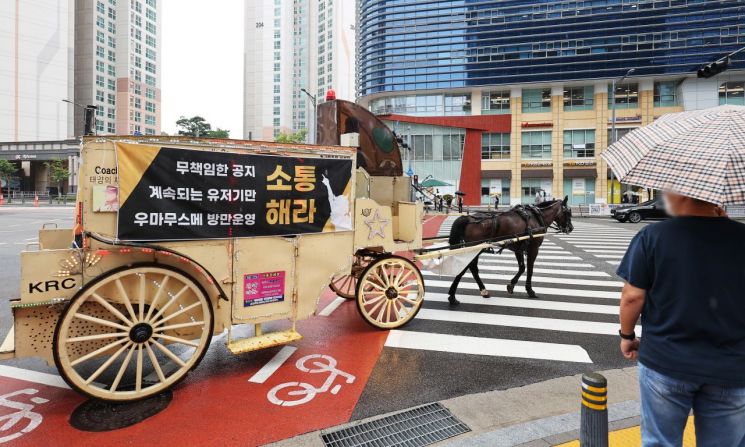
 A carriage with protest banners against the game company's operational policies by domestic users of Kakao Games' 'Uma Musume: Pretty Derby' was running on the road near Pangyo Station in Seongnam-si, Gyeonggi-do, where Kakao Games' headquarters is located, on the morning of the 29th.
 [Image source=Yonhap News]
[Asia Economy Reporter Seungjin Lee] The ‘Odeokhu’ has made a move. The term ‘Otaku,’ used in Japan to refer to people who are deeply immersed in a specific culture or hobby, was adapted into Korean as ‘Odeokhu’ with a mocking tone. However, it has now become a driving force in the industry, to the extent of summoning the CEO of a game company.
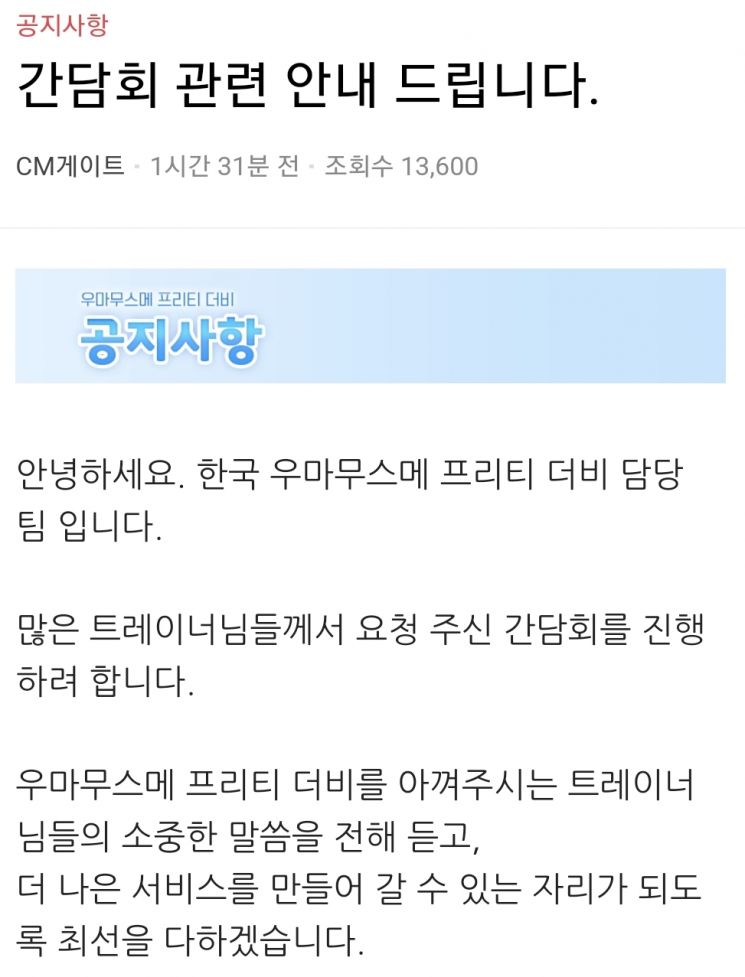
On the 6th, Kakao Games announced through the official cafe of the mobile game ‘Uma Musume Pretty Derby’ that it plans to hold a meeting with users. This action came after Uma Musume users expressed dissatisfaction with Kakao Games’ management and continuously requested a meeting with the company.
Prior to this, Cho Gye-hyun, CEO of Kakao Games, bowed to the users. On the 3rd, through the official cafe, CEO Cho apologized, saying, “I sincerely apologize once again for causing deep disappointment to our customers due to this incident,” and added, “We will carefully check each of the opinions you have sent and do our utmost to improve.”
The apology from CEO Cho and the meeting led by Kakao Games were initiated by the active efforts of some passionate users called ‘Odeokhu’ among the entire Uma Musume user base. They continuously demanded communication with Kakao Games, citing issues such as the discriminatory operation of Korean and Japanese servers by the game company and distributor, imbalance in the distribution of in-game currency, and delays in announcing major events.
When their demands were not met, they started an app market rating attack and held a carriage protest around Bundang-gu, Seongnam-si, where Kakao Games’ headquarters is located, on the 29th of last month. After considering a truck protest and even a refund lawsuit, Kakao Games’ stock price also wavered. What used to be limited to exchanging opinions among some users online through comments escalated to the point where they took to the streets and summoned the game company’s CEO.
The ‘subculture,’ once treated as a culture unique to Odeokhu, is rapidly growing into mainstream culture. This is largely due to the stagnation of mainstream culture such as performances, concerts, and movies during the COVID-19 pandemic. A prime example is the ‘Pokemon Bread’ that shook convenience stores this year. It surpassed 70 million cumulative sales within six months of its release, showing how the collecting culture of some Odeokhu spread nationwide. Another example is Uma Musume, which, despite uncertainty about its popularity in Korea as a subculture game, broke industry predictions and achieved first place in sales on the two major app markets.
What users wanted most in the recent Uma Musume incident was responsible communication. However, missing the right timing for communication led to users taking to the streets. Behind this was apparently some complacency, thinking, ‘How severe could the protests of game users really be?’
Going forward, the influence of Odeokhu is expected to grow stronger, and the mainstream adoption of subculture will accelerate further. The Uma Musume incident should serve as a turning point for the industry to change its approach toward Odeokhu and subculture.
© The Asia Business Daily(www.asiae.co.kr). All rights reserved.


















