7:10 AM Departure to Ulsan Offshore
Central Pressure 950hPa Passing Over Korean Peninsula
Flood Damage in Various Parts of Pohang City
70s Man Dead in Pohang, 20s Missing in Ulsan
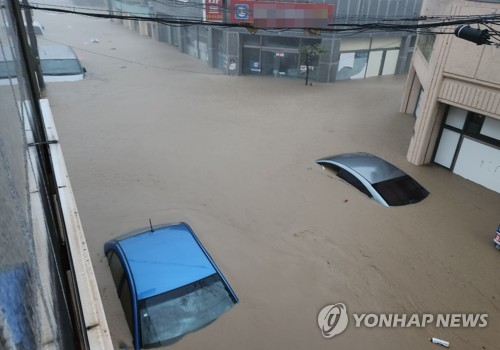 On the morning of the 6th, residential areas in Nam-gu, Pohang City were flooded due to the impact of Typhoon Hinnamnor. (Photo by Yonhap News)
[Asia Economy Reporter Han Jinju] Typhoon Hinnamnor made landfall in Geoje in the early morning of the 6th, passed through Busan, and exited into the sea off Ulsan around 7 a.m. The areas directly affected, including Busan and Pohang, experienced continuous property damage due to heavy rain and strong winds.
According to the Korea Meteorological Administration, Hinnamnor made landfall near Geoje City at 4:50 a.m. and exited into the sea off Ulsan at 7:10 a.m. When passing about 10 km northeast of Busan at 6 a.m., the central pressure was 955 hPa, and the maximum instantaneous wind speed was 40 m/s. At noon, it entered the sea about 100 km northeast of Ulleungdo while maintaining the central pressure.
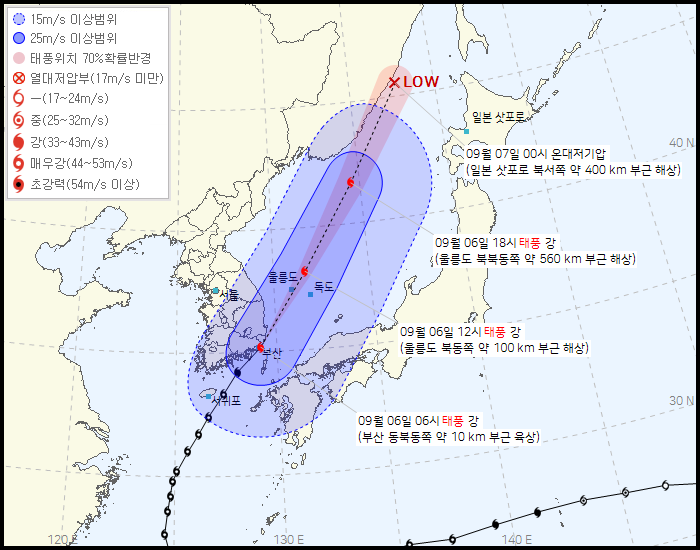
The central pressure at the time of landfall on the Korean Peninsula surpassed that of the strongest typhoons in history. When Hinnamnor passed Jeju at midnight, the central pressure was 945 hPa, and the maximum wind speed was 45 m/s. The lower the central pressure, the stronger the vortex and the greater the power. In 1959, Typhoon Sarah recorded a central pressure of 951.5 hPa (Tongyeong), and in 2003, Typhoon Maemi recorded 954.0 hPa (Busan).
Strong winds are expected to continue until the typhoon completely passes, with a high possibility of storm surges. Strong gusts are forecasted to persist in the metropolitan area until late afternoon. From the 5th to the morning of the 6th, the maximum wind speeds reached 43.1 m/s at Maemuldo, Tongyeong; 42.5 m/s at Gosan; and 42.3 m/s at Gageodo (Shinan). Heavy rain fell from the 4th, with flooding damage concentrated especially in Jeju, Pohang, and Ulsan. Major precipitation amounts include 951.5 mm at Witseoreum, Jeju; 393 mm in Pohang; 334 mm in Ulsan; 333.5 mm at Jirisan (Sancheong); and 251.5 mm in Gangnam (Seoul).
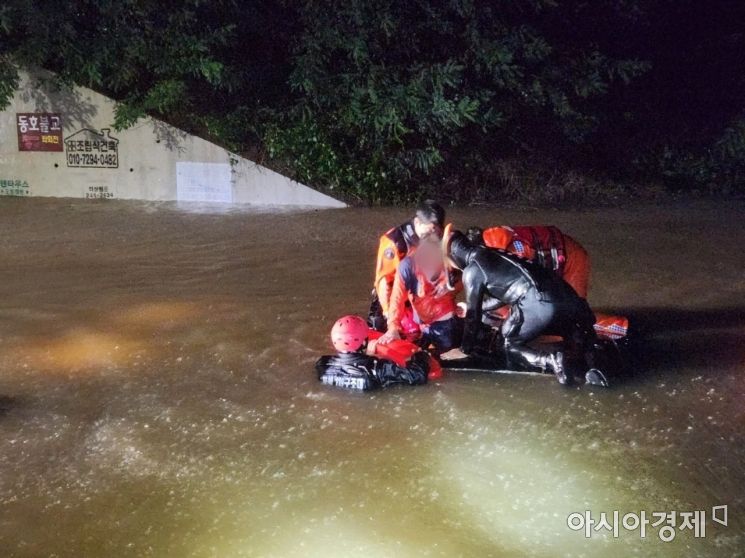 Firefighters are conducting a rescue operation for people trapped in a flooded vehicle in the underpass of Gangdong-myeon, Gyeongju-si, Gyeongbuk. (Photo by the Fire Department)
As Hinnamnor passed through Pohang and Gyeongju, heavy rain caused casualties and property damage. A woman in her 70s was found dead after being swept away by a rapid current on a road in Ocheon-eup, Pohang. Hourly rainfall exceeding 100 mm caused flooding throughout Pohang, isolating residents in markets and lodging facilities who were later rescued. A flood warning was issued for the Hyeongsan River area in Pohang, and about 3,000 residents in Gyeongju and Pohang evacuated due to concerns over river and reservoir flooding. A fire broke out at POSCO Pohang Steelworks as the typhoon passed, and the connection is under investigation.
In Busan, waves overtopped structures and covered the coastal road in Haeundae Marine City, and two men, presumed to be YouTubers, entered the wave zone and were rescued by police. Power outages occurred around Minrakhoe Center, and glass windows of shops near the waterfront park were broken. Since the previous day, heavy rain fell in Busan’s Geumjeong District with over 150 mm and Buk District with 146 mm.
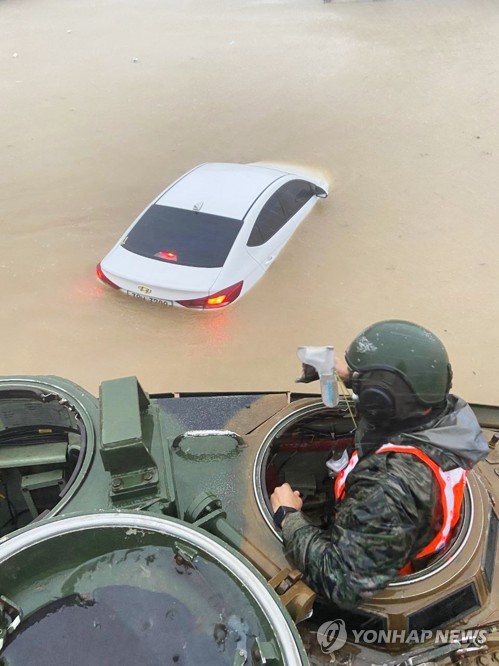 The 1st Marine Division deployed 2 KAAVs and 3 IBSs on the 6th in the flooded area of Pohang, Gyeongbuk, conducting a civilian rescue operation. (Photo by Yonhap News)
According to the Ministry of the Interior and Safety, a man in his 20s went missing overnight in Ulsan due to Typhoon Hinnamnor. It is presumed he suffered an accident related to alcohol consumption. A total of 3,463 people temporarily evacuated to emergency shelters in areas at high risk of landslides or flooding. Gyeongnam had the highest number with 2,224 evacuees, followed by Jeonnam with 614 and Busan with 366. Separately, pre-evacuation orders were issued to a total of 14,386 people. Due to the flooding of Chilseongcheon in Pohang, 2,239 residents of Jenaeri were guided to evacuate.
Additionally, one commercial building was further flooded in Jeju, and three houses were flooded in Jeju and Gyeonggi. Road embankments collapsed in Jecheon, Chungbuk, and Gwangju, Gyeonggi. In Jeju, where the typhoon struck, two vehicles were flooded and one fishing boat capsized. Power outages affected 44 locations in Jeju, Gyeongnam, Busan, and Ulsan. Passenger ship operations were suspended on 70 vessels across 50 routes, and 251 flights were canceled at 12 airports. From the first train to 3 p.m. that day, 354 KTX and regular train services on 11 lines including the Gyeongbu and Honam lines were either suspended or partially operated.
© The Asia Business Daily(www.asiae.co.kr). All rights reserved.



















