The Provincial Assembly Previously Extended the Remaining Nuclear Power Plant's Lifespan
[Asia Economy Reporter Park Byung-hee] California, USA, which had significantly increased the proportion of renewable energy aiming for an eco-friendly energy transition by 2045, is facing a blackout (large-scale power outage) crisis due to severe heatwaves and drought. As the power shortage worsened, the California State Legislature ultimately decided to extend the lifespan of the controversial nuclear power plants.
Bloomberg reported on the 5th (local time) that California, where temperatures exceeded 43 degrees Celsius amid ongoing heatwaves, declared a power grid emergency.
California authorities indicated the possibility of rolling blackouts on the 6th, when power demand could reach an all-time high as the Labor Day holiday ends. Bloomberg diagnosed that California’s power supply network has become vulnerable during the transition from fossil fuels to eco-friendly energy.
Recently in California, the use of air conditioners by businesses and households has surged due to the heatwave, pushing power demand beyond its limits and raising concerns about large-scale blackouts.
The U.S. National Weather Service predicted that temperatures in Sacramento, the capital of California, would consecutively break records with 45 degrees on the 5th and 46 degrees on the 6th. Downtown Los Angeles recorded its highest temperature this year at 39.4 degrees on the 4th.
Elliott Mainzer, CEO of the California Independent System Operator (CAISO), which manages California’s power grid, warned at a press conference that "rolling blackouts could occur as soon as today," urging residents to triple their efforts to conserve electricity. He emphasized that without voluntary power reduction efforts, CAISO would raise the emergency response to level 2 to secure reserve power, and rolling blackouts would be a last resort.
California set a goal to produce 100% of its electricity from eco-friendly renewable energy by 2045 and increased related investments. Over the past few years, California has consecutively shut down gas power plants and strongly promoted eco-friendly energy policies by increasing the share of solar power. On the 10th of last month, the California Energy Commission unanimously approved a plan to install up to 5 gigawatts (GW) of wind turbines on the West Coast by 2030 and expand to up to 25 GW by 2045. According to S&P Global, eco-friendly energy including hydropower contributes up to 45% of the total power grid.
However, concerns are rising that the eco-friendly energy transition is being pushed too hastily as fears of power shortages due to this year’s heatwave grow. To make matters worse, severe drought has significantly reduced hydropower generation, which accounts for 10% of California’s power production, this year.
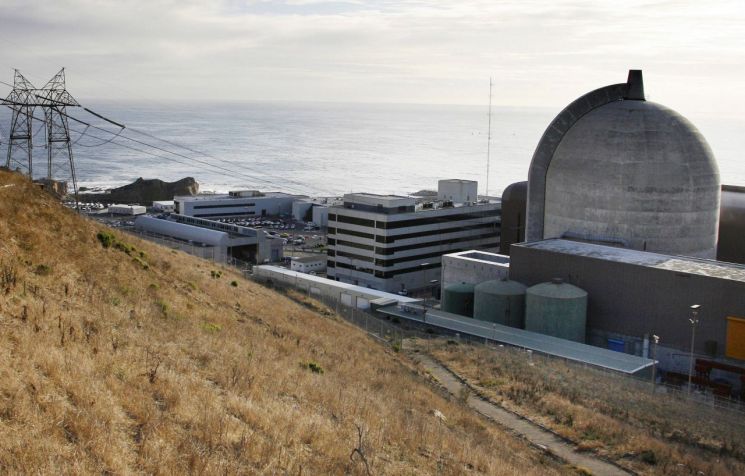
Earlier, on the 1st, the California State Legislature passed a bill extending the lifespan of the Diablo Canyon nuclear power plant, the last remaining nuclear facility in California. The Diablo nuclear plant, originally scheduled to close by 2025, can now operate for up to five more years.
Some argue that without the 2250 MW Diablo nuclear plant, California cannot achieve its 2045 eco-friendly energy transition goals. Last year, Diablo accounted for 9% of California’s power production. Considering only the eco-friendly energy sector, its production share was 15%.
© The Asia Business Daily(www.asiae.co.kr). All rights reserved.

















