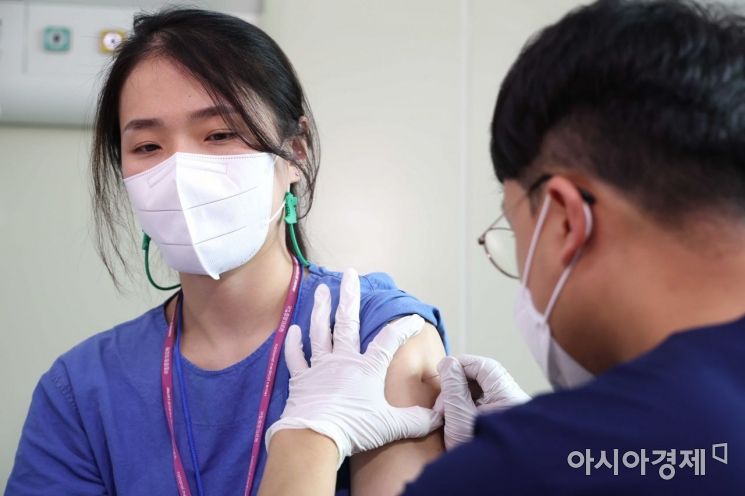
 On the 27th, nurse Ihanna, who will be treating monkeypox patients, is receiving a monkeypox vaccine at the main building of the National Medical Center in Jung-gu, Seoul. Photo by Honam Moon munonam@
[Asia Economy Reporter Song Seung-seop] The second monkeypox patient in South Korea was found to have contacted a total of 15 people. So far, there are no high-risk contacts; 2 are classified as medium-risk contacts, and 13 as low-risk contacts, indicating that the possibility of transmission through everyday community contact is almost nonexistent.
On the 4th, the Korea Disease Control and Prevention Agency (KDCA) announced that it had identified the movement of Patient A, the second monkeypox case, during the infectious period and classified the risk levels according to exposure. In this process, KDCA confirmed 2 medium-risk contacts who were family and friends, and 13 low-risk contacts who met the patient at clinics and pharmacies.
Medium-risk contacts undergo active monitoring for 21 days from the last exposure date at their local public health center, checking for suspicious symptoms. Low-risk contacts receive health education and are instructed to report or inquire immediately upon recognizing any suspicious symptoms.
Patient A is a Korean national who returned from Europe on the 18th of last month (asymptomatic at the time). Symptoms appeared on the 28th of the same month, ten days after returning, starting with fever, headache, and dizziness. On the 30th, experiencing localized pain, the patient visited a local clinic. On the 1st of this month, two weeks after returning, the patient personally contacted the public health center. Seoul epidemiologists classified the patient as a suspected case and conducted genetic testing, which ultimately confirmed monkeypox.
The KDCA explained, “Since appropriate protective equipment was worn at medical institutions and the main infection route?direct exposure to bodily fluids?was unlikely, the contacts were classified as low risk,” adding, “Domestic and international monkeypox guidelines report that transmission through everyday community contact is almost nonexistent.”
It is known that Patient A did not have rashes or blisters when visiting the clinic on the 30th of last month. The hospital noted complaints of skin pain.
Meanwhile, Patient A did not disclose travel history to medical staff, and the medical staff did not inquire about overseas travel history. After the first confirmed case, the quarantine authorities announced in July that they would provide medical institutions with overseas travel history from five countries with frequent monkeypox outbreaks (the United Kingdom, Spain, Germany, Portugal, and France), but the system was not operational.
© The Asia Business Daily(www.asiae.co.kr). All rights reserved.

















