Prices Stabilized but Won-Dollar Exchange Rate Surges
BOK Finds It Difficult to Change Tight Monetary Policy
Rising Exchange Rate Negatively Impacts Domestic Prices
Concerns Over Decreasing Foreign Reserves Due to Exchange Rate Defense
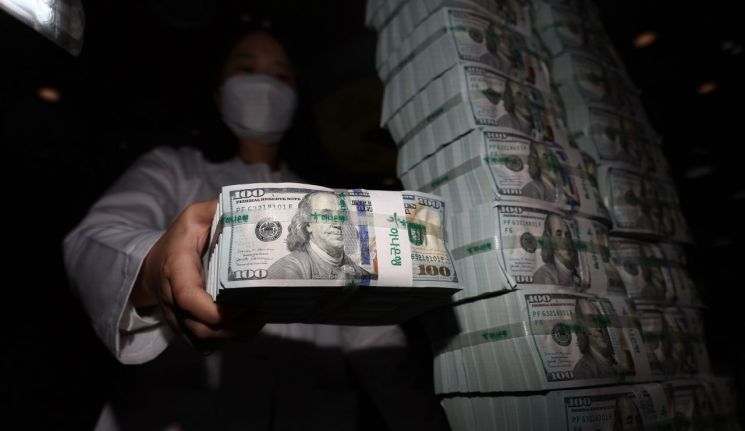 On the 1st, an employee is organizing dollars at the Hana Bank Counterfeit Response Center in Jung-gu, Seoul.
 [Photo by Yonhap News]
The won-dollar exchange rate surged sharply, surpassing the 1,360 won per dollar mark. This is the highest level in 13 years and 5 months since the global financial crisis. Although the consumer price inflation rate slightly eased last month, the prices of essential goods that significantly impact the everyday lives of ordinary people remained high. With exchange rates and prices showing instability, the Bank of Korea is expected to continue its tightening policy.
On the 2nd, the won-dollar exchange rate closed at 1,362.6 won in the Seoul foreign exchange market, up 7.7 won from the previous day's closing price, continuing its upward trend. This closing price was the highest in 13 years and 5 months since April 1, 2009 (1,379.5 won). Strong U.S. economic indicators have increased expectations that the U.S. Federal Reserve (Fed) will continue its aggressive tightening, and concerns about a slowdown in the Chinese economy have strengthened the preference for the dollar. The dollar index, which measures the value of the dollar against six major currencies, approached the 110 level.
The won has depreciated further amid the intensifying strong dollar phenomenon and growing concerns about economic slowdown due to the recent accumulation of trade deficits. According to the Ministry of Trade, Industry and Energy, South Korea's trade deficit last month was $9.47 billion, marking the largest deficit in 66 years since trade statistics began in 1956. Semiconductor exports, which are a major export item, declined for the first time in 26 months due to weakening global demand and falling prices.
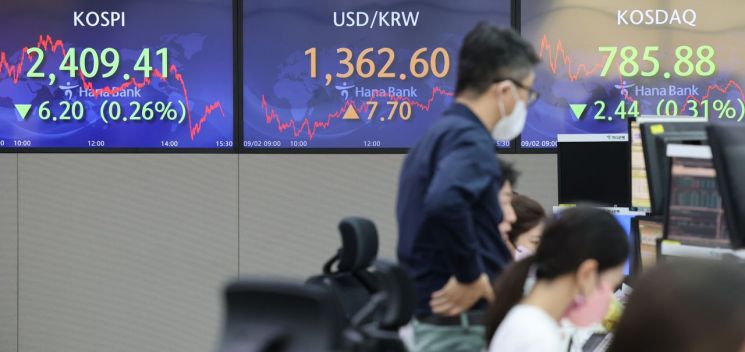
Since South Korea is highly dependent on exports, the accumulation of trade deficits is interpreted as a sign of slowing economic growth, which leads to a greater depreciation of the won. In particular, the recent weakness of the Chinese yuan, which has a strong correlation with the won, has further pushed up the won-dollar exchange rate. China has repeatedly locked down major cities due to the spread of COVID-19, and if the Chinese economy slows down, it will place a greater burden on South Korea’s export-dependent economy.
Regarding consumer prices, the inflation rate slowed to the 5% range last month, marking a slowdown for the first time in seven months. According to Statistics Korea, the consumer price index last month was 108.62 (2020=100), up 5.7% year-on-year. This was the first time since January this year that the inflation rate decreased compared to the previous month. The recent decline in international oil prices had a significant impact. As a result, some analyses suggest that inflation may have peaked. Eo Un-seon, head of the Economic Trend Statistics Division at Statistics Korea, said, "Unless the downward trend in international oil and grain prices is completely reversed, it is likely that inflation has peaked in real terms."
However, agricultural product prices rose by 10.4%, an increase from 8.5% the previous month, and dining-out prices rose by 8.8%, marking the highest level in 30 years since October 1992, indicating that prices for ordinary people remain unstable. Core consumer prices, which exclude seasonal factors and temporary shocks, also maintained an upward trend. Since an increase in the won-dollar exchange rate raises import prices and can stimulate domestic inflation, high inflation is likely to continue.
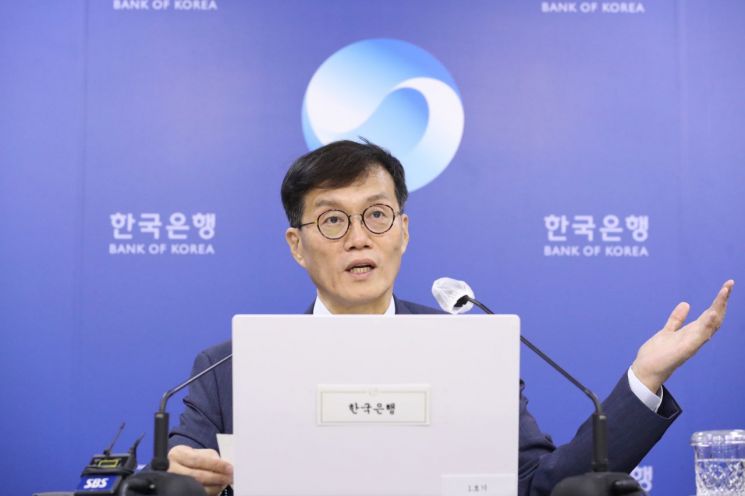 Bank of Korea Governor Lee Chang-yong is explaining the base interest rate hike at the monetary policy direction press conference held at the Bank of Korea in Jung-gu, Seoul, on the morning of the 25th of last month.
 [Image source=Yonhap News]
Given the ongoing instability in exchange rates and prices, analyses suggest that the Bank of Korea’s policy of raising interest rates is unlikely to change easily. On the 25th of last month, the Bank of Korea raised its base rate by 0.25 percentage points, maintaining the Korean base rate (annual 2.5%) at a level similar to the U.S. base rate (annual 2.25?2.5%). However, if the Fed raises its base rate by at least 0.5 percentage points at the Federal Open Market Committee (FOMC) meeting scheduled for the 20th?21st (local time), the interest rate gap between Korea and the U.S. will widen again. In that case, the won’s value against the dollar is likely to fall further.
The shrinking foreign exchange reserves are also a concern. Following the Monetary Policy Committee meeting last month, Bank of Korea Governor Lee Chang-yong expressed confidence in the foreign exchange reserves, saying, "People worry that foreign exchange reserves are insufficient by IMF standards, but I came from the IMF," yet many believe it is too early to be complacent given that the won-dollar exchange rate has risen to levels seen during the financial crisis. If exchange rate volatility increases, the foreign exchange authorities will need to intensify interventions to defend the exchange rate, which could rapidly deplete foreign exchange reserves.
As exchange rate instability grows, economic and financial leaders plan to hold an emergency macroeconomic and financial meeting on the 5th to review the recent economic situation. Attendees will include Deputy Prime Minister and Minister of Economy and Finance Choo Kyung-ho, Bank of Korea Governor Lee Chang-yong, Financial Services Commission Chairman Kim Ju-hyun, Presidential Office Economic Secretary Choi Sang-mok, and Financial Supervisory Service Commissioner Lee Bok-hyun.
© The Asia Business Daily(www.asiae.co.kr). All rights reserved.
![Clutching a Stolen Dior Bag, Saying "I Hate Being Poor but Real"... The Grotesque Con of a "Human Knockoff" [Slate]](https://cwcontent.asiae.co.kr/asiaresize/183/2026021902243444107_1771435474.jpg)


















