Golf Boom Reverses Trend of Amateur Players in Schools
Rising Green Fees Increase Costs for Field Training
Success Requires Overcoming Fierce Competition... "Must Balance with Studies"
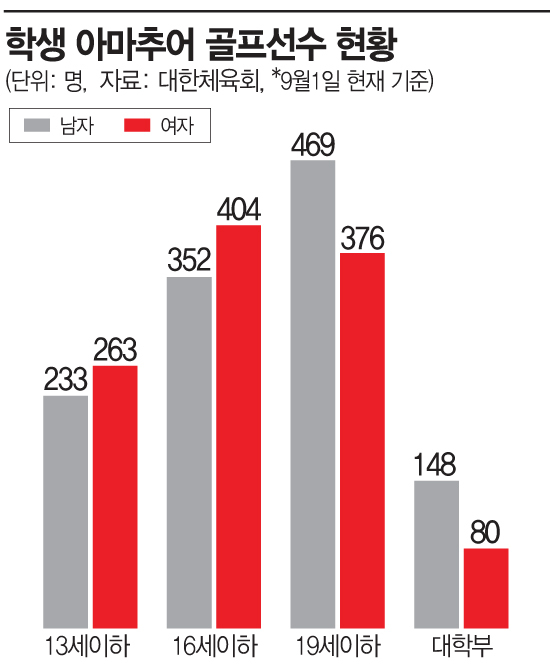
[Asia Economy Reporter Choi Taewon] The number of amateur student golf players has increased since the COVID-19 pandemic, but concerns have been raised that training conditions have worsened due to rising cost burdens. Experts advise that even if players become professionals while bearing financial burdens, they should carefully consider their career choices because, except for the top 2% of professional players, it is difficult to maintain a stable livelihood.
Golf Boom Revives Young Talent Growth... Only Those in Top 2% Can Lead a 'Stable Life'
According to the Korea Sports Council on the 14th, as of September 1, there are 2,325 student golf players belonging to school sports teams from elementary to university levels. The number of student players steadily decreased from 5,538 in 2000 to 2,023 in 2020. However, with the golf boom following the COVID-19 pandemic, the number rose by 11% to 2,246 last year compared to the previous year. This year, it has increased by more than 80 players compared to last year.
On the other hand, the path to becoming a professional player is not easy. According to the Korea Professional Golfers' Association (KPGA) and the Korea Ladies Professional Golf Association (KLPGA), there are only 2,351 KPGA tour professionals and 1,521 KLPGA full members. For student players, it is like passing through the eye of a needle.
Even after passing this gateway, many tour professionals face harsher conditions than expected, according to industry insiders. Purely participating in tournaments is not enough to make a living, so many take side jobs or quit their careers midway. The golf industry estimates that only about 1% of players can live comfortably on prize money alone, and even including sponsorship support, only about 2% can do so.
Expensive Green Fees, Worsening Training Conditions
Voices from the field say that training conditions have actually worsened. This has led to calls for the golf community to actively improve the growth environment.
A major obstacle to junior players' growth is training costs.
Due to the nature of golf, field training is essential, but related costs are entirely borne by the players themselves. This differs from other sports where most training takes place in stadiums or gyms.
In particular, recent competitive green fee hikes at major golf courses are negatively impacting training environments. Since the COVID-19 pandemic, green fees have increased by 30%. Caddie fees have also surged, adding to the difficulties. According to the Korea Golf Consumer Agency last month, caddie fees paid by domestic golfers last year are estimated at 1.5934 trillion KRW, 2.4 times higher than 651.6 billion KRW in 2011.
According to the Korea Golf Course Management Association, the total market size of the golf course industry (golf course sales + caddie fees) surged 18.3% year-on-year to 7.0066 trillion KRW in 2020.
Golf courses reluctant to host student tournaments are also a factor hindering student players' growth. For example, the student golf tournaments hosted by the Gyeonggi-do Golf Association have been held annually for several years at Gunsan Country Club in Jeonbuk due to the inability to secure golf courses within the province. Although there are over 170 golf courses in Gyeonggi-do, golf courses hesitate to rent out for student tournaments because it would hurt their revenue.
This is also compared to the environment in South Africa, which has recently gained attention in major tournaments. South Africa is widely known for its excellent golf infrastructure. With about 490 golf courses and low green fees, it is analyzed that these factors contribute to the expansion of golf’s base. Ashley Buhai, who won her first career victory at the 2022 LPGA Tour’s final major AIG Women’s Open, Charl Schwartzel, the inaugural champion of the LIV Golf Series first event, and Brandon Grace, who won the second event, are all from South Africa.
Need to Move Away from Performance-First Culture
There are also criticisms that a performance-first culture hinders players' potential.
Park Noseung, a competition committee member of the Korea Golf Association and widely known as a ‘Golf Daddy,’ said, “If players become impatient and greedy, they focus only on short-term results. If you really want to develop a great player, you should give them opportunities to become familiar with golf and swing freely from the very beginning of teaching how to use golf.”
Park also cited examples of major players. “Looking at famous overseas professional players like Bubba Watson, who has won 12 times on the PGA Tour, or Matthew Wolff, who moved to LIV, many have swings that we cannot understand. On the other hand, in domestic amateur tournaments, all 65 players who made the cut have almost identical swings,” he explained. He pointed out that uniform education methods ignoring individual characteristics actually hinder players’ growth potential.
Need to Establish a System for Balancing Academics and Golf
Meanwhile, since it is difficult to become a professional and even if one does, the likelihood of sustaining a livelihood solely through a playing career is low, there are suggestions to prepare a second path outside of golf from an early age.
In fact, the School Sports Promotion Act, revised last June, prohibits student players who do not meet minimum academic standards from participating in competitions starting in 2024. This is a stricter regulation compared to the previous rule that only restricted competition participation when necessary.
In March this year, the Ministry of Education announced the ‘2022 Basic Plan for Promoting School Sports,’ which strengthens the system to guarantee student athletes’ right to learn. The plan includes provisions for regulating the scale and scope of competitions restricting participation of student players who do not meet minimum academic standards and establishing criteria for these standards.
Park said, “Golf is a sport relatively easy to balance with studying. The important thing is not to give up on studying.”
© The Asia Business Daily(www.asiae.co.kr). All rights reserved.

















