Heatwaves, Droughts, Wildfires Followed by Hail Damage... Including Human Casualties
"71% of Climate Change Overall Caused by Humans"
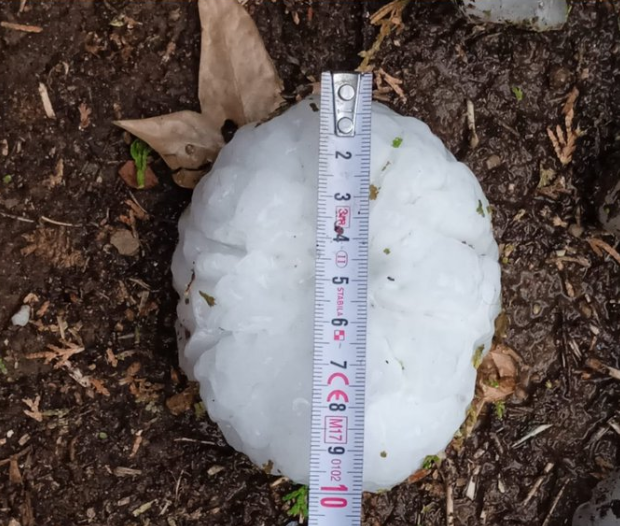 A storm accompanied by hail occurred in the Girona region of Catalonia, Spain.
 Photo by Spanish local meteorological agency capture.
[Asia Economy Reporter Yoon Seul-gi] In Spain, which had been suffering from wildfires and drought due to an unusually early heatwave in June, hailstones measuring 10 cm in diameter have now fallen, causing casualties. As climate change accelerates recently, extreme weather events seem to be occurring more frequently.
According to foreign media such as AFP and BBC, a hailstorm occurred around 7:30 p.m. on the 30th in the Girona area of Catalonia, Spain. The hailstones measured 4 inches (about 10.16 cm), larger than a baseball (7.23 cm in diameter). The falling speed of hail varies depending on its size, and in this case, it is estimated to have fallen at a maximum speed of 115 km/h.
Hailstones of this size and force fell for about 10 minutes, resulting in casualties. A 20-month-old child died after being hit on the head by hail, and about 50 people suffered injuries such as broken bones and bruises.
Hail is mainly formed in cumulonimbus clouds and forms well when the atmosphere is unstable. Hot air rapidly rises to the upper layers, where water vapor freezes into ice, and through repeated cycles of rising and falling, the ice melts and refreezes, causing the hailstones to grow larger.
The local meteorological agency stated, "This is the largest hailstone size recorded since 2002," and added, "Because this summer has been abnormally hot, more intense tropical storms are expected in the future."
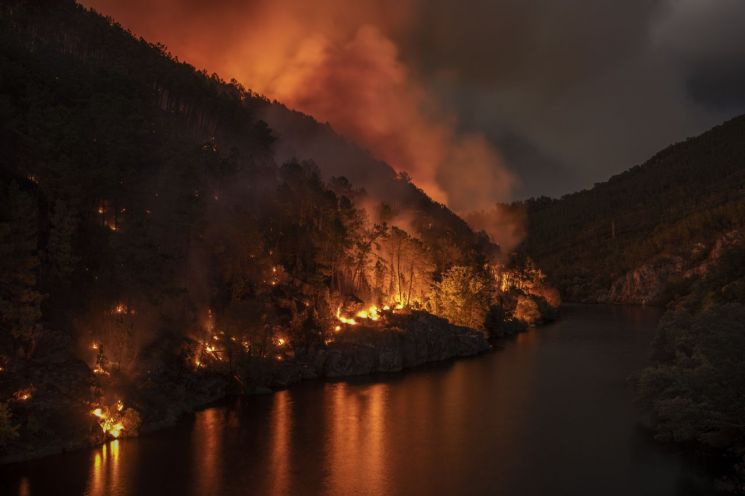 On the 1st (local time), a forest is burning due to a wildfire that occurred in Ribadavia, Ourense Province, northwestern Spain. [Image source=Yonhap News]
Recently, Spain has been experiencing severe climate change, with frequent extreme weather events. According to Spanish authorities, Spain has been enduring a heatwave since early June. This is the earliest heatwave since 1981.
Most regions in Spain recorded temperatures of 40 degrees Celsius, with some areas soaring up to 44.7℃. Due to the prolonged duration, casualties have been mounting. As of July 21, the death toll from the heatwave reached 1,047.
Wildfire damage has also been continuous. According to AFP on the 1st, wildfires burned 290,000 hectares across 400 areas, about four times the recent annual average of 67,000 hectares.
Additionally, there are concerns about typhoon damage. According to the local Spanish media The Local, unstable pressure is currently located in the relatively high-latitude central Atlantic, placing the area under the influence of hurricanes. The U.S. National Hurricane Center forecasts a 70% chance of cyclone formation in the Atlantic over the next few days.
Meanwhile, Europe has experienced a series of heatwaves, wildfires, and record droughts this summer, and experts have pointed out that these extreme weather events are caused by human-induced climate change.
The UK climate information website 'Carbon Brief' analyzed over 400 research reports on 504 extreme weather events between 1850 and May of this year and found that about 71% of the events were influenced by human activity.
In particular, 93% of the 152 heatwave events were influenced by human activities. For droughts, 55 out of 81 cases (68%) were affected by humans, and for heavy rain and floods, 71 out of 126 cases (56%) were influenced by human factors.
© The Asia Business Daily(www.asiae.co.kr). All rights reserved.


















