[Asia Economy Sejong=Reporter Kim Hyewon] The key trends in holiday gift-giving before and after COVID-19 were 'contactless,' 'premium,' and 'diversity.' There was a tendency to purchase gifts online and have them delivered by courier to the doorstep, sending more expensive gifts than usual instead of visiting hometowns. The formation of a 'stay-at-home' culture also broadened the range of gifts to include quarantine supplies, home appliances, and alcoholic beverages.
The Rural Development Administration Education and Culture Information Service (Nongjeongwon) analyzed more than 2.27 million data points published on online news, communities, and blogs from January 1, 2019, to understand how COVID-19 affected gift-giving culture as the first holiday after the COVID-19 endemic.
A representative trend after COVID-19 was untact (contactless). As COVID-19 spread, holiday gifts were increasingly purchased online and delivered by courier. According to statistics from the Korea Transport Institute, the average daily number of travelers during the holiday period sharply dropped from 6.47 million in 2019 to 4.32 million during the 2022 Lunar New Year. The online transaction amount for agricultural and livestock products during Chuseok increased more than twofold from 374.5 billion KRW in 2019 to 721.3 billion KRW last year.
Due to social distancing preventing visits to hometowns, interest in premium gifts increased to express sincerity through gifts. Recently, ultra-premium gift sets exceeding traditional premium levels, such as 3 million KRW Hanwoo beef sets and wine sets priced comparable to cars, have attracted attention.
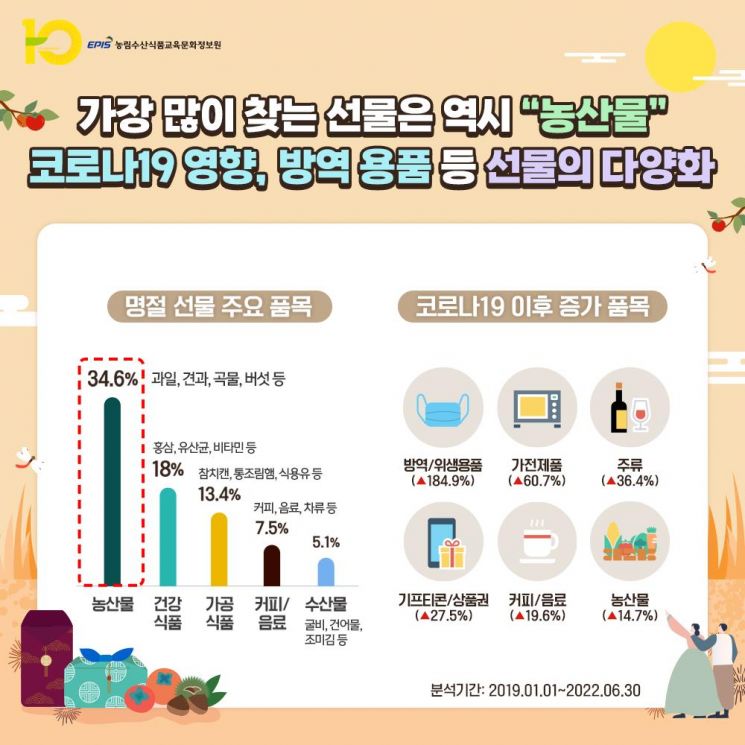
COVID-19 also demonstrated the diversity of holiday gifts. Quarantine supplies, which had not been considered as gifts before, emerged as new items of interest, and as time spent at home increased, information on home appliances, alcoholic beverages, and gifticons that can be given contactlessly also increased.
Among the effects of COVID-19, traditional holiday gifts such as agricultural products showed the highest preference. Among these, fruits appeared overwhelmingly in mentions of agricultural products.
In particular, domestic fruits used for ancestral rites such as apples, pears, dried persimmons, and jujubes ranked high. Exotic fruits such as Hallabong, grapes (including Kyoho and Shine Muscat), and mangoes were also frequently mentioned as holiday gifts. This seems to reflect both the practical aspect of being usable for ritual foods and the intention to express sincerity by gifting high-priced exotic fruits.
Lee Jong-soon, head of Nongjeongwon, said, "This Chuseok is about a month earlier than usual, so farmers and distributors are busy preparing for Hangawi," adding, "Nongjeongwon will also do its best to promote the consumption of domestic agricultural and livestock products."
© The Asia Business Daily(www.asiae.co.kr). All rights reserved.
![Clutching a Stolen Dior Bag, Saying "I Hate Being Poor but Real"... The Grotesque Con of a "Human Knockoff" [Slate]](https://cwcontent.asiae.co.kr/asiaresize/183/2026021902243444107_1771435474.jpg)











