[Asia Economy Reporter Lee Seon-ae] Jeong Han-hae (38) is subject to the highest tax rate on comprehensive financial income taxation (including local income tax, the rate is 49.5%). When interest and dividend income arise from general financial product investments, taxes amounting to nearly half of the profits are imposed, making investment burdensome. Through consultations with Samsung Securities’ Digital PB service, Jeong learned that by utilizing low-coupon bonds with low nominal interest rates, he could increase after-tax returns through tax savings and began actively investing. Currently, Jeong is investing in Treasury bonds such as Kookgo 20-8 with a 1-year maturity and Kookgo 20-6 with a 3.1-year maturity. These bonds are advantageous for those in the highest tax bracket because they have low nominal interest rates. Taxes are imposed only on the nominal interest rate, and capital gains from bond trading are not taxed. The pre-tax yields of these two bonds are approximately 3.2% and 3.6% annually, but for Jeong, who is in the highest tax bracket (49.5%), the bank-equivalent pre-tax yields rise to about 5.45% and 5.96% annually.
High-net-worth individuals facing heavy tax burdens are using 'low-coupon bonds' as an investment tool to increase after-tax returns. Samsung Securities announced on the 1st that the sales volume of low-coupon bonds from the beginning of this year to August reached 2.6 trillion KRW, which is 5.3 times the amount during the same period last year.
Income from bond investments is mainly divided into periodic interest income and capital gains. A 15.4% interest income tax is imposed on interest but not on capital gains. Since capital gains are excluded from interest income tax, they are also exempt from comprehensive income tax. Among bonds traded in the over-the-counter market, low-coupon bonds issued during past low-interest-rate periods have seen their prices fall significantly compared to face value due to recent interest rate hikes, increasing the capital gains portion. Therefore, the proportion of interest income (nominal interest) subject to interest income tax in the total bond investment returns is relatively low, making it advantageous for reducing tax burdens.
If a 1-year maturity bond with a face value of 10,000 KRW and a nominal interest rate of 1% is purchased at 9,780 KRW, the nominal interest of 1% is taxable, but the capital gain of 220 KRW is tax-exempt. Thus, the pre-tax yield of the bond is about 3% annually, but due to the tax-exempt capital gains effect, the bank-equivalent pre-tax yield can reach up to 5.5% annually depending on income level (for those in the highest comprehensive tax bracket of 49.5%).
The 'bank-equivalent pre-tax yield' is the bank deposit interest rate level required to achieve the same after-tax return as investing the principal in bonds over a certain period. Due to these advantages, low-coupon bonds are gaining popularity as a favored product among high-net-worth clients who must pay not only interest income tax but also comprehensive income tax on financial income exceeding 20 million KRW annually when investing in general interest products.

According to Samsung Securities’ analysis, the purchase amount of low-coupon bonds by ultra-high-net-worth individuals with assets exceeding 3 billion KRW increased noticeably by 6.4 times compared to the same period last year. Analysis of the bonds most frequently purchased by these investors showed that domestic bonds with nominal interest rates around 1% attracted many investors. Additionally, the average purchase amount per customer was 2.2 billion KRW depending on the product, and for certain bonds, average investments reached as high as 25 billion KRW per person.
Regarding overseas low-coupon bonds, wealthy investors are actively investing in U.S. Treasury bonds and domestic corporate KP bonds, attracted by the fact that capital gains and even foreign exchange gains are tax-exempt.
Among overseas low-coupon bonds, the top purchased items were mostly U.S. Treasury bonds with nominal interest rates below 1%. For example, 'T 0.125 02/15/24' (nominal interest rate 0.125%, remaining maturity 18 months) attracted investments of up to 200 billion KRW. Also, relatively low nominal interest rate KP bonds issued by Shinhan Financial Group’s hybrid capital securities gained popularity.
In fact, an investor in the highest comprehensive tax bracket who invested in the U.S. Treasury bond (T 0.125 02/15/24) with 1.5 years remaining maturity on January 3rd of this year and sold it on August 31st could achieve a bank-equivalent pre-tax annual yield of 26.52%, thanks to tax-exempt capital gains and foreign exchange gains.
What caught attention regarding investors is that younger investors under 40 showed high interest in tax-saving low-coupon bonds, which are often considered the domain of middle-aged and older individuals. Their purchase growth rate of low-coupon bonds soared by 11.2 times compared to the same period last year. This trend appears related to the increasing use of digital channels for bond investments, similar to stocks.
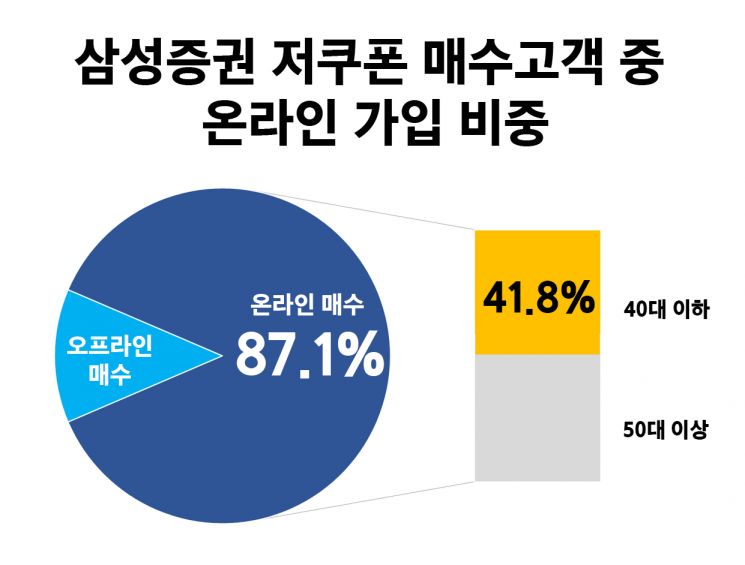
Among all customers who traded domestic bonds over-the-counter at Samsung Securities this year, a remarkable 87% used mobile apps or PCs for transactions, reflecting the so-called “thumb investor” bond investment boom. Among them, those under 40 accounted for 42%.
Baek Hye-jin, Executive Director of SNI Strategy at Samsung Securities, stated, “Among high-net-worth individuals, there is an increasing trend of employing bond portfolio strategies that combine high-coupon bonds offering stable pre-tax interest rates in the 4% range with low-coupon bonds that reduce tax burdens and increase after-tax real returns. We plan to continuously supply high-quality domestic and international bonds in a timely manner to enhance customer satisfaction.”
© The Asia Business Daily(www.asiae.co.kr). All rights reserved.


















