Temperature Differences Between Continents and Oceans Cause Impact
South Asia Region and East Asia Including Korea Affected
Experts Say "Global Warming Has Made the Monsoon Stronger"
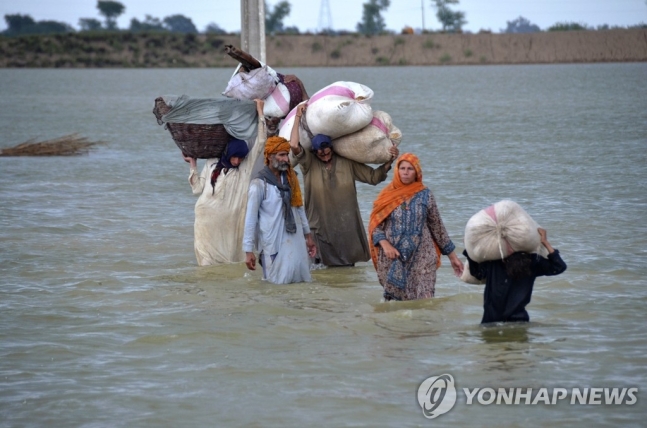 A displaced family in Jaffarabad, Balochistan province, southwestern Pakistan, is carrying household items while passing through an area flooded by heavy rain. Photo by AP Yonhap News
[Asia Economy Reporter Kim Juri] Pakistan is suffering from unprecedented summer heavy rains across the country. Due to floods caused by continuous heavy rains for three months, the government declared a state of emergency, and the death toll has reached over 1,100. One-third of the territory is submerged, and it is estimated that more than 33 million people, or one in seven of Pakistan's population, have been affected by the floods.
The worst flooding in Pakistan occurred due to record-breaking concentrated heavy rains brought by the so-called "monster monsoon." The monsoon, meaning seasonal wind, originates from the Arabic word mausim, which means season. The monsoon, caused by the temperature difference between the continent and the ocean, blows from the continent to the sea in winter and from the sea to the continent in summer. Many Asian countries, including South Asia such as Pakistan and India, as well as East Asia including Korea, are influenced by the monsoon climate.
Some scientists analyze that global warming has made the monsoon stronger and more irregular. As temperatures rise, more water vapor is generated, leading to heavy rainfall. Research shows that if the Earth's temperature rises by 1 degree Celsius, the amount of rain during the rainy season in South Asia increases by 5%. Experts say that the record-breaking downpours this summer in countries with monsoon climates, such as Korea and Pakistan, are not unrelated to the unusually large amount of water vapor.
Sheri Rehman, Pakistan's Minister of Climate Change, cited the global climate crisis as the main cause of the floods.
Minister Rehman stated, "Pakistan has the most glaciers outside the polar regions," and added, "The glaciers in the northern mountainous region of Pakistan have been melting faster than usual, worsening the heavy rains." She emphasized, "This is a large-scale humanitarian disaster caused by climate anomalies."
Ahsan Iqbal, Minister of Development Planning, also said, "Pakistan has become a victim of climate anomalies due to the irresponsible development of developed countries," and added, "Our carbon emissions are among the lowest in the world, and the world has an obligation to help us respond to climate change."
Furthermore, according to Minister Iqbal, the estimated damage from the floods far exceeds 10 billion dollars. He explained that this damage is greater than that of the 2010 flood disaster. Pakistan also suffered significant damage from monsoon floods in 2010, when over 2,000 people died and about one-fifth of the territory was submerged.
Minister Iqbal predicted, "It will take about five years to recover from the flood damage," and warned, "We will face a severe food shortage situation within a few days."
© The Asia Business Daily(www.asiae.co.kr). All rights reserved.

















