Majority Opinion "No Time Limit Between Aggravated Conditions, Past Drunk Navigation, and Recidivism"
Opposing Opinion "Regulation Legislated Based on Criminal Policy Considerations for Crime Prevention"
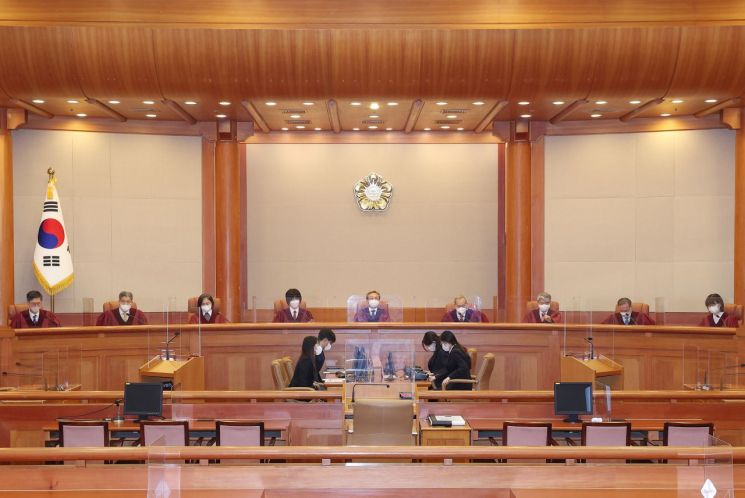 Chief Justice Yoo Nam-seok of the Constitutional Court (center) and other justices entered the Grand Bench of the Constitutional Court in Jongno-gu, Seoul, on the afternoon of the 31st and took their seats.
 [Image source=Yonhap News]
[Asia Economy Reporter Heo Kyung-jun] The Constitutional Court has ruled that the law punishing those who operate a vessel under the influence of alcohol 'two or more times' is unconstitutional. Previously, the Constitutional Court had declared the 'Yoon Chang-ho Act,' which strengthened penalties for drunk driving of automobiles, unconstitutional in November and May of last year.
On the 31st, the Constitutional Court delivered an unconstitutional ruling by a 7 (unconstitutional) to 2 (constitutional) vote in the constitutional review case concerning Article 104-2, Paragraph 2 of the Maritime Safety Act.
The provision stipulates that a person who operates a ship under the influence of alcohol two or more times shall be punished with imprisonment for 2 to 5 years or a fine of 20 million to 50 million won. This provision was established when the Maritime Safety Act was amended in 2020 following the collision accident on Busan Gwangandaegyo Bridge caused by the drunk operation of the Russian cargo ship Sea Grand's captain in February 2019.
The Constitutional Court pointed out, "The provision under review is intended to strengthen punishment for those who violate the prohibition on drunk operation more than once, but it does not set any time limit between the past violation, which is an aggravating factor, and the repeated drunk operation subject to punishment."
It further judged, "If the past violation occurred a long time ago and the subsequent violation of the prohibition on drunk operation cannot be evaluated as a 'repeated act threatening the life or body of social members,' it is difficult to recognize the necessity of aggravated punishment."
On the other hand, Justices Lee Sun-ae and Moon Hyung-bae dissented, stating, "The provision was legislated based on criminal policy considerations to prevent crimes related to drunk operation by strictly punishing repeat offenders, and repeated drunk operation is highly blameworthy, so aggravated punishment under the provision has a reasonable basis."
© The Asia Business Daily(www.asiae.co.kr). All rights reserved.
![Clutching a Stolen Dior Bag, Saying "I Hate Being Poor but Real"... The Grotesque Con of a "Human Knockoff" [Slate]](https://cwcontent.asiae.co.kr/asiaresize/183/2026021902243444107_1771435474.jpg)
















