Transition from Current 2-Gun·8-Gu to 2-Gun·9-Gu System
Highest Average Population per Basic Local Government among Metropolitan Cities
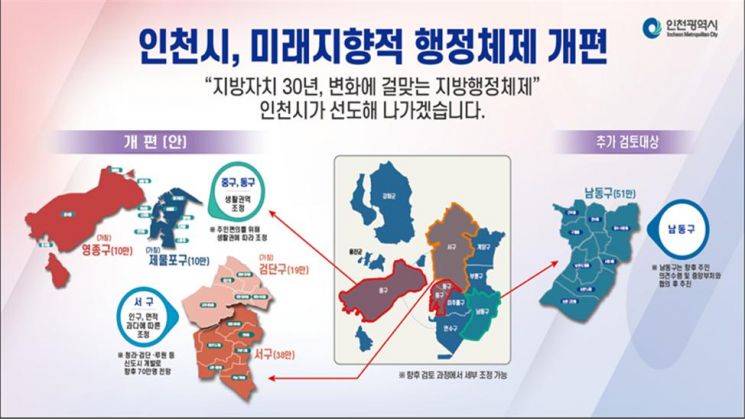
[Asia Economy Reporter Park Hyesook] Incheon City is promoting a future-oriented and rational administrative district reorganization suitable for living areas and population size for the first time in 27 years.
Mayor Yoo Jeong-bok held a briefing on the 31st and stated, "The current administrative district system, established in 1995, has been maintained for 27 years despite changes in administrative and social conditions, causing increasing inconvenience to citizens," adding, "We will promote the transition from the current 2 counties and 8 districts system to a 2 counties and 9 districts system through administrative district adjustments and subdivision."
According to the city's plan for administrative district reorganization, Jung-gu (140,000 people) and Dong-gu (60,000 people) will first be separated and reorganized into Yeongjong-gu (100,000 people), centered on Yeongjongdo Island, and Jemulpo-gu (100,000 people), covering the inland areas of Jung-gu and Dong-gu.
The administrative district change between Jung-gu and Dong-gu has been steadily mentioned since the 2010s. Jung-gu's living areas are completely separated between the Yeongjong region and the inland region, and administrative inefficiency has increased due to the dual administration, such as the opening of Jung-gu's second government office on Yeongjongdo.
Dong-gu, a city centered on ports and their supporting facilities, has a vague boundary with the inland area of Jung-gu, which has many ports including Incheon Port, and their living areas are quite similar.
The city plans to merge the inland areas of Dong-gu and Jung-gu into one autonomous district called Jemulpo-gu and separate the Yeongjong area into Yeongjong-gu, minimizing residents' inconvenience through adjustments based on living areas.
Also, Seo-gu, with a population of 570,000, will separate the Geomdan area to create a new Geomdan-gu (190,000 people), while maintaining the rest of Seo-gu (380,000 people).
Seo-gu has the largest population and the largest area among inland regions in Incheon. The area of Seo-gu (118.5 km²) is larger than the combined areas of Dong-gu (7.1 km²), Michuhol-gu (24.8 km²), Gyeyang-gu (45.5 km²), and Bupyeong-gu (32 km²).
Transportation infrastructure such as the Airport Railroad, Airport Expressway, and Ara Waterway divides Seo-gu into north and south, and the Geomdan area, which was incorporated into Seo-gu from Gimpo County in 1995, has cultural differences from other Seo-gu areas. Administrative inefficiency has also increased, with the Seo-gu Geomdan branch office established there.
Currently, the population is about 570,000, but with ongoing new town developments in areas like Cheongna, Luwon, and Geomdan, the population is expected to increase to over 700,000 in the future. The Geomdan area alone is expected to see an increase of more than 100,000 people.
Subdivision due to population increase is inevitable, and the city has decided to adjust the southern part of Seo-gu to remain Seo-gu and the northern part to become Geomdan-gu.
Namdong-gu currently has a population of 510,000, but with the completion of the Guwol 2 District development, the population is expected to increase significantly. The city plans to review the possibility of administrative district reorganization after gathering residents' opinions and consulting with central government ministries.
If the administrative district reorganization is realized, Incheon City will transition from the existing 2 counties and 8 districts system to a 2 counties and 9 districts system.
Incheon's registered resident population was 2.35 million in 1995 but has increased by 610,000 to 2.96 million as of July this year. The average population per basic local government is 296,000, the highest among metropolitan cities. Also, last year, the number of civil complaints reached 1.1 million annually, ranking third nationwide.
Busan, with a population of 3.33 million similar to Incheon, has 16 counties and districts (1 county and 15 districts), and the average population per basic local government is 208,000, about 90,000 less than Incheon.
Mayor Yoo emphasized, "An irrational administrative system makes it difficult to properly respond to rapidly changing society and diverse resident demands, and there will inevitably be limits to improving residents' welfare and convenience," adding, "We will gather opinions from local residents and political circles and prepare detailed plans for administrative district reorganization through professional research services and proceed accordingly."
© The Asia Business Daily(www.asiae.co.kr). All rights reserved.

















