Wholesale Rice Price (20Kg) Falls 21.6% While Consumer Price Index Rises 6.3%
Rice Price Measures: Guarantee 300 Won per Bowl of Rice, Expand Agricultural Budget, Demand Immediate Suspension of Agricultural Imports
Despite Isolating 370,000 Tons of Rice Last Year, Prices Plummet... Purchase Completed After 4 Months, Considered a 'Missed Opportunity'
National Assembly Proposes Amendment to 'Grain Management Act'... Opposition May Adopt Rice Price Crash Issue as Party Policy
[Asia Economy Reporter Oh Ju-yeon] Rice prices have plummeted by more than 20% compared to last year, marking the largest drop in 45 years. Farmers in various regions such as Gimje and Yeonggwang in Jeonbuk, where rice farming has been abundant this year, have plowed over their fields as a sign of protest, urging the government to take measures against the 'rice price collapse.' They explain that at the current rice price of 220 won per bowl, which amounts to about 600 won for three meals a day, labor and fertilizer costs cannot even be covered.
While farmers are looking solely to the government, authorities tasked with stabilizing prices amid rising inflation have been unable to come up with effective measures. Some critics argue that the government alone is being blamed for the failure to predict the decline in rice consumption. The logic is that farmers should have cultivated crops other than rice to respond to the decrease in rice consumption. However, the counterargument is that telling farmers to switch to alternative crops essentially means telling them to quit rice farming, reflecting a lack of serious reflection on the future of the food industry.
In a situation where over 80% of grains consumed domestically are imported, rice remains the only crop with a grain self-sufficiency rate exceeding 90%. Legislative discussions are underway in the National Assembly, mainly led by Democratic Party lawmakers, to respond to the rice price collapse, drawing attention to whether these will be adopted as party policy.
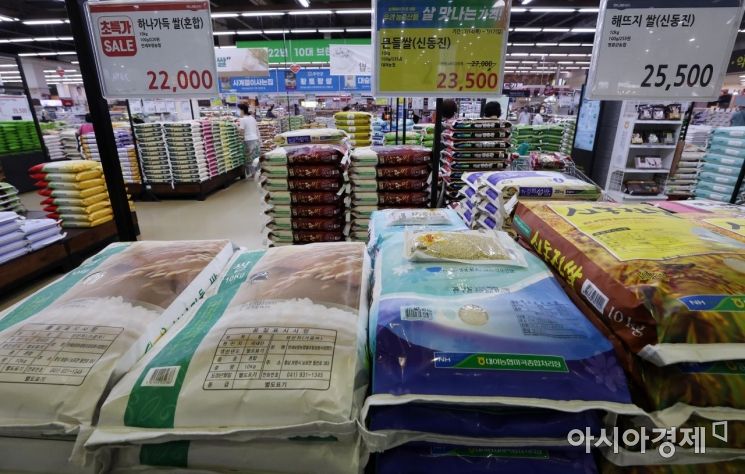 These days, as food prices rise daily, the price of rice, the staple grain for Koreans, is actually continuing to fall. Since October last year, the farm-gate price of rice has steadily declined and is currently below the average level. Rice farmers are experiencing a "double hardship" with reduced income amid high inflation. The photo shows the rice sales section at a large supermarket in Seoul. Photo by Hyunmin Kim kimhyun81@
■"Rice price per bowl (100g) dropped from 300 won to 220 won, two meals a day cost 400 won... Prices rose everywhere but rice prices fell"
Despite painstakingly cultivating rice while worrying about frequent pests and heavy rains, farmers did not expect to have to crush their own crops with their hands ahead of Chuseok.
On the 30th, Ha Won-oh, chairman of the National Farmers' Federation, told Asia Economy in a phone interview, "Farmers approaching harvest season are plowing over rice fields with tractors instead of combines (grain harvesting vehicles) as a protest against the government," adding, "They are hoping for government measures against the rice price decline, but there has been no response." Chairman Ha explained, "If you calculate the price per bowl (100g) of rice, it has fallen from about 300 won last year to 210-220 won now," and "With labor and fertilizer costs all rising, even receiving last year's price results in a loss."
According to Statistics Korea, as of the 15th of this month, the farm gate price for 20kg of rice (cleaned grain) was 42,522 won, down 23.6% compared to the same period last year. This is the lowest price since 2018 and the largest drop in 45 years.
While consumer prices have been rising, rice prices alone have fallen. According to the Korea Agro-Fisheries & Food Trade Corporation's agricultural product distribution information, the wholesale price of rice (20kg) dropped 21.6% from 58,860 won last year to 46,150 won. During the same period, the consumer price index rose 6.3% from 102.26 to 108.74. Considering inflation rates, even selling at last year's price results in losses.
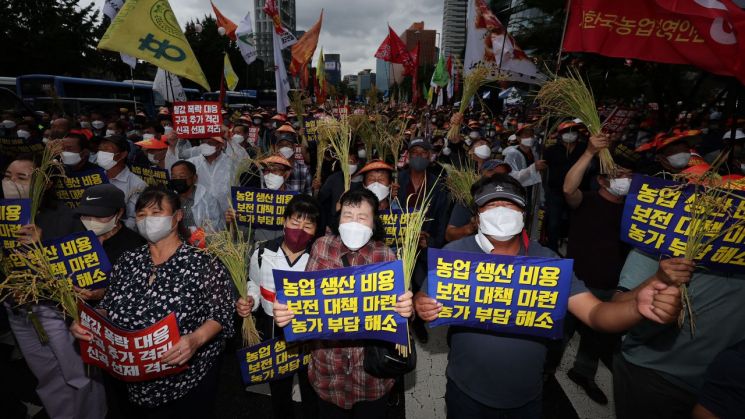
Accordingly, about 10,000 members of farmers' organizations such as the Korea Association of Successor Farmers and the National Farmers' Federation held a rally in Yongsan, Seoul on the 29th, demanding guarantees for rice prices. They called for measures to stabilize rice prices, guaranteeing 300 won per bowl of rice, expanding the agricultural budget, and an immediate halt to agricultural product imports.
In particular, they are urging the government to prepare measures to respond to this year's purchase policies and price declines, but apart from the market isolation measures decided last year, no additional responses have been made. There are also reports that the rice processing complexes (RPCs), which should store this year's newly harvested rice, are already full of last year's rice, leaving no place for this year's harvest.
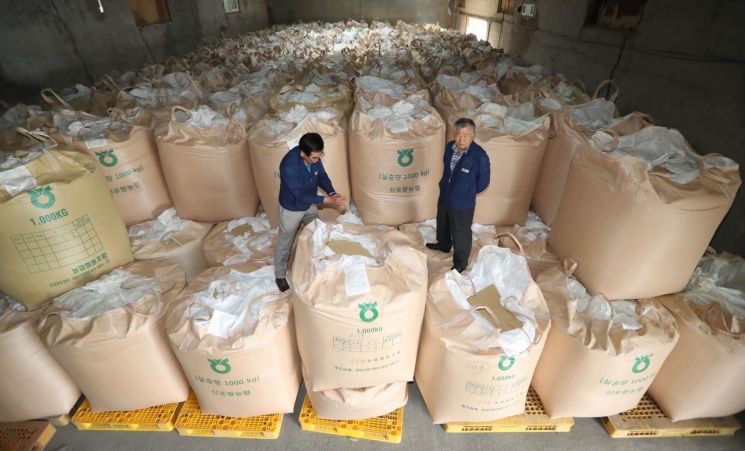
■Why do rice prices fall despite 270,000 tons plus additional isolation... Problems in timing, method, and statistics
The problem is that expectations of 'further price drops' make it even harder to get a fair price. In December last year, the government decided to isolate 270,000 tons of rice from the market as a preemptive measure to alleviate farmers' difficulties due to price declines. However, only about half of the targeted volume was actually auctioned, and the auction prices were lower than the farm gate prices.
According to the office of Democratic Party lawmaker Seo Sam-seok, a member of the National Assembly's Agriculture, Food, Rural Affairs, Oceans and Fisheries Committee, the government decided on December 28 last year to preemptively isolate 200,000 tons of rice and to proceed with 70,000 tons depending on market conditions. However, the purchase was only completed on April 8 this year, and the auctioned volume was 145,000 tons, far short of the initial target. Critics say the term 'preemptive measure' is misleading.
Although it was a measure to stabilize farm household economies, the 'reverse auction method' through minimum bidding resulted in an average auction price (in February) estimated at 177,100 won (based on 80kg of cleaned rice). Considering that the farm gate price at the time was about 202,000 won, this was about 15% lower, drawing criticism that it did not meet the purpose of the system.
The second market isolation was decided on April 27 for an additional 126,000 tons, but the auction results on May 16 showed that the auctioned volume was 126,000 tons. The purchase was completed about two months later on July 20, with an average auction price of 168,500 won, which was about 9.5% lower than the farm gate price of 186,200 won (May). On July 1, a third isolation of 100,000 tons was additionally decided, but rice prices continued to fall despite this.
The office of lawmaker Seo points out problems in timing, method, and statistics. They said, "The Agriculture, Food, Rural Affairs, Oceans and Fisheries Committee had argued that market isolation measures should have been taken preemptively from October last year, but the decision was only made in December, and it took four months to complete the purchase, which happened this year," adding, "Prices had already fallen drastically during that period." They also criticized, "The isolation was based on the assumption that 270,000 tons were overproduced, but even after isolating about 370,000 tons, which is 100,000 tons more than initially planned including the third additional isolation, prices could not be stabilized. This raises suspicion that the initial production and demand statistics were miscalculated."
■Calls in the National Assembly to amend the 'Grain Management Act' to mandate market isolation during rice price collapse
In the National Assembly, voices are emerging, mainly from opposition lawmakers on the Agriculture, Food, Rural Affairs, Oceans and Fisheries Committee, urging amendments to the 'Grain Management Act' to automatically isolate rice from the market during rice price collapses.
The amendment to the Grain Management Act, proposed by Democratic Party lawmaker Yoon Jun-byeong, includes raising the legal standards for rice purchase and obligating the Minister of Agriculture, Forestry and Fisheries to compulsorily purchase excess rice from agricultural cooperatives when the conditions are met. Currently, the government can purchase rice within the range of excess production when rice production exceeds demand by more than 3% and when harvest season prices fall more than 5% compared to the average year, but these are discretionary provisions. As a result, the Ministry of Agriculture is criticized for a passive attitude even when market isolation is required.
In a phone interview, lawmaker Yoon said, "The government should calculate supply and demand properly when purchasing grains and isolate effectively to have an impact, but the market isolation that should have been done in November last year was delayed until the first half of this year, resulting in a missed opportunity." He added, "The opportunity cost of isolating rice is 800 billion won, but if preemptive measures are taken, it would cost 200 to 300 billion won. The government needs to understand the situation more closely."
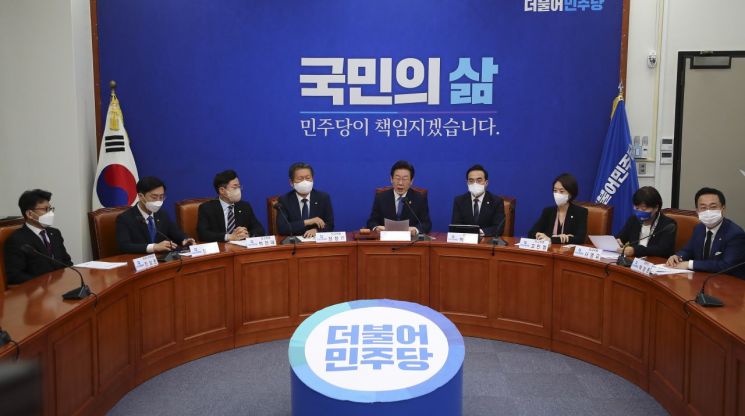
Within the Democratic Party, the newly formed leadership has commonly addressed the rice price collapse issue during the recent party convention, so there is a high possibility of expanding discussions at the party level. On the 21st, party leader Lee Jae-myung said at a joint rally in Gangjin, Jeonnam, regarding the rice price decline, "Agriculture must be protected and fostered as a strategic industry for national security," and Supreme Council members Jeong Cheong-rae, Seo Young-kyo, and Park Chan-dae also pointed out the rice price collapse issue during regional primary campaigns and pledged to lead efforts to resolve it.
The Democratic Party began with a press conference on June 13 calling for measures to stabilize rice prices, held discussions on rice price measures at the standing committee level on the 1st, and on the 22nd, former emergency committee chairman Woo Sang-ho urged the government at an emergency committee meeting to 'additionally isolate 100,000 tons before Chuseok.' The Democratic Party plans to hold a rice price stabilization meeting with government ministries such as the Ministry of Agriculture, Food and Rural Affairs and the Ministry of Strategy and Finance through a rice price normalization task force on the 1st of next month.
On the day, Democratic Party spokesperson Lee Su-jin told reporters after the morning floor strategy meeting, "Yesterday, Democratic Party lawmakers on the Agriculture, Food, Rural Affairs, Oceans and Fisheries Committee attended the farmers' general rally demanding measures against the rice price collapse and spoke sufficiently about farmers' difficulties," adding, "We plan to hold a policy meeting of the Democratic Party rice price task force this Thursday." A Democratic Party lawmaker said regarding the rice price collapse issue, "Whether it will be adopted as party policy is up to the leadership, but given the current situation, I believe it should be pursued as party policy."
© The Asia Business Daily(www.asiae.co.kr). All rights reserved.



















