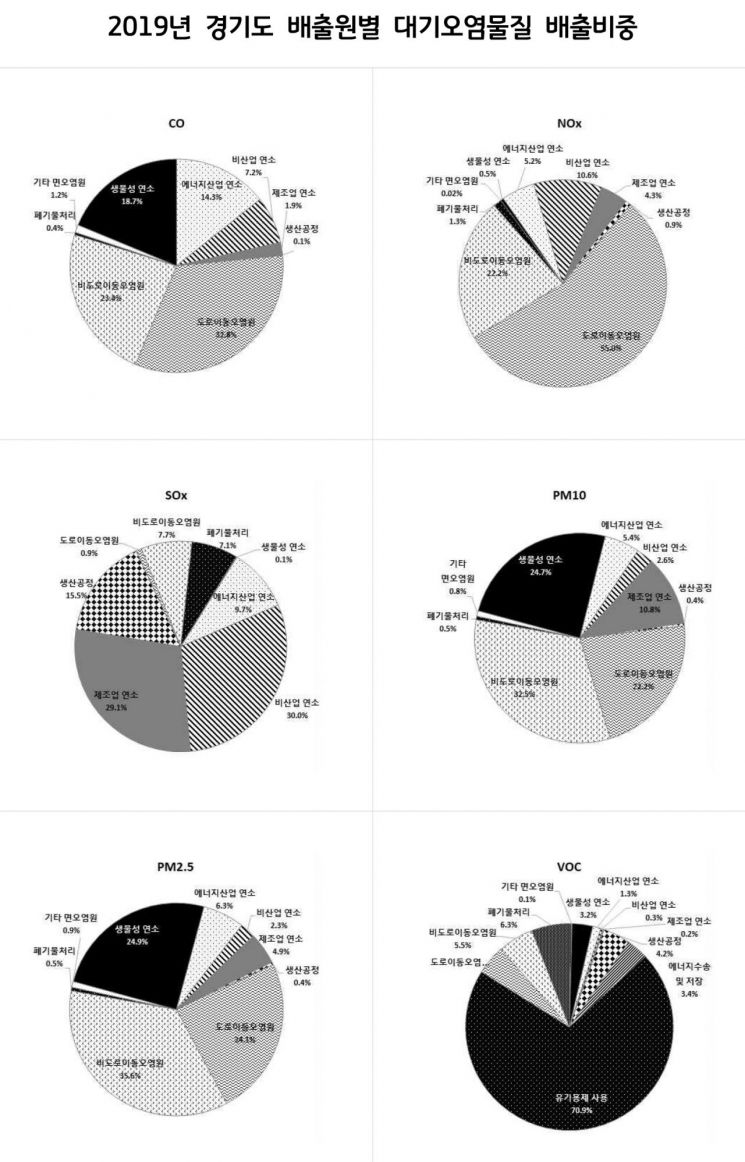
[Asia Economy (Suwon) = Reporter Lee Young-gyu] It has been pointed out that 7% of fine dust emissions in Gyeonggi Province are due to wood fuel, and therefore management by the relevant local governments is necessary.
On the 30th, the Gyeonggi Research Institute published a report titled "Analysis of Fine Dust Impact and Improvement Measures Due to the Use of Wood Fuel."
According to the analysis based on data from the National Fine Dust Information Center, among the annual PM10 emissions of 29,918 tons in Gyeonggi Province in 2019, emissions related to wood fuel such as wood stoves and boilers (185 tons), traditional Korean agungi stoves (14 tons), and charcoal kilns (578 tons) amounted to 778 tons, accounting for 2.6%.
Among the annual PM2.5 emissions of 9,880 tons, emissions related to wood fuel such as wood stoves and boilers (122 tons), agungi stoves (12 tons), and charcoal kilns (548 tons) reached 681 tons, accounting for 6.8%.
It was analyzed that wood fuel, which imposes a heavy air pollution load, is still widely used mainly in suburban rural areas within the province.
Looking at the annual PM2.5 emissions by city and county due to wood fuel use, wood stoves and boilers generated the most emissions in Hwaseong City (103,000 tons) and Anseong and Pyeongtaek Cities (74,000 tons each), while charcoal kilns produced the highest emissions in Yangju City (94 tons) and Yeoju City (66 tons).
Meanwhile, in a survey of residents, when asked "How many households out of 10 in your residential area do you know are using wood fuel?" 7.9% responded "I know," while 92.1% answered "I do not know well."
In response, the research institute suggested measures to reduce this, including ▲ preparing and promoting guidelines that include information on the adverse health effects of wood fuel use ▲ implementing support projects for eco-friendly fuel conversion such as supplying individual or village-type LPG in rural areas ▲ and, in the long term, introducing a fine dust emission certification system for wood fuel combustion devices.
Kim Dong-young, senior research fellow at the Gyeonggi Research Institute, emphasized, "Awareness of the use of wood fuel is necessary," adding, "The central government should establish institutional standards regarding usage locations and forms, and local governments should strengthen management not only of wood fuel use but also of biomass combustion around daily life, such as agricultural residue burning, direct-fire barbecue restaurants, and commercial cooking facilities."
© The Asia Business Daily(www.asiae.co.kr). All rights reserved.
![Clutching a Stolen Dior Bag, Saying "I Hate Being Poor but Real"... The Grotesque Con of a "Human Knockoff" [Slate]](https://cwcontent.asiae.co.kr/asiaresize/183/2026021902243444107_1771435474.jpg)
















