Seoul Apartment Rental Market in the Past Year... Highest Level Since Records Began
"No Place to Go Due to Soaring Jeonse Prices"... Impact of Lease Renewal Rights and More
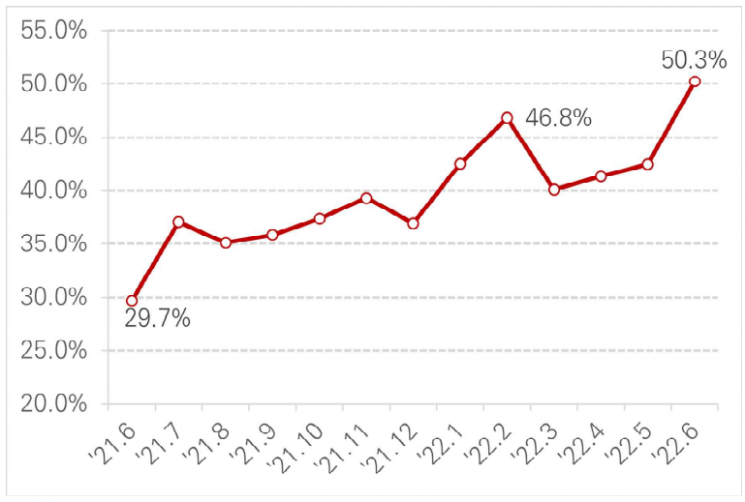
Over the past year, half of the apartment rental and lease transactions in Seoul were renewals of existing contracts. The proportion of renewal contracts has been steadily increasing. This trend is interpreted as the result of multiple factors, including the recent sharp rise in jeonse prices making moving difficult, leading more tenants to stay in their current residences, and the contract renewal right allowing tenants to remain in their existing homes for an additional two years.
On the 30th, the Korea Construction Industry Research Institute (KCIRI) analyzed rental and lease contracts in Seoul from June last year to June this year and found that out of 185,481 rental and lease contracts, 73,352 were renewals of existing contracts.
The renewal contract rate has steadily increased since the related data was first released in June 2021, when it recorded the lowest rate of 29.7%, reaching 50.3% last June.
Various interpretations have emerged regarding the increase in the renewal contract rate. Fundamentally, the rise in renewal contracts appears closely related to the recent surge in jeonse prices. Even when tenants’ contracts expire and they consider moving elsewhere, the jeonse prices in other areas have also risen significantly, leading more cases of tenants choosing to stay in their current homes. According to KB Monthly Time Series statistics, Seoul’s jeonse prices increased by 24.87% over two years from June 2020 to June 2022.
It is also possible to interpret that the government’s contract renewal right system, introduced in 2020 to stabilize tenants’ housing, has taken root in the market. The contract renewal right allows tenants to request a renewal of their two-year contract once, with rent increases capped at 5%. In fact, the usage rate of the contract renewal right among lease renewals in June reached 62.9%.
Kim Seong-hwan, a senior researcher at KCIRI, said, "Although cases of renewal contracts such as 'tacit renewals' existed before the introduction of the contract renewal right, the explicit introduction of this right has made the act of renewal itself more common and stable in the market."
However, even when lease contracts were renewed, there was an increase in cases where the contract renewal right was not used. The usage rate of the renewal right, which was close to 70% in June 2021, decreased to 62.9% in June 2022.
Despite the ability to limit rent increases to within 5% through the contract renewal right, 27.1% of renewal contracts were made without using this right.
Landlords can refuse the tenant’s contract renewal right only if the landlord or their direct ascendants intend to reside in the property. Although the contract renewal right was introduced, landlords’ 'renewal right avoidance tactics' have been rampant over the two years. A typical case is notifying tenants of "direct residence" to nullify the 5% rent cap, then signing new contracts with new tenants at market rates.
An industry insider said, "Although tenants can file damages lawsuits in cases of false residence claims, it is practically difficult because tenants must verify whether the landlord is actually residing there, which is cumbersome. Given that jeonse prices have risen not only in the current residence but also in other areas, many tenants likely judged that renewing contracts even beyond the 5% cap was preferable."
© The Asia Business Daily(www.asiae.co.kr). All rights reserved.


















