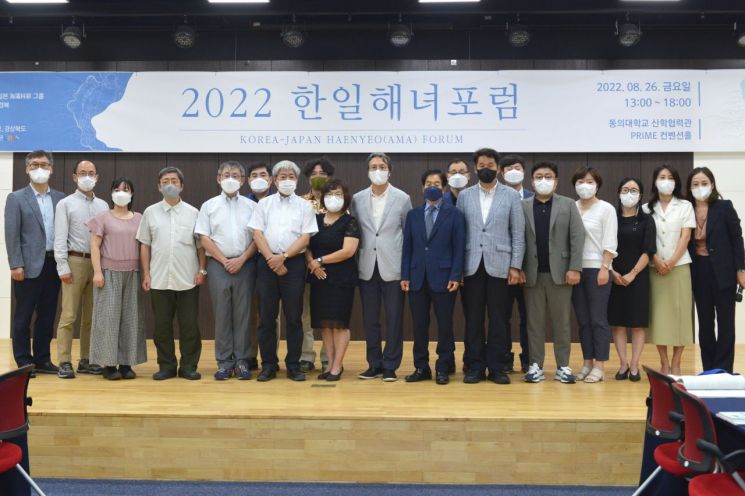
 Participants of the Dong-Eui University Korea-Japan Haenyeo Forum are taking a group commemorative photo.
[Asia Economy Yeongnam Reporting Headquarters Reporter Hwang Du-yeol] The Dong-Eui University Korea-Japan Haenyeo Research Institute jointly held the ‘2022 Korea-Japan Haenyeo Forum’ with the Japanese Seaweed Science Group and others on the 26th at the Prime Convention Hall in the Industry-Academic Cooperation Building of Dong-Eui University.
Busan haenyeo, domestic academia, local governments, social enterprises, Japanese academia, and the National Folk Museum participated in presentations and discussions, and a photo exhibition titled ‘Haenyeo Scenes of Gyeongbuk and Busan’ was also held.
In Part 1 of the forum, ‘Looking Back at Haenyeo,’ Yeosu-gyeong Researcher from Hanbit Cultural Heritage Research Institute presented on ‘Haenyeo as a Subject of the Marine Economy Beyond the Value of Cultural Heritage.’
Following this, Professor Akira Tsukamoto of Mie University in Japan introduced historical materials on the characteristics of Korea-Japan haenyeo and the Korean haenyeo’s diving activities in modern Japan through his presentation on ‘The Development Process of Haenyeo Culture in Modern East Asia.’
In Part 2, ‘Haenyeo and Seaweed,’ Kim Nam-il, Head of the East Coast Headquarters of Gyeongsangbuk-do, presented on ‘The Value of Seaweed as an Ecological Indicator of the East Coast and the Role of Haenyeo.’
After the presentation, Head Kim said, “Next year, we plan to establish a research center as a national project to enhance the economic value of haenyeo and fishing villages through seaweed farming in the East Sea.”
Professor Ryota Ishikawa of Ritsumeikan University in Japan explained in his presentation on ‘Modern Korea-Japan Relations and Seaweed Trade’ that “Agar produced in Joseon was exported from Busan to Japan and remains active today,” adding, “Agar trade has expanded beyond Korea-Japan trade to Europe and Africa.”
During the comprehensive discussion, Professor Akiyoshi Fujita of Tenri University in Japan said, “The existence of haenyeo, active only in Korea and Japan, is an excellent example of sustainable fisheries, and I hope it will be introduced in textbooks in Europe and the United States.”
Kang Soon-hee, Manager of Namcheon Fishing Village Association, and Haenyeo Kim Kyung-sook said, “It is regrettable that seaweed does not grow well in Korea’s seas due to phenomena such as warming and seaweed bed degradation,” adding, “Expanding support for haenyeo is important to preserve sustainable fishing activities.”
Yoo Hyung-sook, Director of the Korea-Japan Haenyeo Research Institute at Dong-Eui University, said, “Following the 2016 BEXCO forum, academic exchanges on Korea-Japan haenyeo have been held again in Busan,” adding, “Since the event, there have been achievements such as the enactment of haenyeo-related support ordinances in Busan and Gyeongsangbuk-do, and the ordinance supporting haenyeo decompression sickness treatment in Gijang-gun. I hope continuous research will lead to various support policies.”
© The Asia Business Daily(www.asiae.co.kr). All rights reserved.
![Clutching a Stolen Dior Bag, Saying "I Hate Being Poor but Real"... The Grotesque Con of a "Human Knockoff" [Slate]](https://cwcontent.asiae.co.kr/asiaresize/183/2026021902243444107_1771435474.jpg)











