Only 11.6% of Defense Industry Sales Are from SMEs
Urgent Need for Business Priority and Export Strategy Policies
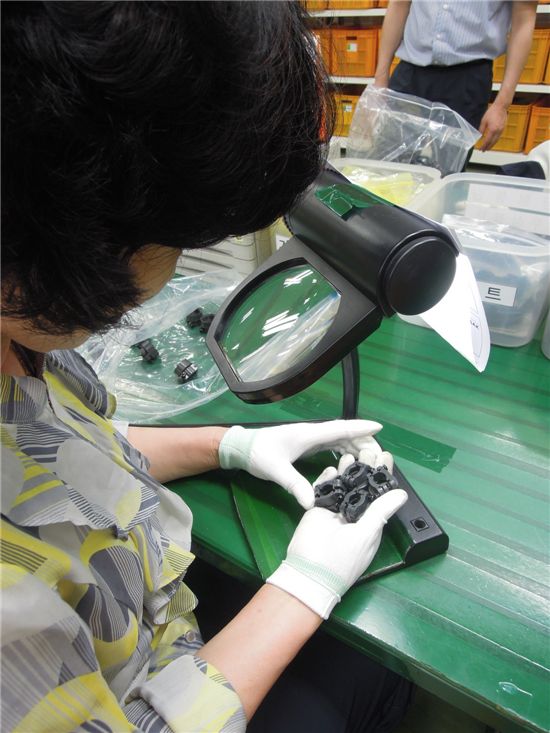 Yeonhap Precision employs a total of 412 staff members. Among them, 227 are production workers, 56 are technical staff, and 52 are researchers.
[Asia Economy Yang Nak-gyu, Military Specialist Reporter] While major defense companies are thriving, small and medium-sized enterprises (SMEs) remain stagnant due to the structural characteristics of the defense industry, which involves significant national-level restrictions and a system where supply prices are not properly reflected. The military enforces low-price bidding through a low-price bidding system, and large companies pressure suppliers to reduce the prices of parts. Even if the Defense Acquisition Program Administration (DAPA) adopts some products from SMEs through rapid research and development projects, there is no guarantee of subsequent contracts, which may result in wasted development costs.
According to the "Defense Industry Business Analysis Disclosure Data" published annually by the Korea Defense Industry Promotion Association, there were 86 defense companies registered with the state in 2020. Among them, 27 were large companies and 59 were SMEs. However, in terms of sales, large companies accounted for an overwhelming 88.4% (13.5831 trillion KRW), while SMEs accounted for only 1.7631 trillion KRW.
If SMEs are not nurtured, concerns arise that more will leave the defense industry, leading to a decline in manufacturing capabilities and increased dependence on foreign countries.
The industry emphasizes the need to enhance the technological development capabilities of SMEs. There are calls to prioritize business rights and support for companies that succeed in technology development. Since the defense industry is directly linked to national security, the selection of technologies that benefit national security should take precedence over market economy logic.
A defense industry insider pointed out, "In the case of large companies, most have formed groups of partner companies," adding, "Even if the quality of parts from partner companies is excellent, it is difficult to supply if they belong to competitors."
There is also an assessment that the U.S. policy to strengthen supply chains could be an opportunity for domestic small and medium defense companies. In February, President Joe Biden issued an executive order directing a focused review of supply chains related to national security. The intention is to build reliable supply chains within the U.S. manufacturing sector or allied countries in the defense sector to restrict the use of Chinese parts in domestic weapons.
The U.S. hopes to secure supply chain safety for hypersonic missiles, which require high security, through cooperation with allies. Since the South Korean military is strengthening the Korean-style three-axis system (Kill Chain, Korean Missile Defense, Massive Punishment and Retaliation) to counter North Korea's nuclear missile threat, nurturing SMEs is possible through missile defense cooperation with the U.S. Joint production following joint development through shared requirements is also feasible.
However, due to the Buy America Act, it is difficult for domestic SMEs to enter the U.S. market, so policy support is necessary.
Defense experts argue that Korea should join the National Technical Information Service (NTIS) and sign a Reciprocal Defense Procurement Memorandum of Understanding (RDP MOU) with the U.S. The U.S. has joint development and production of weapons through reciprocal defense procurement agreements with 28 countries worldwide, including the UK, Australia, Canada, Japan, Germany, and France. However, South Korea is excluded.
Jang Won-jun, a research fellow at the Korea Institute for Industrial Economics & Trade, said, "If the Korea-U.S. RDP is concluded, domestic defense companies' products will be able to enter the U.S. defense market more easily due to exemptions from the Buy America Act," adding, "Our government should also support defense SMEs policies in various ways."
The defense industry has begun reshaping through mergers and acquisitions (M&A) triggered by the emergence of SME sales listings. The first company to show interest in STX Engine was SNT Heavy Industries. SNT Heavy Industries has been responsible for the transmission in the domestic development project of the powerpack (engine + transmission) for the K-2 tank but has struggled because it cannot produce engines independently. Acquiring STX is expected to create synergy effects. Additionally, STX Engine caused a stir in the industry by winning a contract worth about 9.4 billion KRW in December last year for the Coastal Surveillance Radar-II system development project, and it is highly regarded for other promising projects such as engines for the Coast Guard vessels and performance upgrades for K-9 self-propelled howitzer engines.
Daewoo Shipbuilding & Marine Engineering (DSME) is also seeking a new owner. It plans to announce the results of external consulting related to management normalization soon. The issue gained momentum after illegal strikes by DSME subcontractor unions highlighted operational problems. Despite public funds amounting to 12 trillion KRW, independent survival has become difficult, and a drastic measure of partial sale of the defense division is expected. Currently, Hanwha, Samkwang M&D, and Samwon Heavy Industries are showing interest.
© The Asia Business Daily(www.asiae.co.kr). All rights reserved.
![User Who Sold Erroneously Deposited Bitcoins to Repay Debt and Fund Entertainment... What Did the Supreme Court Decide in 2021? [Legal Issue Check]](https://cwcontent.asiae.co.kr/asiaresize/183/2026020910431234020_1770601391.png)















