Joined as an Advisor at Bungaejangter... Interview with Kim Hanmoe, CEO of MOI Watch
"Even 30-Year Experts Find It Difficult to Authenticate Sophisticated Chinese Counterfeit Watches"
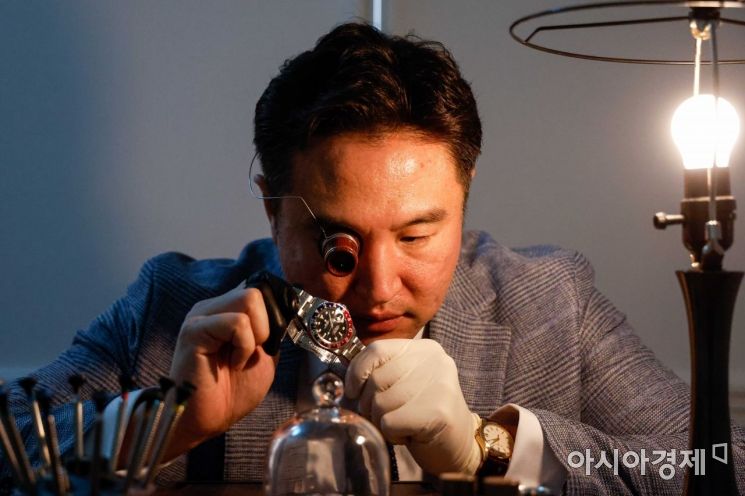 Kim Hanmoe, CEO of MOI Watch, is posing before an interview on the 25th at BGZT Collection in Gangnam-gu, Seoul. Photo by Jinhyung Kang aymsdream@
"Even after 30 years in the watch business, it is difficult to distinguish Chinese counterfeit products with the naked eye," said Kim Hanmoe, CEO of MOI Watch. He stated that the counterfeit manufacturing technology in China has reached a level that can no longer be ignored. The saying "Chinese fake watches are obvious" is now a thing of the past. Even those who have long been involved in buying, selling, and repairing watches find it challenging to authenticate these counterfeits. The advanced counterfeit manufacturing skills from China are disrupting the growing secondhand luxury watch market. There are cases where buyers thought they purchased genuine products but received counterfeits, as well as instances where sellers listed items believing them to be authentic, only to find out later they were fake. In such a confusing situation, Bungaejangter, a secondhand trading platform, recently appointed CEO Kim, a leading expert in luxury watch authentication, as an advisor. We met him at the ‘Beugeujeuteu Collection,’ a secondhand luxury trading store set up by Bungaejangter in Centerfield, Yeoksam-dong, to hear about Chinese counterfeit manufacturing technology and the secondhand luxury watch market.
CEO Kim explained, "Chinese factories have improved their technology by competing with each other and even recruiting Swiss technicians because counterfeit products sell well." He added, "Now, each factory specializes in producing specific models of a particular brand." He believes that around 2016, the level of counterfeit production in China significantly improved. Previously, the manufacturing process involved one factory making the exterior or case, while the movement (the watch’s power mechanism) was sourced from elsewhere. Such assembled products could be identified with the naked eye by those familiar with watches. However, Chinese factories now possess the technology to produce movements themselves, making it difficult to distinguish fakes. Moreover, as technology advances, counterfeit watches containing genuine parts have emerged, making it even harder to authenticate based solely on components."
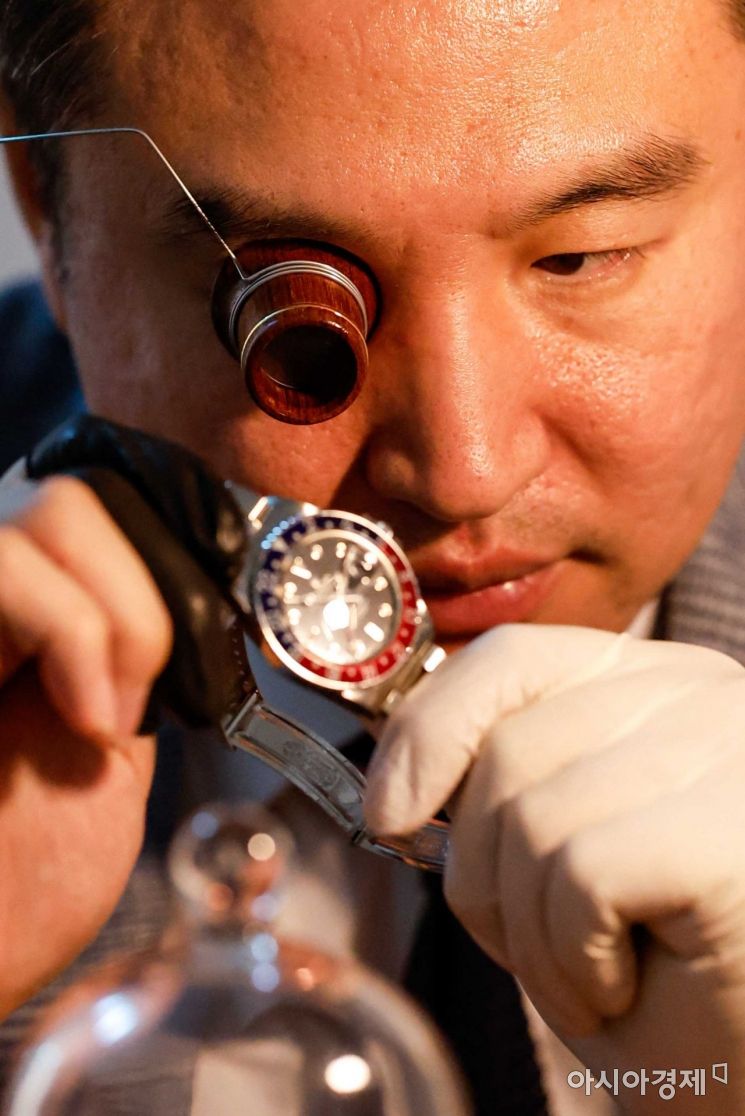 Kim Hanmoe, CEO of MOI Watch, poses ahead of an interview on the 25th at BGZT Collection in Gangnam-gu, Seoul. Photo by Jinhyung Kang aymsdream@
How much of these counterfeits are entering the domestic market? CEO Kim said it is difficult to determine precisely. The era of wholesale smugglers bringing in counterfeit watches from China is long gone. Now, individuals purchase counterfeit watches directly from overseas and release them into the domestic market. Kim explained, "Counterfeit Chinese watches are entering the country disguised as other products like sneakers in personal parcels." Given this situation, no one knows exactly how many counterfeits are circulating. It is only estimated that the volume could be ten times that of the genuine market. Considering that eBay recently reported a 12% increase in secondhand luxury watch sales compared to the previous year, the volume of counterfeit watches is also expected to have increased. Counterfeit products with competitive prices are openly sold in luxury secondhand stores and online sites.
One reason CEO Kim partnered with Bungaejangter is that while counterfeit products flood the market, there is a shortage of experts who can detect them. Watch authentication was traditionally done by those with experience in repair or sales, relying on know-how rather than professional expertise. Many authentications were not professional. CEO Kim developed his authentication skills while making watches. He also visited Chinese factories to understand their processes and compared them with Swiss manufacturing to systematize and develop professional authentication techniques. He is recognized for elevating watch authentication to an academic level. Specializing in precise and specialized authentication methods, he serves as a professional watch authentication advisor for the Korea Luxury Authentication Institute and as an instructor, having trained over 1,000 watch repair and authentication students over 15 years.
 Kim Hanmoe, CEO of MOI Watch, is being interviewed on the 25th at BGZT Collection in Gangnam-gu, Seoul. Photo by Jinhyung Kang aymsdream@
Watch authentication is divided into two stages: the first stage involves examining the exterior, and the second stage involves disassembling the watch to inspect internal components. Sometimes, a few parts can reveal whether a watch is counterfeit, but in other cases, a full inspection is necessary. CEO Kim noted that many consumers do not want their watches disassembled, so he developed technology to authenticate watches without opening them. He emphasized, "We focus on training Bungaejangter’s internal staff to enhance authentication capabilities. Authentication is difficult to master in just one or two years of learning. Our priority is to raise the overall level of expertise."
CEO Kim added, "I want to contribute to creating a safe watch trading ecosystem by applying my expertise in watch authentication so that users can trade secondhand watches easily and conveniently on Bungaejangter. This year, we plan to systematically conduct and strengthen related training for internal authenticators and sales staff at Bungaejangter."
© The Asia Business Daily(www.asiae.co.kr). All rights reserved.
!["The Woman Who Threw Herself into the Water Clutching a Stolen Dior Bag"...A Grotesque Success Story That Shakes the Korean Psyche [Slate]](https://cwcontent.asiae.co.kr/asiaresize/183/2026021902243444107_1771435474.jpg)


















