Kishida Cabinet's Approval Rating Plummets Amid Controversy Over Unification Church
Japanese Opposition Claims "Unification Church Expanding Influence in Japan Under LDP Protection"
"98 Current LDP Lawmakers Linked to Unification Church"
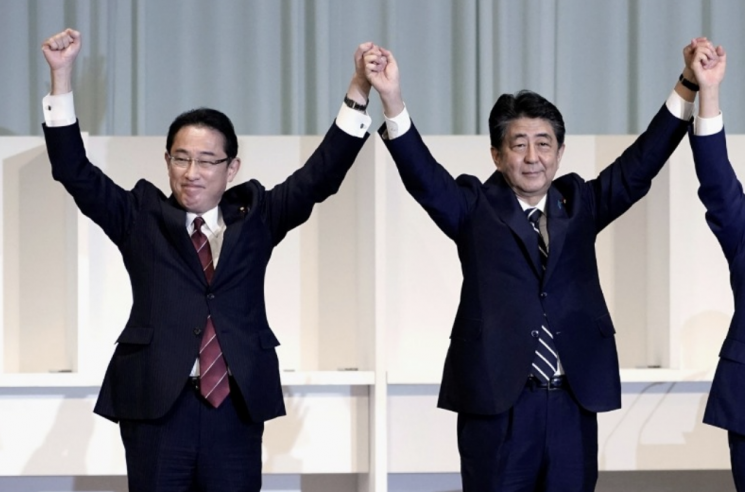 Prime Minister Fumio Kishida (left) and former Prime Minister Shinzo Abe (right). (Image source=AP)·Yonhap News
[Asia Economy Reporter Lee Ji-eun] Following the shooting death of former Japanese Prime Minister Shinzo Abe, suspicions are spreading that Japan's ruling Liberal Democratic Party (LDP) and the Family Federation for World Peace and Unification (formerly the Unification Church) have maintained a close relationship for a long time.
Opposition parties launched fierce attacks, claiming that under the protection of the LDP, the Unification Church expanded its influence and in return provided political funding. The LDP has strongly denied these claims, but major Japanese media outlets analyze that the mutually beneficial relationship between the two sides has lasted for at least half a century.
On the 23rd, the Mainichi Shimbun reported that as the controversy surrounding the relationship between the LDP and the Unification Church did not subside, the approval rating of the Kishida Fumio Cabinet hit its lowest point since its inception. The cabinet's approval rating dropped sharply by 16 percentage points from last month's survey to 36%. According to the poll, 87% of respondents said there was a problem with the relationship between the LDP and the Unification Church.
In response, LDP lawmakers are struggling to explain their ties with the Unification Church. According to data released by the daily Gendai on the 17th of last month, a total of 98 incumbent LDP lawmakers are known to have connections with the Unification Church. Among them, 78 members of the House of Representatives and 20 members of the House of Councillors have maintained friendly relations with Unification Church-affiliated organizations, and 34 of these are former cabinet officials or party executives.
As the controversy grew, Prime Minister Kishida reshuffled his cabinet, replacing 14 out of 19 ministers as part of personnel reform. However, it backfired when it was revealed that seven ministers in the new cabinet and about 20 appointed vice ministers and political affairs officials were also connected to the Unification Church.
◆Relationship Formed Through 'Anti-Communism'
LDP lawmakers' ties with the Unification Church are not a recent development. Foreign media and political insiders in Japan believe that this bond has lasted for over 50 years.
The relationship between the Unification Church and the LDP dates back to 1968. The late Reverend Sun Myung Moon, who founded the Unification Church in Korea in 1954, began proselytizing in Japan four years later and was officially recognized as a religious corporation by the Japanese government in 1964.
Subsequently, in 1968, Reverend Moon established the "Japan International Federation for Victory over Communism," emphasizing "anti-communism" as its banner. At that time, the LDP was struggling with large-scale anti-government protests led by the Communist Party and the student movement organization "Zen Gakko To Kai." Japanese foreign media believe that Reverend Moon emphasized anti-communist ideology to leverage political support and expand the church's influence. This anti-communist ideology aligned with the interests of both the LDP and the Unification Church, marking the beginning of their cooperative relationship.
In the same year, former Prime Minister Kishi Nobusuke, Abe's maternal grandfather, was introduced to Reverend Moon through Ry?ichi Sasakawa, a political heavyweight and Class A war criminal. Kishi began appearing at Unification Church-related gatherings. As his relationship with Kishi deepened, the Unification Church relocated its headquarters church near Kishi's residence. According to the book "History of the Unification Church Movement in Japan," written by a church official, the new headquarters church was reportedly housed in a building that the Kishi Cabinet used as the Prime Minister's official residence.
From the 1970s, former Prime Minister Kishi became more actively involved in these gatherings. The history book of the Unification Church records his remarks expressing hope for the church's revival.
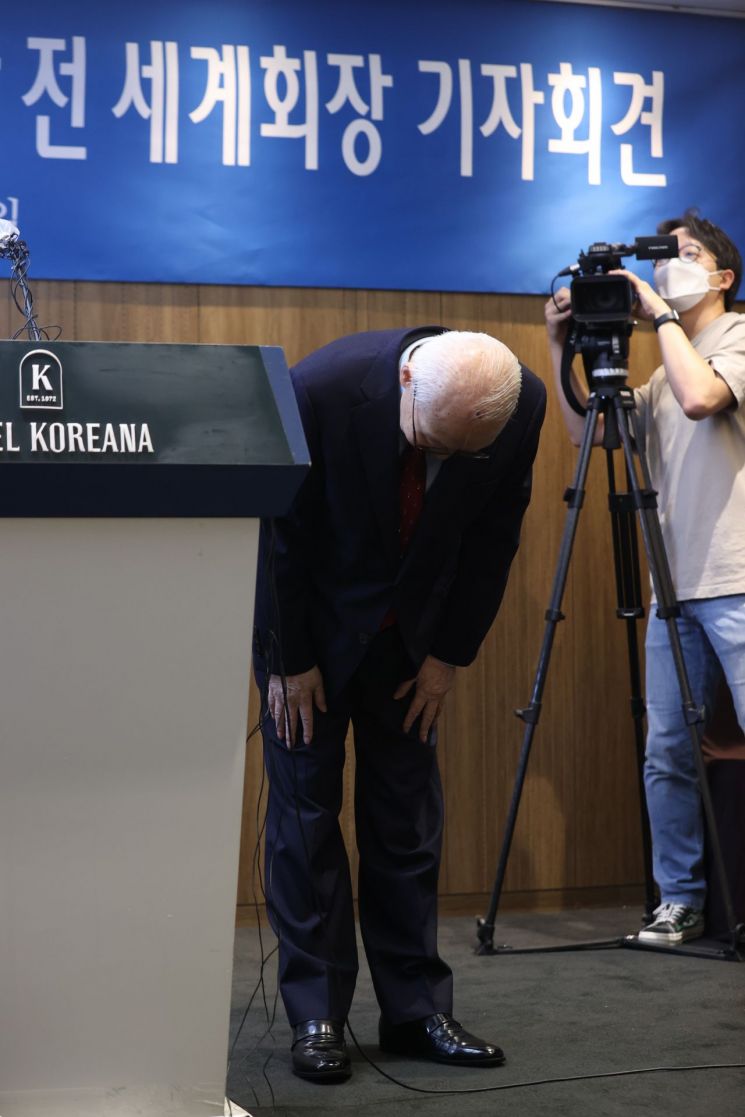 Gwak Jeong-hwan, former global president of the Family Federation for World Peace and Unification (Unification Church), is bowing his head in greeting at a press conference held on the morning of the 19th of last month at the Koreana Hotel in Jung-gu, Seoul, regarding the shooting and death of former Japanese Prime Minister Shinzo Abe.
 [Image source=Yonhap News]
◆Former Prime Minister Kishi's Unification Church Network Continues to Abe
The relationship, which began through "anti-communism," grew even stronger in the 1980s. This was because the perception spread that leveraging the church's influence could provide an advantage in elections. Former LDP lawmakers told the Asahi Shimbun in interviews that Kishi's Unification Church network was fully passed on to his son-in-law, former Foreign Minister Abe Shintaro.
Abe, who became LDP Secretary-General, actively encouraged lawmakers in his faction to receive support from the Unification Church and utilized the church's network to expand his own influence.
The Unification Church also provided massive political funding in 1986 to promote the enactment of the "State Secrecy Protection Law," which prohibited the external disclosure of state secrets. According to the Asahi Shimbun, the Unification Church supported 150 politicians in the 1986 House of Representatives and House of Councillors elections, most of whom were elected.
Even in the 1990s, when the LDP struggled with issues such as the introduction of consumption tax and debates over forming new parties, it repeatedly utilized the Unification Church's influence in elections. The Unification Church reportedly avoided social controversy by enjoying the protection of the political power it secured in this way.
The close relationship with the Unification Church continued through three generations: Kishi Nobusuke, Abe Shintaro, and former Prime Minister Shinzo Abe. Former Prime Minister Abe also actively used the Unification Church's influence to build his political base.
In 2006, while serving as Chief Cabinet Secretary in the Koizumi Cabinet, Abe sent a congratulatory message to the Unification Church-related organization "Universal Peace Federation (UPF)." Recently, it was revealed that Inoue Yoshiyuki, a member of the House of Councillors and former secretary to Abe, was elected with direct support from the Unification Church.
As the controversy expanded, LDP lawmakers themselves acknowledged their ties with the Unification Church. It is understood that they received support from the church by selling political fundraising party tickets. Former Minister of Education, Culture, Sports, Science and Technology Suematsu Shinsuke revealed that a Unification Church official purchased party tickets at an event held to raise his political funds. The LDP's Hokkaido 3rd electoral district branch was also suspected of selling party tickets worth 250,000 yen to a Unification Church organization.
© The Asia Business Daily(www.asiae.co.kr). All rights reserved.

![Clutching a Stolen Dior Bag, Saying "I Hate Being Poor but Real"... The Grotesque Con of a "Human Knockoff" [Slate]](https://cwcontent.asiae.co.kr/asiaresize/183/2026021902243444107_1771435474.jpg)
















