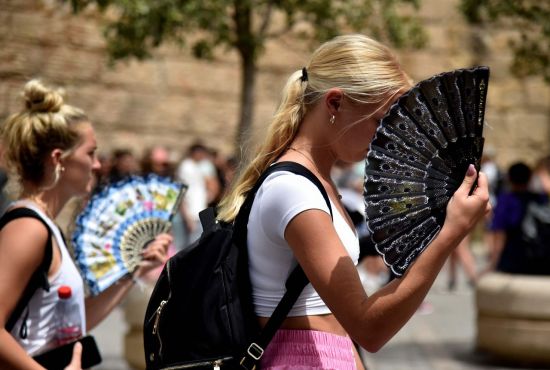
 Women are walking while fanning themselves on the streets of Seville in southern Spain, where the heatwave continues. [Image source=Yonhap News]
[Asia Economy Reporter Lee Ji-eun] The unprecedented heatwave that occurred in Europe this summer is projected to become the average summer weather by 2035. Concerns are being raised that even if the world reduces greenhouse gas emissions to the levels promised under the 2015 Paris Agreement, it will be difficult to stop this trend.
According to an analysis commissioned by the UK Climate Crisis Advisory Group (CCAG) to the Met Office Hadley Centre (MOHC) on the 25th (local time), the average summer temperature in Central Europe is predicted to rise by more than 4 degrees Celsius compared to the pre-industrial era by 2100.
The Climate Crisis Advisory Group analyzed, "Although the world aims to limit the increase in Earth's surface temperature to 1.5 degrees under the Paris Agreement, this research data shows that countries need to make much greater efforts than they currently are."
Professor Peter Stott of MOHC warned, "The European heatwave in 2003, which caused 70,000 deaths, was considered an exceptional event at the time, but if greenhouse gas emissions continue, such conditions will become the norm." This year, unprecedented heatwaves have continued across Europe.
According to CNN and other outlets, the UK exceeded 40 degrees Celsius for the first time last month, the Rhine River in Germany has exposed its riverbed due to ongoing drought, and fires caused by rising temperatures have burned forests in France and Spain. In Spain and Portugal, the heatwave lasting more than ten days has resulted in over 1,900 cumulative deaths. However, despite these conditions, global climate measures are showing sluggish results.
The International Energy Agency (IEA) forecasted that global coal consumption will reach its highest level since 2013 this year. The outlook for greenhouse gas reduction is also bleak.
The Intergovernmental Panel on Climate Change (IPCC), a UN-affiliated body, stated last April that to limit the rise in Earth's surface temperature to 1.5 degrees, the world must reduce greenhouse gas emissions by 43% by 2030 compared to 2019 levels. If current emission levels remain unchanged, the net emissions in 2030 will be only 57 gigatons, which is not significantly different from last year's global emissions of 53 gigatons.
The Climate Crisis Advisory Group emphasized, "If temperatures are not lowered starting now, especially around the Arctic, climate disasters will occur in a chain reaction," and stressed, "The world must urgently and swiftly reduce greenhouse gases to buy time."
© The Asia Business Daily(www.asiae.co.kr). All rights reserved.
![Clutching a Stolen Dior Bag, Saying "I Hate Being Poor but Real"... The Grotesque Con of a "Human Knockoff" [Slate]](https://cwcontent.asiae.co.kr/asiaresize/183/2026021902243444107_1771435474.jpg)
















