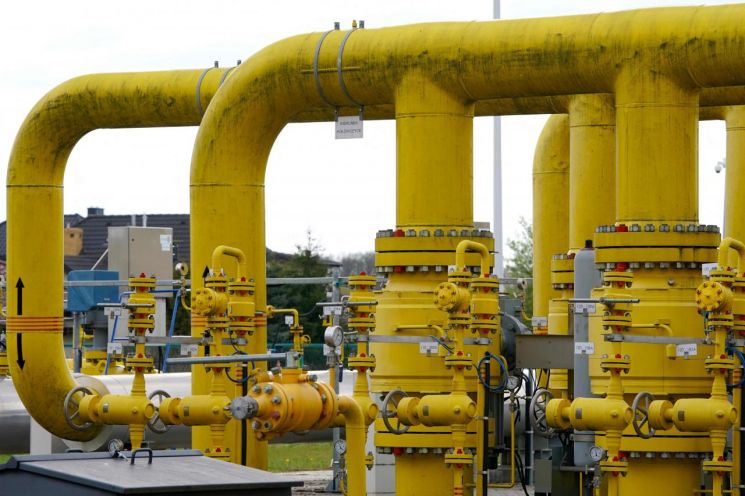
 Gas pipeline inside the Lembelski Cheese and Natural Gas Hub near Warsaw, the capital of Poland
 [Image source=Yonhap News]
[Asia Economy Reporter Kim Daehyun] Yara International, the world's largest fertilizer company headquartered in Norway, announced that it will further reduce ammonia production in Europe due to rising gas prices.
According to Bloomberg and other sources, on the 25th (local time), Yara announced in a statement that it has cut ammonia production to 35% of total capacity. Yara had already reduced production to 45% in March. Yara's ammonia production is estimated to decrease by about 3.1 million tons annually.
Yara stated, "We will optimize operations by maximizing the use of global raw material supply chains and production facilities to meet consumer demand," adding, "If possible, we will continue producing nitrogen fertilizer using imported ammonia."
Currently, natural gas prices in Europe are steadily rising. The Dutch TTF futures price, a benchmark for European gas prices, was around 70 euros per megawatt-hour (MWh) in early February before the war, but as of the 15th, it reached 220 euros (September contract), tripling in value.
Ammonia, the main component of chemical fertilizers, is produced using natural gas and air as raw materials, consuming a large amount of energy in the process. When natural gas prices rise, ammonia production costs also soar accordingly.
Other European fertilizer companies are also significantly reducing production. CF Industries announced it will halt ammonia production at its UK plant, and Grupa Azoty, Poland's largest chemical company, has also cut ammonia production. According to raw material market analysis firm CRU Group, even before Yara reduced production, 41% of European ammonia production facilities had either cut or planned to cut production.
There are concerns that reduced fertilizer production could disrupt food production. Ant?nio Guterres, UN Secretary-General, warned at a UN Security Council meeting the day before, "If the fertilizer market is not stabilized this year, there will be food shortages next year as well."
© The Asia Business Daily(www.asiae.co.kr). All rights reserved.

















