Ban on Paper Cups, Straws, and Umbrella Plastic Use Starting November 24
Deposit System for Disposable Items Suspended Amid Business Owner Burden Controversy
Government: Reducing Disposable Use Is Key to Plastic Reduction Policy... Will Promote Awareness Efforts
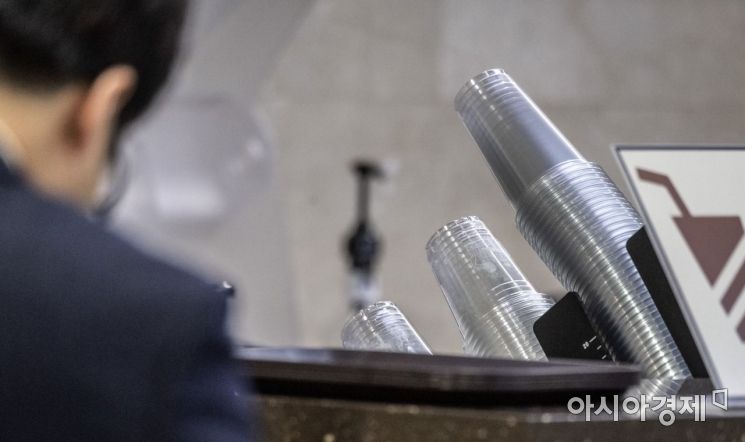 A coffee shop located in a government office building in Seoul has a large stack of plastic cups inside the store. Photo by Yoon Dong-joo doso7@
[Asia Economy Reporter Yoon Seul-gi] Restrictions on the use of disposable items such as paper cups in stores will be expanded. As the government is actively working to reduce the use of disposable products, it is expected that unnecessary resource waste and environmental pollution will decrease, but concerns have been raised that the burden on industries with high disposable product usage may increase.
The Ministry of Environment released the "Guidebook on the Scope of Application for Reducing Disposable Product Use" on the 24th, which contains guidelines related to the expansion of restrictions on disposable product use. The expansion of disposable product use restrictions being implemented this time is in accordance with the Enforcement Rules of the Act on the Promotion of Saving and Recycling Resources, which were revised and promulgated on December 31 of last year.
Currently, only the use of disposable plastic cups is prohibited, but starting from November 24, disposable paper cups, straws, and stirring sticks will be added to the list of restricted items. The target facilities and industries will also be expanded. Disposable product use will be restricted in ▲ collective catering facilities ▲ general restaurants ▲ rest area restaurants ▲ large-scale stores ▲ sports facilities. The use of plastic umbrellas will also be restricted in large-scale stores, and disposable plastic cheering items will be banned in sports facilities.
If the disposable product use regulations are violated, according to Article 41, Paragraph 2, Subparagraph 3 of the Resource Recycling Act, those who use or provide disposable products free of charge will be subject to a fine of up to 3 million won.
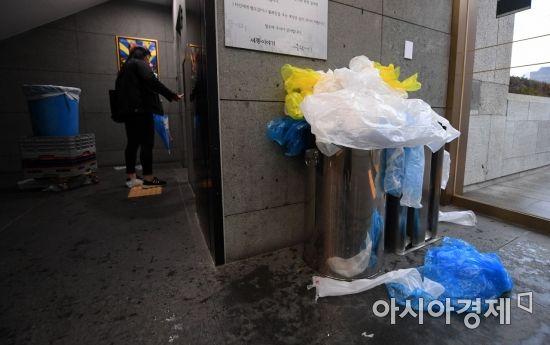
Accordingly, the burden is expected to increase in industries with high disposable product usage, such as cafes and funeral homes. Previously, the "Disposable Cup Deposit System" was also suspended before implementation due to concerns that it would increase the burden on the field. The disposable cup deposit system was planned to be implemented for cafes, bakeries, and fast-food franchises with more than 100 branches, where customers pay a 300 won deposit when purchasing beverages in disposable cups and receive a refund upon returning the cup.
However, this system was criticized for increasing the burden on small business owners and small-scale franchise operators. Store owners must attach labels themselves to sell disposable cups, and they bear all responsibilities for cleaning, collection, and refunds. The price of the label stickers that must be attached to disposable cups was also problematic. Store owners purchase the labels at 317 won each, but sell them to customers for 300 won, resulting in a 17 won loss. Adding card fees and other costs further increases the burden on store owners.
As a result, there are calls for a public discussion process regarding disposable product use regulations. According to a survey conducted by the Korea Consumer Agency from April 7 to April 15 targeting 1,400 adult consumers aged 20 and over who had used coffee shops within the last three months, 58.7% responded that they "did not know well" about the disposable cup deposit system, exceeding half. The Consumer Agency pointed out, "There seems to be a need to strengthen publicity about the disposable cup deposit system."
An official from the Ministry of Environment said, "Reducing disposable product use is a core policy for reducing plastic, and participation from all members of society is necessary," adding, "To this end, we will continuously promote various information to help the public understand the reduction of disposable product use more easily."
© The Asia Business Daily(www.asiae.co.kr). All rights reserved.


















