Annual Inflation Rate Expected at 5% Range
Highest in 24 Years if Realized
Korea-US Base Rate Inversion Also a Factor
Big Step Consideration Ahead
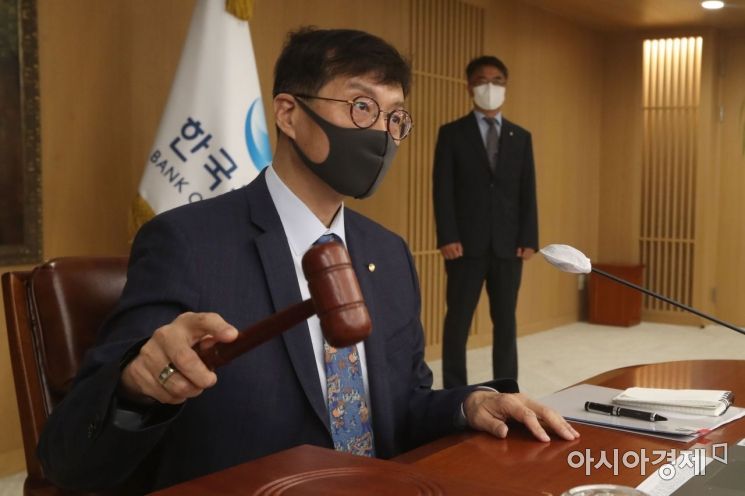 Bank of Korea Governor Lee Chang-yong is presiding over the Monetary Policy Committee plenary meeting held at the Bank of Korea in Jung-gu, Seoul on the 25th. 220825
[Asia Economy reporters Seo So-jeong and Moon Je-won] Lee Chang-yong, Governor of the Bank of Korea, strongly indicated plans to continue the interest rate hike trend by significantly raising this year’s consumer price inflation forecast to 5.2%. If the annual forecast in the 5% range is realized, it will mark the highest annual inflation rate in 24 years since 1998 (7.5%). Although international raw material and grain prices are gradually stabilizing, domestic inflation remains in the 6% range and has yet to reach its peak, with high inflation expected to continue for some time. The inflation forecast for next year was also raised by 0.8 percentage points from 2.9% to 3.7%. However, with growing concerns over a global economic recession and economic slowdowns in the U.S. and China, export prospects for the second half of the year are bleak. Combined with rising inflation and interest rate hikes, consumption may also decline, posing significant challenges for the Bank of Korea’s future monetary policy direction.
◆ Highest inflation rate in 24 years = The reason the Bank of Korea sharply raised its consumer price inflation forecast for this year is due to persistent inflationary pressures. The consumer price index in July rose by 6.3% year-on-year, driven by increases in dining out and agricultural, livestock, and fishery product prices, marking the highest rise in 23 years and 8 months since November 1998 (6.8%).
The problem lies in the uncertainty of the inflation peak timing. The government and the Bank of Korea expect inflation to peak around September to October and then slow down, but recent abnormal weather events such as heavy rains have caused a sharp rise in agricultural product prices, and prices for personal services have also increased, intensifying inflationary pressures. Professor Lee In-sil of Sogang University Graduate School of Economics said, "While inflation in the U.S. has passed its peak, domestic inflation has not yet reached its peak, and the high inflation situation is expected to continue into the second half of the year. The expected inflation rate remains high at around 4%, so the Bank of Korea should focus on inflation rather than economic slowdown when conducting monetary policy now."
◆ Widening interest rate gap between Korea and the U.S. again = The reversal of benchmark interest rates between Korea and the U.S. is also a factor driving the Monetary Policy Committee’s rate hikes. The U.S. Federal Reserve (Fed) consecutively implemented giant steps (0.75 percentage point hikes) at last month’s Federal Open Market Committee (FOMC) meeting, raising the upper bound of the U.S. policy rate to 2.50%, higher than Korea’s 2.25%. Although the Bank of Korea raised rates by 0.25 percentage points this month, equalizing the upper bound, if the U.S. again takes a big step (0.50 percentage point hike) or a giant step next month, the interest rate gap between Korea and the U.S. will inevitably widen further.
Jo Young-moo, a research fellow at LG Economic Research Institute, expressed concern, saying, "For the Korean won, which is not a key currency like the dollar, if interest rates are reversed or narrowed, foreign investment funds may flow out, and the resulting sharp rise in the won-dollar exchange rate could fuel inflation." Recently, the won-dollar exchange rate surged to around 1,346 won, adding inflationary pressure and providing a pretext for further rate hikes. Although the foreign exchange authorities intervened verbally for the first time in two months to curb the relentless rise in the exchange rate, it was insufficient to stop the upward trend.
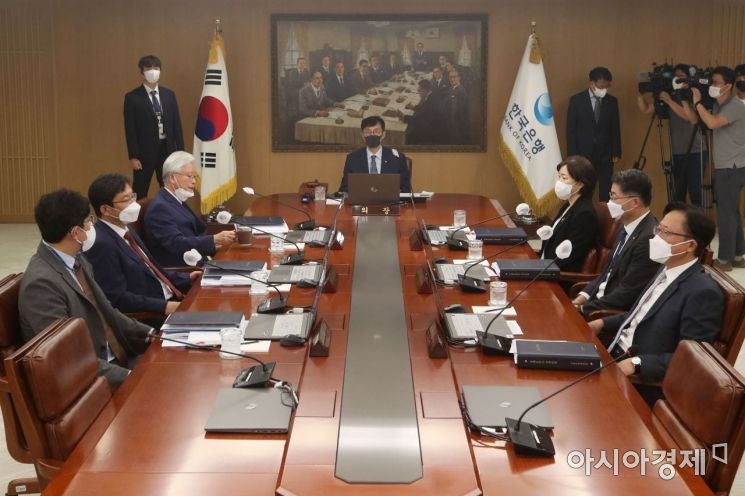 Lee Chang-yong, Governor of the Bank of Korea, is presiding over the regular Monetary Policy Committee meeting held on the 25th at the Bank of Korea in Jung-gu, Seoul. / Photo by Joint Press Corps
◆ Divergent views on future big steps = Experts agreed on the need for rate hikes by the Monetary Policy Committee in the second half of the year but showed differing opinions on taking a big step of raising the benchmark interest rate by 0.50 percentage points at once. Professor Kang Sung-jin of Korea University’s Department of Economics said, "Although the exchange rate has risen significantly, inflation seems to be slowing down slightly, so it is not easy for the Bank of Korea to choose a big step." On the other hand, Cho Kyung-yeop, head of economic research at the Korea Economic Research Institute, said, "Considering inflation and exchange rate issues, it is necessary to somewhat align with the U.S. benchmark interest rate to reduce medium- to long-term burdens, so a big step should also be considered in the future."
On the same day, the Bank of Korea lowered its real gross domestic product (GDP) growth forecast for this year from 2.7% to the 2.6% range. The growth forecast for next year was also lowered by 0.3 percentage points from 2.4% to 2.1%. This is due to the possibility of a slowdown in export growth amid economic downturns in the U.S., China, and other countries, as well as reduced consumption caused by inflation and interest burdens.
© The Asia Business Daily(www.asiae.co.kr). All rights reserved.


















