O Tae-seok, 1st Vice Minister of Science and ICT, Reveals at Hydrogen Economy Symposium on the 25th
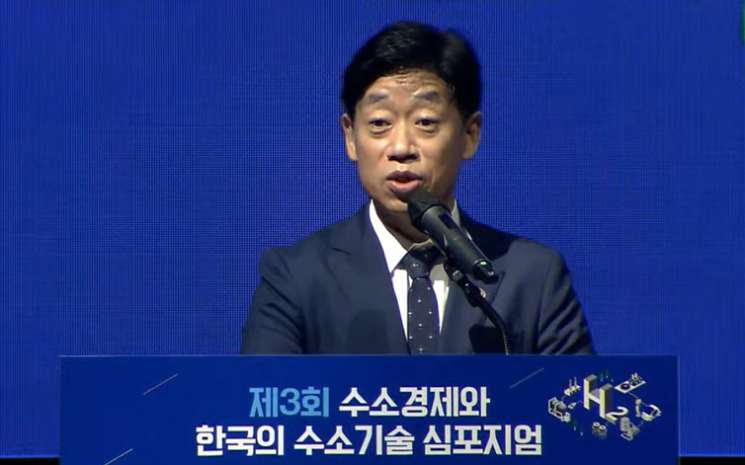
[Asia Economy Reporter Kim Bong-su] The government is strengthening joint public-private research and development (R&D) to realize the hydrogen economy, a representative alternative energy for the decarbonization era, and will launch a pan-ministerial R&D project for the development of representative hydrogen utilization technologies starting in 2024.
On the morning of the 25th, Oh Tae-seok, the 1st Vice Minister of the Ministry of Science and ICT, attended the '3rd Hydrogen Economy and Korea's Hydrogen Technology Symposium' held at the Daejeon Convention Center and made these remarks. Vice Minister Oh said, "We will actively promote R&D projects to enhance the technological competitiveness of companies in order to nurture leading companies that will lead the global hydrogen market by 2030," adding, "We plan to present a hydrogen technology development roadmap within this year and aim to promote a representative pan-ministerial R&D preliminary feasibility study project by 2024 to elevate hydrogen production and distribution technologies, which are core to the hydrogen economy, to a world-leading level."
Hydrogen energy is emerging not only as a key means for carbon neutrality transition but also as an alternative that can strengthen energy security in various countries. Global hydrogen demand is expected to increase to about 100 million tons by 2030 and 550 million tons by 2050. Leading hydrogen countries such as Europe, Japan, and the United States are continuously announcing policies to secure stable hydrogen supply and are investing generously in acquiring hydrogen technologies.
Recently, Germany invested a total of 33 trillion won in hydrogen over ten years. In particular, it has launched a public-private cooperative R&D project worth 11 trillion won to activate the green hydrogen-based value chain. The United Kingdom also announced a plan in April to reduce dependence on Russian energy by gradually halting imports of Russian crude oil, which accounts for 8% of total oil demand, and to invest 600 billion won to secure 10 GW of hydrogen production capacity by 2030. Hydrogen is emerging as a powerful energy security tool.
The government also plans to announce measures to foster hydrogen technology, including designating it as a national strategic technology within this year. First, related ministries will establish a 'Hydrogen Technology Development Roadmap' to foster hydrogen technology. Through this, they will achieve localization of hydrogen technology materials, parts, and equipment, present mid- to long-term technology development directions to secure ultra-gap core technologies, and engage in joint public-private technology development. Fuel cell technology for hydrogen electric vehicles was transferred to Hyundai Motor Company based on research results from the G7 project, which was jointly promoted by the public and private sectors since 2000. This resulted in Hyundai Motor Company becoming the "overwhelming No. 1 in the global hydrogen vehicle market." Last year, Hyundai Motor Company recorded a 53.5% market share, ranking first in the global hydrogen electric vehicle market.
An official from the Ministry of Science and ICT said, "In hydrogen R&D, public-private cooperation is most important, so this symposium is expected to be a forum where experts suggest directions for hydrogen R&D policy and the Ministry of Science and ICT listens and reflects them in policy."
© The Asia Business Daily(www.asiae.co.kr). All rights reserved.
![From Hostess to Organ Seller to High Society... The Grotesque Scam of a "Human Counterfeit" Shaking the Korean Psyche [Slate]](https://cwcontent.asiae.co.kr/asiaresize/183/2026021902243444107_1771435474.jpg)
















