Increased Energy Usage Due to Heatwave... Power Plant Operations Disrupted by Drought
'Climate Disaster' Drives Up Inflation Pressure... Economic Impact Expected to Worsen
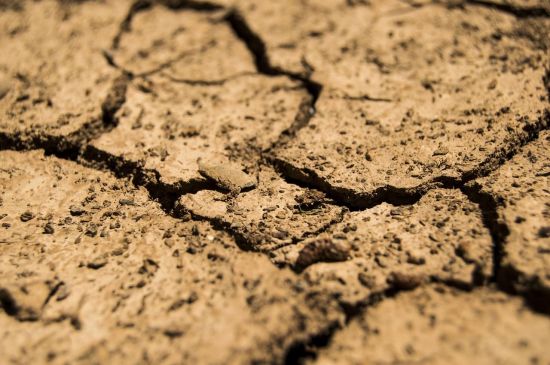 The three major economic powers of the world?the United States, China, and the European Union (EU)?are suffering economic damage due to severe drought.
[Asia Economy Reporter Yoon Seul-gi] The record-breaking heatwaves that began in the United States, Europe, and China have led to droughts, turning climate disasters into a reality. As rivers dry up, agriculture, manufacturing, and transportation sectors are taking a direct hit, while concerns over energy supply shortages are growing due to a lack of water needed to operate nuclear and hydroelectric power plants.
According to a recent report by The Wall Street Journal (WSJ), the three major economic zones of the world?the United States, China, and the European Union (EU)?are suffering economic damage due to severe droughts. Following the sharp rise in prices caused by COVID-19 and the Ukraine war, climate disasters such as heatwaves are compounding the situation, driving up food and energy prices. Damage is appearing across industries, from agriculture to power generation, manufacturing, and tourism, putting global supply chains on high alert.
The first sector to be hit directly by the drought is agriculture. Last month, the price of extra virgin olive oil in Spain rose by about 7%. This was due to a significant reduction in harvests caused by heatwaves with temperatures around 40 degrees Celsius. If the drought continues, forecasts suggest that harvest yields could drop to one-third of the average year.
As riverbeds dry up, there are signs of logistics paralysis and reduced hydroelectric power generation. In Germany, a key gateway for European trade, the water levels of the Rhine River and Italy’s Po River have dropped to unprecedented lows. Normally, the Rhine’s depth ranges from 3 to 6 meters, but recently it has shallowed to about 1.9 meters, raising concerns about grounding and leading to a reduction in cargo volume.
The energy crisis is also accelerating. In Germany, reduced inland water levels have decreased hydroelectric power generation, disrupting plans to phase out Russian natural gas. In France, higher river temperatures have prevented river water from effectively cooling nuclear power plants, forcing a reduction in power output.
In the United States, corn and soybean harvesting has begun in earnest, but due to drought effects, yields are expected to be lower than government forecasts, raising concerns that this will be insufficient to alleviate food shortages. According to the U.S. National Centers for Environmental Information (NCEI), last month’s temperatures across the U.S. were the third highest in history.
Already this year, U.S. cotton production has decreased by 28% compared to the previous year. According to an analysis by the U.S. Department of Agriculture (USDA), 66% of U.S. cotton-producing areas are experiencing drought. Due to record heatwaves and drought, farmers are abandoning cotton cultivation, leading to concerns that harvests could drop by about 40%, which has caused cotton prices to surge.
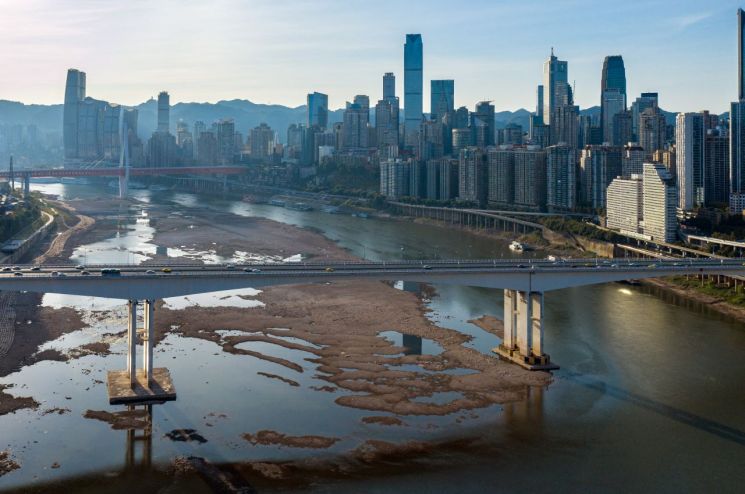 The Jialing River, a tributary of the Yangtze River passing through Chongqing, China, is revealing its parched bed due to severe drought on the 21st. [Image source=Yonhap News]
China is also experiencing its worst heatwave since 1961, with temperatures exceeding 40 degrees Celsius daily. Across the country, including Sichuan, Chongqing, and Hubei provinces, 2.15 million hectares of crops have been damaged by drought, and parts of the Yangtze River basin, the country’s "lifeline," have completely dried up.
Drought is also impacting manufacturing. According to the South China Morning Post (SCMP), as power demand surged and power shortages occurred, factories in Sichuan Province were ordered to shut down for six days starting on the 15th to alleviate the power shortage. Sichuan is home to clusters of semiconductor, lithium, and solar battery factories, raising concerns that the new energy vehicle industry could also be affected.
Meanwhile, climate disasters caused by global warming are acting as factors increasing inflationary pressures in the second half of the year. According to the report "Recent Global Heatwave Expansion and Its Impact on the World Economy," published on the 4th by the International Finance Center, "Heatwaves are intensifying in mid-latitude regions such as parts of North America, Europe, and Asia, which account for a significant portion of global economic growth," and "Global heatwave phenomena further expand risks such as ▲logistics disruptions ▲power shortages ▲production setbacks ▲food shortages, acting as additional downward factors on global economic growth."
The report continued, "As global warming continues, abnormal climate issues including heatwaves are expected to worsen," warning, "Therefore, it is important to note that the impact of various abnormal climate events like this heatwave on global economic growth may continue to increase."
© The Asia Business Daily(www.asiae.co.kr). All rights reserved.

















