Minister Lee Chang-yang "Concerns over Inflation Reduction Act... Considering WTO Complaint"
Subsidies Only for North American Electric Vehicles... Excluding Ioniq 5, etc.
Domestic Battery Industry Also on Alert... High Dependence on China for LG Energy Solution, etc.
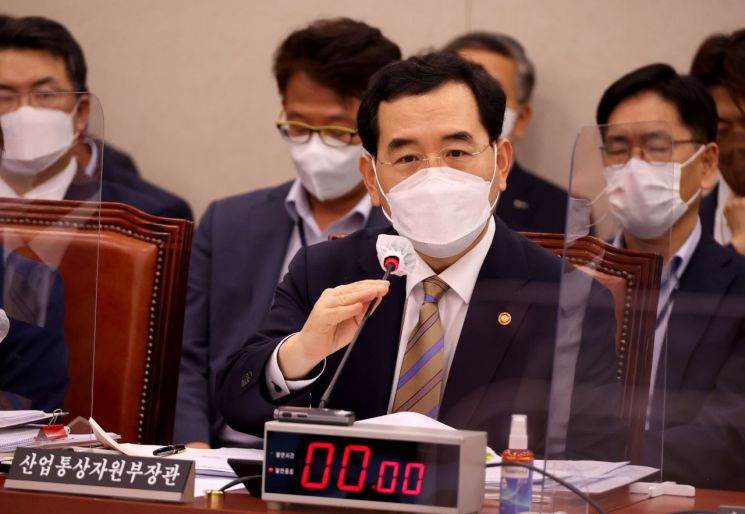 Minister Lee Chang-yang Responding
 (Seoul=Yonhap News) Photo by Baek Seung-ryeol = Minister Lee Chang-yang of the Ministry of Trade, Industry and Energy is answering questions from lawmakers at the plenary meeting of the Industry, Trade, Small and Medium Enterprises Committee held at the National Assembly in Yeouido, Seoul on the 22nd of August, 2022. [National Assembly Press Photographers Group]
srbaek@yna.co.kr
(End)
<Copyright(c) Yonhap News Agency, Unauthorized reproduction and redistribution prohibited>
[Asia Economy Sejong=Reporter Lee Junhyung] Lee Chang-yang, Minister of Trade, Industry and Energy, announced on the 22nd that he is considering filing a complaint against the United States' Inflation Reduction Act (IRA) with the World Trade Organization (WTO).
At the plenary meeting of the National Assembly's Industry, Trade, Industry, and Small and Medium Venture Business Committee on the same day, Minister Lee said, "We are concerned about the IRA." He added, "As soon as the IRA was introduced, we conveyed concerns about possible violations of WTO and Free Trade Agreement (FTA) regulations to the U.S. Trade Representative (USTR) under the name of the head of the Trade Negotiation Headquarters."
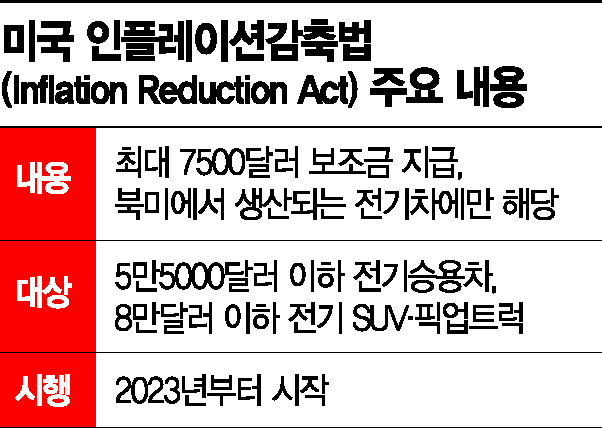
The IRA, signed by U.S. President Joe Biden on the 16th, is a law that stipulates that only electric vehicles finally assembled in North America, including the United States, can receive subsidies. According to the law, new U.S.-made electric vehicles can receive subsidies of $7,500 (approximately 10 million KRW) per vehicle. To qualify for the subsidy, from next year, the origin ratio of battery parts and critical minerals used in electric vehicles must exceed 50% and 40%, respectively. The critical minerals origin ratio will be raised to 80% in 2027.
The IRA is essentially a law targeting China, which is emerging as a new powerhouse in electric vehicles, but South Korea cannot avoid being affected. This is because all electric vehicles exported by Hyundai Motor Group, such as the Ioniq 5 and Kia EV5, are produced in South Korea. This is why all five electric vehicle models sold by Hyundai Motor Group in the U.S. are excluded from subsidy support. If domestic automakers do not receive subsidies, their price competitiveness compared to U.S.-made electric vehicles will inevitably decrease.
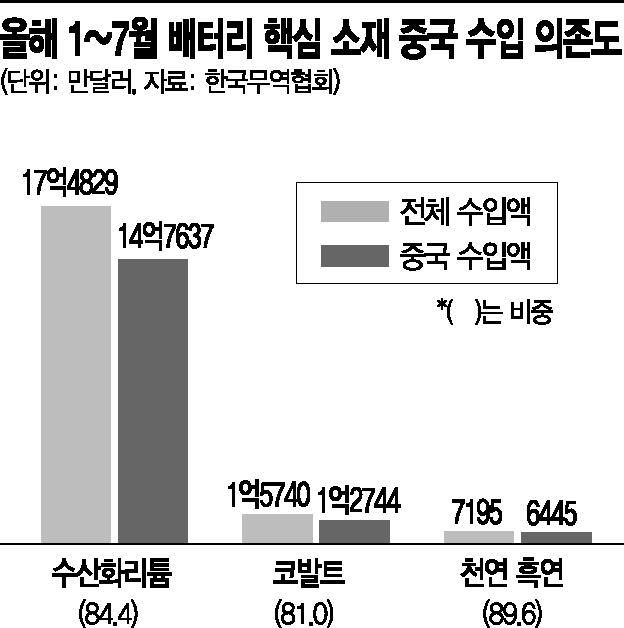
The domestic battery industry is also on high alert. Major Korean battery companies such as LG Energy Solution and SK On have a high dependence on Chinese raw materials. According to the Korea International Trade Association, the import share of lithium hydroxide, a key material for secondary batteries, from China reached 84.4% from January to July this year. The import shares of cobalt and natural graphite from China were also 81% and 89.6%, respectively.
The government states that it is expressing concerns about the IRA to the U.S. through various channels. The government's consideration of filing a WTO complaint related to the IRA is also interpreted as an intention to strongly raise issues with the U.S. side. In addition, Ahn Deok-geun, head of the Ministry of Trade, Industry and Energy's Trade Negotiation Headquarters, plans to visit the U.S. early next month to attend the Indo-Pacific Economic Framework (IPEF) ministerial meeting and officially convey concerns about the IRA.
Meanwhile, Hyundai Motor has decided to start early construction of an electric vehicle-only factory to be established in Georgia, USA. Originally, Hyundai planned to start construction of the Georgia plant in the first half of next year and begin mass production from 2025. However, Hyundai is considering starting construction of the Georgia plant in October to proactively respond to the IRA. If early construction is realized, the factory completion and mass production timeline is expected to be about six months earlier, in the second half of 2024.
© The Asia Business Daily(www.asiae.co.kr). All rights reserved.
![Clutching a Stolen Dior Bag, Saying "I Hate Being Poor but Real"... The Grotesque Con of a "Human Knockoff" [Slate]](https://cwcontent.asiae.co.kr/asiaresize/183/2026021902243444107_1771435474.jpg)













