If Expected Inflation Rises by 1%p, Consumer Prices Increase by 0.67%p
Measures Needed to Stabilize Prices of Frequently Purchased Basket Items
[Asia Economy Reporter Han Ye-ju] Since expected inflation has a very significant impact on consumer prices, there is a claim that the inflation anxiety among recent economic agents must be stabilized to ensure price stability.
The Korea Economic Research Institute (KERI) stated this on the 23rd through its report titled "Analysis of the Relationship between Expected and Perceived Inflation and Consumer Prices and Its Implications."
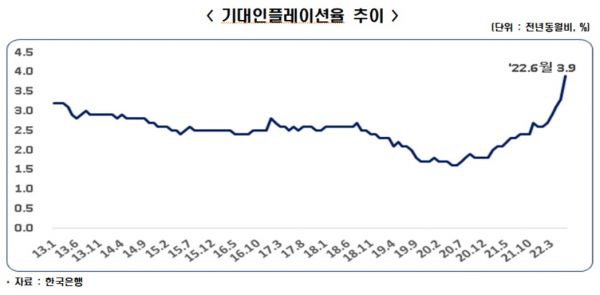
According to the Bank of Korea, the expected inflation rate in June this year was 3.9%, marking the highest level since March 2012 (4.1%).
KERI's analysis indicates that due to instability in price variables such as prices of major daily necessities, wages, and exchange rates, economic agents' expectations of future consumer price levels are rapidly increasing. Additionally, recent abnormal weather conditions such as high temperatures, droughts, and heavy rains have negatively affected agricultural yields, and combined with the rising prices during Chuseok, inflation anxiety among economic agents is spreading quickly.
To verify this, KERI analyzed the relationship between expected inflation and consumer prices using monthly data from January 2013 to June 2022.
The analysis showed a correlation coefficient of 0.76 between consumer prices and expected inflation, indicating a strong closeness between the two variables. It was also found that if expected inflation rises by 1 percentage point, consumer prices increase by 0.67 percentage points.
KERI then projected consumer prices assuming that expected inflation would peak in September, when Chuseok occurs, and then slow down. As a result, if expected inflation calms down, consumer prices are expected to peak at 7.0% in September and then ease to the high 5% to high 6% range for some time.
Additionally, KERI estimated a model explaining expected inflation using perceived inflation and actual inflation (consumer prices) to comparatively assess their effects on expected inflation.
The analysis revealed that when perceived inflation rises by 1 percentage point, expected inflation increases by 0.66 percentage points, whereas when actual inflation rises by 1 percentage point, expected inflation only increases by 0.06 percentage points. KERI interpreted this as meaning that perceived inflation has a very large influence on the formation process of consumers' expected inflation.
Since expected inflation has a strong influence on consumer prices, KERI viewed stabilization measures targeting perceived prices to calm expected inflation as an efficient price stabilization policy.
To this end, they argued that it is necessary to improve distribution structures to stabilize prices of daily necessities with high consumption frequency and relevance to grocery prices such as pork, release government stockpiles of items with high consumption weights, expand the application of tariff quotas, and even consider temporary reductions in consumption taxes if necessary.
Choo Kwang-ho, Director of Economic Policy at KERI, advised, "Although the rapid rise in prices is expected to ease after Chuseok, global supply disruption factors such as intensified resource and grain nationalism and worsening crop conditions due to climate change remain, so high inflation is likely to persist. Stabilizing supply and demand for key items affecting perceived prices to calm inflation expectations is the core of price stabilization measures."
© The Asia Business Daily(www.asiae.co.kr). All rights reserved.

















