Statistics Korea "3 out of 10 Households Are Single-Person Households"
"Watermelon Prices Rise Due to Poor Crop, Peach Prices Fall as Shipments Increase"
Retail Industry Launches Small-Pack Products Targeting Single-Person Households
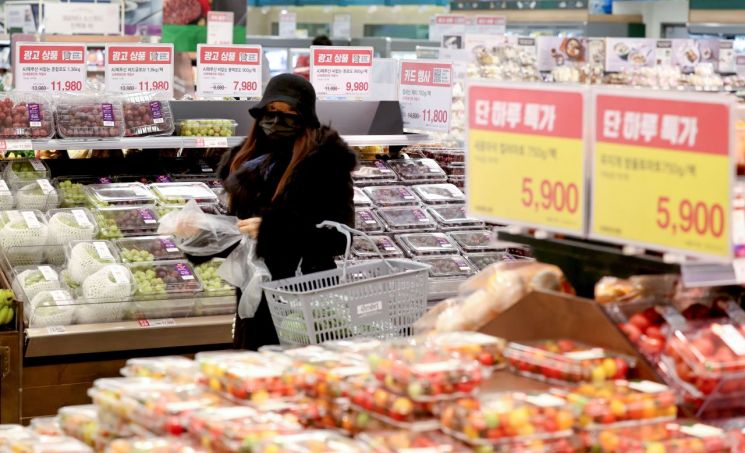 As the number of single-person households increases, peaches, which are less burdensome in quantity than large watermelons, are gaining popularity. The photo shows citizens shopping at the food section of a large supermarket in Seoul.
 [Image source=Yonhap News]
[Asia Economy Reporter Park Hyun-joo] As single-person households increase, fruit consumption trends are also changing. Smaller fruits are gaining popularity over larger ones, and small-packaged products are preferred over bulk quantities.
The number of single-person households continues to rise. According to the 2021 Population and Housing Census results announced by Statistics Korea last July, the number of single-person households reached 7.17 million last year, an increase of 7.9% compared to the previous year. This accounts for 33.4% of all households, meaning that three out of every ten households are single-person households.
Along with this societal trend, the popularity landscape of fruits is also shifting. According to Emart on the 22nd, from the 1st of last month to the 18th of this month, peaches ranked first in total fruit sales at Emart. For the past two years, watermelons held the top spot with peaches in second place, but this summer, peach sales increased by 22.9% while watermelon sales decreased by 8.7%, causing peaches to rise in rank.
Emart attributes this phenomenon to the increase in 1-2 person households, which has led to a decrease in watermelon consumption. Since it is difficult for 1-2 person households to consume a whole large watermelon, demand has shifted to peaches, which are less burdensome in quantity. In fact, while overall watermelon sales declined, sales of smaller watermelons such as Black Mango Watermelon and Kkamang Apple Watermelon increased by 11.5%.
Prices also influenced the change in popular fruit rankings. According to the Korea Agro-Fisheries & Food Trade Corporation (aT) Agricultural Products Distribution Information (KAMIS), on the 19th, the wholesale price of Baekdo peaches (premium grade, 4.5 kg) was 20,780 KRW, down 7.4% from 22,448 KRW a year earlier. Meanwhile, during the same period, the price of watermelons (premium grade, 1 whole) rose 27.8% from 19,452 KRW to 24,860 KRW.
On a retail price basis, Baekdo peaches (premium grade, 10 pieces) dropped 1,491 KRW from 22,800 KRW a year ago to 21,309 KRW, whereas watermelons (premium grade, 1 whole) increased by 3,324 KRW from 23,940 KRW to 27,264 KRW. The decline in watermelon production due to hot and humid weather in major growing regions contrasts with the increase in both production and shipment volume of peaches this year, enhancing their price competitiveness.
However, there is also an interpretation that the popularity of peaches has risen among the MZ generation. Certain peach varieties, such as those produced by famous farms or the Shinbi peach and flat peach, have gained popularity, leading to the creation of the new term 'Bokketting' (Peach + Ticketing). This term reflects the intense purchasing enthusiasm comparable to concert ticketing for popular idol singers.
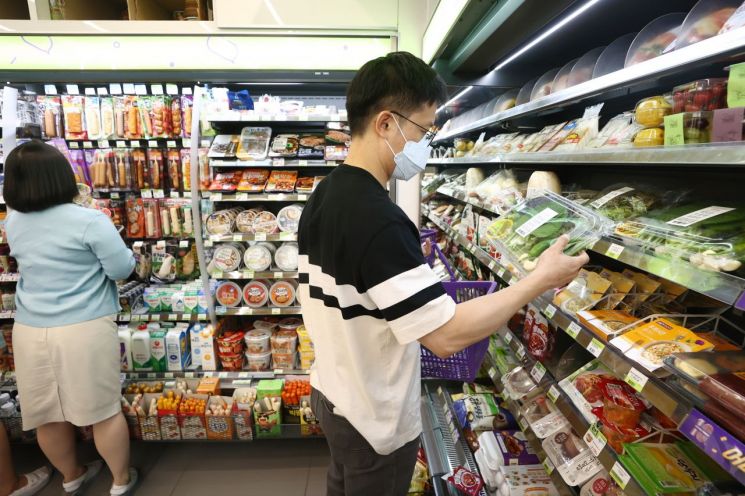 Sales of small-packaged products have increased due to the rise in single-person households. The photo shows a citizen examining small-packaged vegetables at a convenience store in Seoul.
 [Image source=Yonhap News]
Demand for 'small-packaged products' has also increased. In response, large supermarkets have launched small-packaged products containing portions suitable for one or two people in various categories including agriculture, livestock, and fisheries. According to Homeplus, sales of small-packaged seafood products from June 1 to 15 increased twentyfold compared to January. During the same period, sales proportions of small-packaged livestock and vegetable products also rose by 320% and 120%, respectively.
Convenience store chains are also selling various single-serving ingredients. CU offers a small-packaged vegetable series called 'Singsing Saengsaeng,' which includes 15 types of vegetables such as garlic, chili peppers, green onions, assorted wraps, and cabbage. Seven Eleven introduced 'Seven Farm,' a fresh food brand offering vegetables, fruits, meats, and seafood in portions for one to two people.
Small-packaged cut fruits that can be eaten conveniently without washing or cutting are also popular. On the 8th, Emart24 announced that sales of cut fruits increased by 35% compared to the same period last year. Sales growth rates were particularly high in single-resident residential areas (58%), office districts (49%), and academy districts (38%).
© The Asia Business Daily(www.asiae.co.kr). All rights reserved.
![Clutching a Stolen Dior Bag, Saying "I Hate Being Poor but Real"... The Grotesque Con of a "Human Knockoff" [Slate]](https://cwcontent.asiae.co.kr/asiaresize/183/2026021902243444107_1771435474.jpg)

















