National Consumer Price Index Up 5.4% Year-on-Year... Due to Rise in Petroleum Products and Dining Out
[Asia Economy Sejong=Reporter Kwon Haeyoung] In the second quarter of this year, prices rose simultaneously in all 17 cities and provinces nationwide compared to a year ago. As prices surged significantly, consumption rapidly froze.
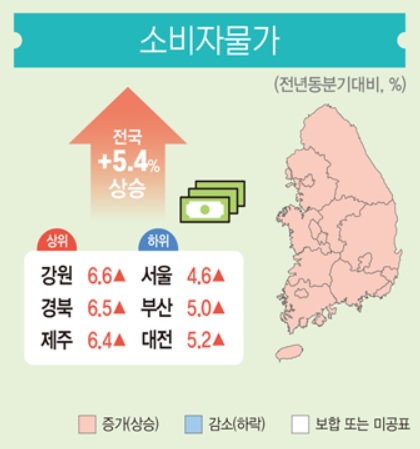
According to the "2022 2nd and 4th Quarter Regional Economic Trends" announced by Statistics Korea on the 22nd, the nationwide consumer price index rose by 5.4% compared to the same period last year. Prices increased in all 17 cities and provinces nationwide due to rises in petroleum products and dining out.
Gangwon (6.6%), Gyeongbuk (6.5%), and Jeju (6.4%) saw price increases higher than the national average due to rises in petroleum products, while Seoul (4.6%), Busan (5.0%), and Daejeon (5.2%) had lower increases than the national average.
With prices soaring, nationwide retail sales decreased by 0.2% compared to the same period last year. Retail sales had increased by 2.9% in the previous quarter but contracted in the second quarter. In 14 cities and provinces including Chungbuk (-2.0%), Ulsan (-1.9%), and Gyeongbuk (-1.8%), retail sales declined due to decreased sales at passenger car and fuel retail stores, supermarkets, and general merchandise stores. Meanwhile, Daejeon (3.3%), Incheon (2.6%), and Gyeongnam (1.6%) saw retail sales increase due to higher sales at department stores, duty-free shops, and specialty retail stores.
Looking at population movement, eight regions including Gyeonggi (11,203 people), Incheon (5,503 people), and Chungnam (3,646 people) experienced net population inflow in the second quarter. Conversely, nine regions including Seoul (-9,058 people), Gyeongnam (-4,152 people), and Busan (-3,435 people) experienced net population outflow.
Construction orders increased by 16.2% compared to the same period last year due to increased orders for factories, warehouses, and machinery installation.
Nationwide manufacturing production rose by 4.1% year-on-year as production of semiconductors, electronic components, and pharmaceuticals increased, while service industry production grew by 5.4% during the same period due to increases in health and welfare, accommodation and restaurants, and transportation and warehousing.
The nationwide employment rate was 62.7%, up 1.7 percentage points from a year earlier. Gwangju (-0.1 percentage points) saw a decline in employment rate, but Gyeonggi (3.5 percentage points), Gyeongbuk (2.8 percentage points), and Ulsan (2.1 percentage points) experienced increases.
© The Asia Business Daily(www.asiae.co.kr). All rights reserved.
![Clutching a Stolen Dior Bag, Saying "I Hate Being Poor but Real"... The Grotesque Con of a "Human Knockoff" [Slate]](https://cwcontent.asiae.co.kr/asiaresize/183/2026021902243444107_1771435474.jpg)
















