0.1% Point Lower Than Initial Forecast... "Trade Conditions and Inflation Surge Must Be Addressed"
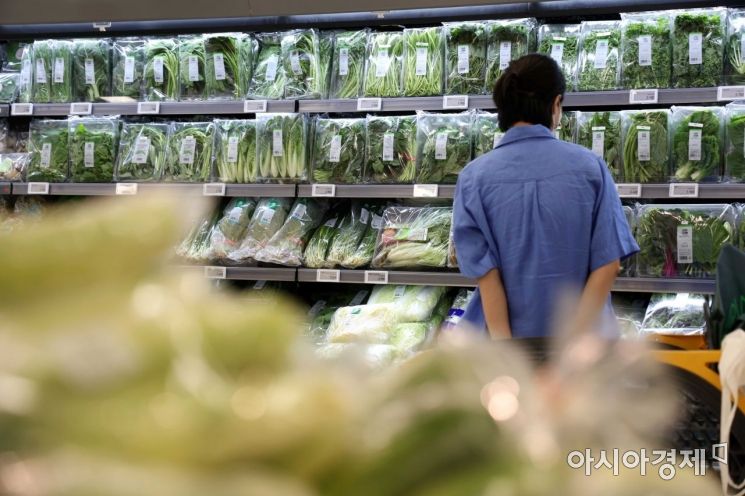 Ahead of Chuseok, there is an emergency in the price of food on the table. According to the National Statistical Portal (KOSIS) of the Statistics Korea, the food and non-alcoholic beverage price index in July was 113.12 (2020=100), up 8.0% from a year ago. Food prices rose the most in one year and five months since February last year. In particular, prices of processed foods such as edible oils (34.7%) and fresh foods such as vegetables and seaweed (24.4%) rose sharply. Citizens are shopping at a large supermarket in downtown Seoul on the 7th. Photo by Moon Honam munonam@
[Asia Economy Reporter Han Yeju] There is a forecast that this year's economic growth rate will reach 2.4%, the level before the outbreak of COVID-19. This figure is 0.1 percentage points lower than the initial forecast of 2.5%.
The Korea Economic Research Institute (KERI) announced this on the 22nd through its report "KERI Economic Trends and Outlook: Q2 2022."
KERI projected that the 2022 economic growth rate will show a pattern of a strong first half and a weak second half (2.9% in the first half, 2.1% in the second half), recording 2.4% on an annual basis, due to weakened consumer sentiment caused by soaring inflation and a wider-than-expected economic slowdown in major countries.
As the base effect from COVID-19 gradually weakens, the sharp interest rate hikes and increased economic uncertainty, which have even dampened corporate investment, have also played a major role in the downward revision of the growth forecast.
Looking in detail, private consumption, which accounts for the largest share in the domestic demand sector, is expected to grow by 3.2%. This is 0.4 percentage points lower than the 3.6% growth rate of private consumption in 2021. Private consumption, which had been recovering on the back of expectations for economic recovery, is expected to show a re-contraction trend as consumer sentiment weakens due to soaring inflation and concerns about economic slowdown.
In particular, with the prolonged slump in self-employed businesses weakening income bases, the rapid interest rate hikes have increased the burden of principal and interest repayments on household debt, significantly reducing the consumption capacity of the private sector. Additionally, the recent sharp rise in prices has also constrained real consumption capacity, limiting consumption recovery.
Facility investment is expected to contract by 2.8% due to a larger-than-expected economic slowdown in major countries caused by prolonged global supply chain disruptions. This is 11.1 percentage points lower than the 8.3% growth rate of facility investment in 2021. Especially, based on the first half of this year, the facility investment growth rate recorded 7.0% compared to the same period last year, but the second half's growth rate is expected to be only 1.5%, indicating a limited rebound.
Construction investment, which has continued to slump due to the government's strong intention to suppress real estate, is expected to contract by 1.7% annually as recent increases in government-led building construction such as public redevelopment have been hampered by soaring raw material prices causing construction delays.
With the stabilization of international raw material prices delayed and recent continuous heavy rains causing sharp price increases in agricultural, livestock, and fishery products, this year's consumer price inflation rate is forecasted to reach 5.3%, the highest in the past 20 years. In particular, the possibility of increased demand pressure around Chuseok is also cited as a major reason for the expected rise in prices. Furthermore, public utility fee hikes, which had been delayed due to COVID-19, are expected to be implemented sequentially from the second half of this year, likely causing a steeper rise in inflation in the latter half.
Real exports, which have driven the growth of the Korean economy, are expected to grow by only 4.1%, 5.8 percentage points lower than the 9.9% export growth rate in 2021, due to a base effect from last year's high performance and the compounded impact of China's deepening economic slowdown.
Research Fellow Lee Seungseok explained, "If the Ukraine crisis prolongs and the global economic slowdown widens due to changes in major countries' monetary policy stances, leading to a prolonged deterioration in trade conditions, the export growth trend could be further weakened."
Meanwhile, the current account balance is expected to fall from $88.3 billion last year to around $48 billion this year, as the rapid increase in imports surpasses export growth and the service account deficit widens.
© The Asia Business Daily(www.asiae.co.kr). All rights reserved.

















