Korea Shipbuilding & Offshore Engineering, Daewoo Shipbuilding & Marine Engineering, Samsung Heavy Industries
R&D Expenses Surpass 100 Billion Won in First Half of the Year
Korea Shipbuilding & Offshore Engineering Leads with 37% Increase YoY
Government Also Promises Support to Maintain Super-Gap Competitiveness
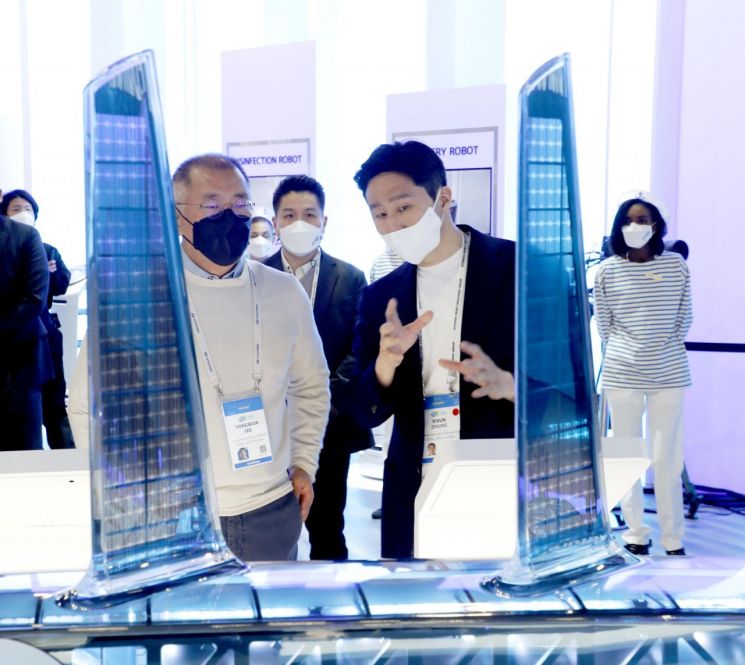 Jung Ki-sun, CEO of HD Hyundai and CEO of Korea Shipbuilding & Offshore Engineering (right), is explaining Avikus's autonomous navigation technology to his cousin, Chung Eui-sun, Chairman of Hyundai Motor Group, who visited the Hyundai Heavy Industries Group booth at CES 2022 last January. Avikus is a specialized company in autonomous ship navigation under HD Hyundai. Photo by Hyundai Heavy Industries Group
[Asia Economy Reporter Choi Seoyoon] The combined research and development (R&D) expenses of South Korea's top three shipbuilders?Korea Shipbuilding & Offshore Engineering, Daewoo Shipbuilding & Marine Engineering, and Samsung Heavy Industries?surpassed 100 billion KRW in the first half of this year. Despite operating losses, R&D spending actually increased. This reflects their intensified efforts to secure advanced technologies to fend off the threatening pursuit from China.
According to the semi-annual reports of the three shipbuilders on the 21st, the total R&D expenditure by Korea Shipbuilding & Offshore Engineering, Daewoo Shipbuilding & Marine Engineering, and Samsung Heavy Industries in the first half reached 103.157 billion KRW, marking a 22.4% (approximately 18.9 billion KRW) increase compared to a year ago.
Korea Shipbuilding & Offshore Engineering showed the highest growth rate. It invested 31.68 billion KRW in R&D in the first half of last year, and increased this by about 11.68 billion KRW to 43.283 billion KRW in the first half of this year, a 36.6% rise over one year.
Daewoo Shipbuilding & Marine Engineering's R&D expenses for the first half of this year were 32 billion KRW, up 11.1% from 28.845 billion KRW in the same period last year. Samsung Heavy Industries spent 27.8 billion KRW on R&D this year, a 17.1% increase from 23.76 billion KRW the previous year.
The proportion of R&D expenses relative to sales also increased. Korea Shipbuilding & Offshore Engineering's R&D-to-sales ratio rose from 0.4% in the previous year's half to 0.5% this year, while Samsung Heavy Industries' ratio grew from 0.7% to 1% over the same period. Daewoo Shipbuilding & Marine Engineering maintained its ratio at 1.3%, unchanged from the previous year.
The three shipbuilders continue to face losses. Their combined operating loss in the first half of this year exceeded 1.5 trillion KRW. Nevertheless, they increased their R&D spending. Although South Korean shipbuilders possess world-class technology, China's technological capabilities have rapidly caught up, prompting a push to secure a super-gap competitive edge.
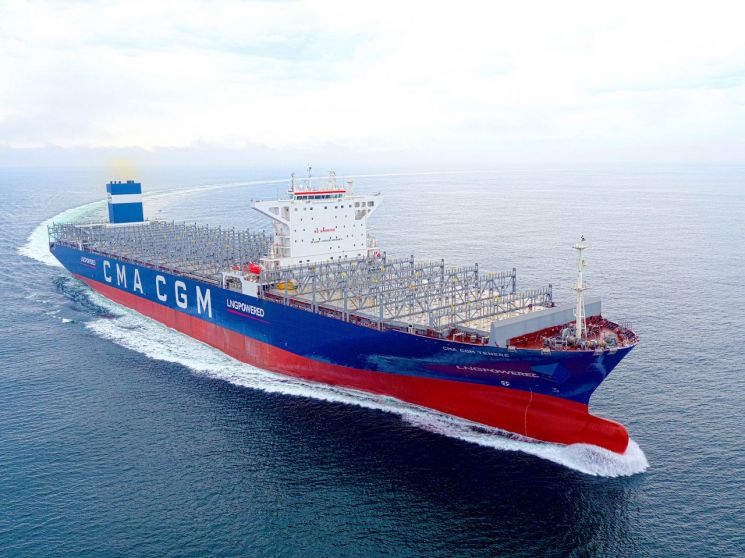 Test run of the world's first LNG-powered large container ship built by Hyundai Heavy Industries Group. Photo by Hyundai Heavy Industries Group
Demand for ships requiring new technologies, such as ammonia-powered vessels and autonomous ships, is gradually increasing. This underscores the growing importance of R&D.
According to Clarkson Research, a UK-based shipbuilding and shipping market analysis firm, the global order volume for liquefied natural gas (LNG) carriers from January to July this year reached 103 vessels, the highest since Clarkson Research began compiling LNG carrier order data in 2000.
LNG carriers, classified as eco-friendly ships, are a field almost entirely dominated by South Korean shipbuilders. During the same period, domestic shipbuilders secured 76% of the global LNG carrier orders.
The government has also pledged support for technological development in the shipbuilding industry. On the 19th, Lee Chang-yang, Minister of Trade, Industry and Energy, held a meeting with the CEOs of the three shipbuilders and stated, "The government will collaborate with the industry to develop technologies to maintain a super-gap in low-carbon ships and core ship types, and proactively respond to the markets for zero-carbon ships and autonomous ships."
At the same meeting, the three domestic shipbuilders announced plans to invest 234 billion KRW this year. They intend to expand investments in facility development such as smart yards and eco-friendly equipment, as well as develop zero-carbon and digital transformation technologies including ammonia-powered ships, carbon capture devices, and smart ship data platforms.
© The Asia Business Daily(www.asiae.co.kr). All rights reserved.


















