Cable TV Industry Welcomes Regulatory Innovation Including Technology Neutrality
IPTV Cash Giveaway Competition and Content Fee Calculation
Concerns Over Local Commerce Regulation and Revenue Structure Deterioration
Vice Minister Park Yoon-kyu "Efforts for Regulatory Fairness with OTT, etc."
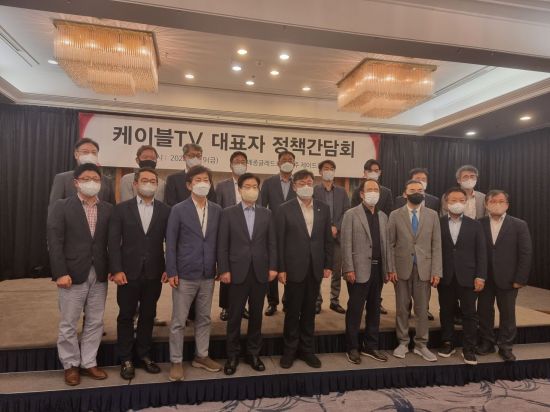 On the 19th, participants are taking a commemorative photo at a policy meeting held between Park Yoon-kyu, Vice Minister of the Ministry of Science and ICT, and representatives of the cable TV industry at Maison Glad Hotel in Jeju Island. Photo by Cha Min-young
[Asia Economy Reporter Cha Min-young] The government met with the cable TV industry and expressed its commitment to work together in the spirit of 'Jultakdongsi (simultaneous effort)' as the industry seeks new business models (BM) linked to information and communication technology (ICT) and local communities. While continuing broadcasting support projects to ensure the survival of local channels, which are the foundation for balanced regional development, the government plans to reduce unnecessary regulations tied to past laws, such as frequent re-licensing reviews.
Cable TV Industry Requests Ban on Cash Prizes for IPTV
At a policy meeting held on the 19th at Maison Glad Hotel in Jeju Island between Park Yoon-kyu, Vice Minister of the Ministry of Science and ICT, and representatives of the cable TV industry, discussions were held on the current status of the cable TV industry following the introduction of technological neutrality and other institutional improvements, as well as requests from comprehensive wired broadcasting operators. Although the Vice Minister has previously held meetings with media industries including IPTV, cable TV, and online video service providers (OTT), this was the first time meeting exclusively with the cable TV industry.
The cable TV industry welcomed the government's regulatory innovation stance and shared difficulties such as indiscriminate prize competitions with IPTV companies under telecom operators, issues with content fee calculations with broadcasting channel usage providers (PP), local commerce, and deteriorating revenue structures.
Lee Rae-woon, Chairman of the Korea Cable TV Broadcasting Association, who opened the discussion, explained successful cases such as Japan’s Digital All-Power City national initiative and trends in ICT public-private cooperation. Chairman Lee said, "We deeply appreciate the government's efforts to promote regulatory innovation such as technological neutrality. For these policies to bear fruit, we request the introduction of expanded product autonomy, increased support for local channels through broadcasting development funds and tax incentives, and a ban on cash prizes to establish a virtuous cycle in paid broadcasting."
Song Goo-young, CEO of LG HelloVision, said, "Cable TV can play a positive role as a universal service by providing broadcasting and communication at low costs compared to IPTV. However, since telecom companies offer many cash paybacks, there should be legal measures to restrict these to protect subscribers."
Lee Han-oh, CEO of Geumgang Broadcasting, also said, "Although the headquarters denies it, verbal agreements and cash kickbacks are widespread on the ground. While the win-win agreement with KT is positive, it would be good if the government could mediate to create a platform for all operators to work together."
Issues with Content Fee Calculation and Revenue Structure Also Exist
There was also a call for urgent guidelines to address content fee calculation issues with the PP industry. CEO Lee Han-oh lamented, "Small businesses have weak negotiating power with PPs, so even without grounds, if they say prices have increased and demand payment, they have to comply. At public hearings or forums, they speak as victims, but clearly, cable TV operators are the 'weaker party'." He also conveyed a request for the Ministry of Science and ICT to actively work on establishing guidelines for content fee calculation.
Hong Ki-seop, CEO of HCN, said, "The Korea Communications Commission has special laws supporting local broadcasting, but it would be appreciated if the Ministry of Science and ICT could also actively address issues such as commentary and interpretation for local channels through special legislation. We are grateful for the positive stance on local commerce and ask for another look at the difficulties faced by local channels."
Concerns were also raised about efforts to diversify the cable TV industry's revenue structure. Yoon Cheol-ji, Chairman of Seogyeong Broadcasting, said, "Home shopping sales contribute the most to revenue, but they are structurally declining, while transmission network and PP fees are increasing, causing much concern. Although new businesses like Wi-Fi at KCTV Jeju Broadcasting are good, there is internal debate about their actual benefits."
Chairman Yoon added, "If the government considers how to generate profits by utilizing the transmission networks owned by cable TV, the industry will actively invest in these networks. Also, diversification into businesses such as golf courses greatly helps cable TV operations, but during re-licensing reviews, questions arise about why new businesses are being pursued. The low profitability of MVNO businesses is also a concern."
Vice Minister Park Yoon-kyu: "Focusing on Regulatory Innovation Related to Local Channels"
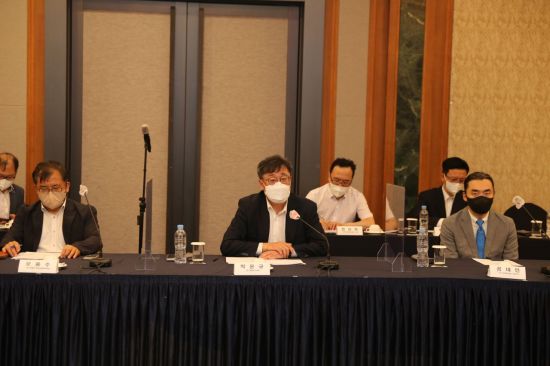 Park Yoon-kyu, 2nd Vice Minister of the Ministry of Science and ICT (center), is speaking at the policy meeting.
After hearing industry opinions, Vice Minister Park Yoon-kyu said, "I understand that the amendment of the Broadcasting Act has provided a basis for government support for cable broadcasting operators in local areas, and from next year’s budget, we will work to create projects that can help. The Prime Minister is very determined and has exceptional drive, so we will resolve any inconveniences felt in competition and innovation," he emphasized.
He continued, "Our focus is on channels related to local areas, specifically local channels. We have reviewed and reduced routine re-licensing conditions stipulated by law, and going forward, we will try to align regulations as closely as possible with those of OTT and other platforms without regulations when competing for essential projects."
He added, "We will also support demonstration projects and other efforts to create new business models. The government will devise support measures with the spirit of Jultakdongsi," explaining that Jultakdongsi means that work is done together from inside and outside.
© The Asia Business Daily(www.asiae.co.kr). All rights reserved.


















