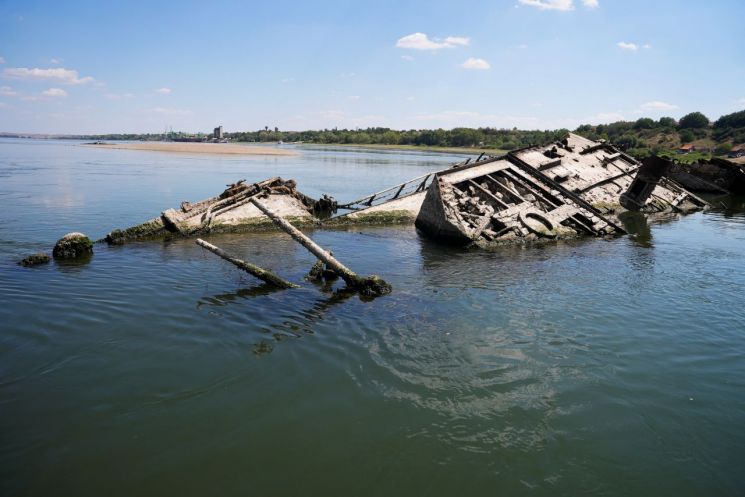
 More than 20 German warships were discovered in the Danube River.
 [Image source=Reuters Yonhap News]
[Asia Economy Reporter Hwang Sumi] Rivers across Europe, suffering from the worst drought in 500 years, are drying up. Following disruptions in ship navigation, concerns over energy supply are growing as nuclear power plant operations are also affected.
According to major foreign media on the 19th (local time), due to the severe drought this summer, the water level of the Danube River near Prahovo, Serbia, dropped to its lowest in 100 years. The Danube River, one of Europe's largest waterways with a length of about 2,860 km, is known to originate in Germany and flow through southeastern Romania into the Black Sea.
With the lowered water level of the Danube, more than 20 German warships have emerged above the water surface. These warships are known to be some of the vessels sunk during World War II when Nazi Germany's fleet retreated to avoid the Soviet army's advance.
This has caused disruptions in the navigation of ships traveling along the Danube. The navigable width has been reduced from 180 meters to 100 meters due to the scattered sunken warships. The ammunition and explosives on the warships also pose a threat to nearby residents.
Serbian authorities have reportedly started emergency dredging work to maintain the Danube's shipping route and have put bids out for hull salvage and explosive removal. Foreign media estimate the cost to be around 29 million euros (approximately 38.9 billion KRW).
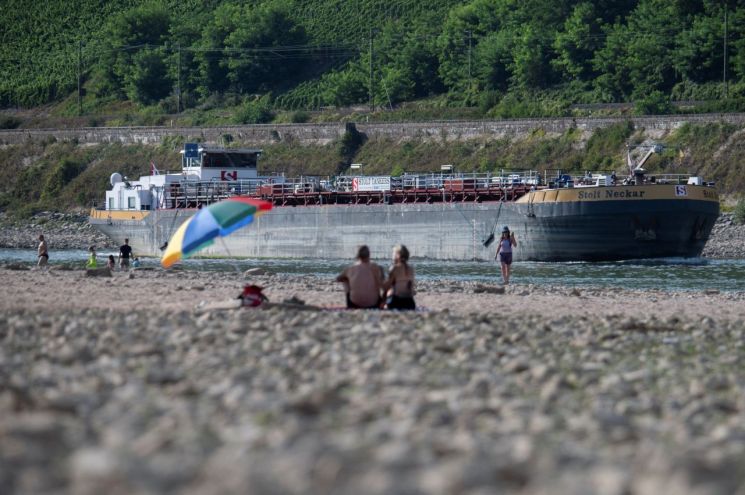 On the 16th (local time), residents in Osterfey, western Germany, were watching ships passing through the narrowed waterway as the water level dropped due to severe drought along the Rhine River embankment. [Image source=Yonhap News]
Meanwhile, as heatwaves and drought continue in Europe, rivers are increasingly exposing their beds. In the UK, which recorded the driest July in 87 years, the upper Thames River has dried up. Parts of the Loire River in western France have also exposed their beds due to prolonged drought.
In Germany, the lowered water level of the Rhine River has disrupted water transport. The German Inland Navigation Association (BDB) has expressed concerns that cargo ship navigation may soon become impossible in some sections.
The severe drought is also impacting the energy sector. According to The New York Times, German energy companies have recently faced emergencies in raw material supply. This is because sufficient amounts of coal cannot be transported via the Rhine River. Coal transport ships are reportedly able to carry only about one-third of their usual capacity. Consequently, Uniper, a German power plant operator, announced that it would have to reduce production at two of its thermal power plants.
In France, nuclear power plants had to temporarily reduce operations. This was due to the rise in river water temperatures used for reactor cooling caused by the heatwave. Authorities are reportedly prohibiting the discharge of warm water into rivers in accordance with wildlife protection regulations.
© The Asia Business Daily(www.asiae.co.kr). All rights reserved.


















