Semiconductor Companies: Smaller Scale Means Lower Proportion of Female Executives
Samsung Electronics and SK Hynix See Steady Decline in Female Employees Over 5 Years
Will Increasing Women in STEM Boost Their Share? "Efforts Needed," Experts Say
[Asia Economy Reporter Kim Pyeonghwa] While the semiconductor industry has been expanding its business scale and workforce thanks to market growth, the proportion of female employees has steadily decreased slightly over the past five years. Although there are expectations that the share could naturally increase as more female talent in science and engineering fields emerges, there is still a consensus that improvements are necessary.
The Smaller the Company, the Less Visible Female Executives
According to the semiconductor industry and the Financial Supervisory Service's electronic disclosure system on the 20th, several semiconductor companies including Samsung Electronics, SK Hynix, DB HiTek, and LX Semicon released their semi-annual reports this month. DB HiTek unveiled its semi-annual report on the 12th, followed by the other three companies disclosing theirs on the 16th.
Looking at these reports, although there are differences depending on company size, all showed the commonality that the proportion of female executives compared to males was low. Samsung Electronics and SK Hynix each had only one female executive among nine registered executives. The female executive in both cases was an outside director.
This phenomenon was more pronounced in relatively smaller companies like DB HiTek and LX Semicon. Both companies had no female registered executives. LX Semicon had one female non-registered executive among 18, but DB HiTek's 32 non-registered executives were all male.
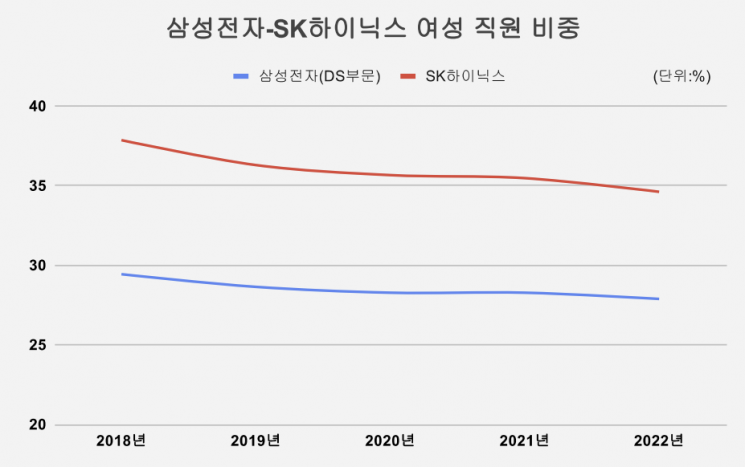 Graph of the proportion of female employees at Samsung Electronics and SK Hynix based on semi-annual reports from 2018 to the end of June 2022 / Photo by Kim Pyeonghwa
Female Proportion Decreases Even as Total Number of Employees Increases
Samsung Electronics and SK Hynix also shared the commonality that the proportion of female employees steadily decreased among the total workforce. Analyzing the semi-annual reports disclosed from 2018 to 2022, the proportion of female employees in both companies decreased by about 1% each year compared to the previous year over five years. Although the difference is slight, the fact that the same downward trend was maintained for a considerable period is noteworthy.
In Samsung Electronics’ DS division, which handles semiconductor business, the proportion of female regular employees dropped from 29.44% at the end of June 2018 to 27.89% at the end of June 2022, a decrease of 1.55 percentage points. SK Hynix showed a similar trend, with a decrease from 37.87% to 34.62%, a 3.25 percentage point drop over the same period.
Conversely, the total number of employees in both companies increased every year. In particular, Samsung Electronics increased the number of regular employees in the DS division by 10.45% as of the end of June this year compared to the previous year. Last year also saw a 10.10% increase, showing a focus on workforce expansion. SK Hynix also slightly increased its total number of regular employees every year over five years, albeit by fractional amounts.
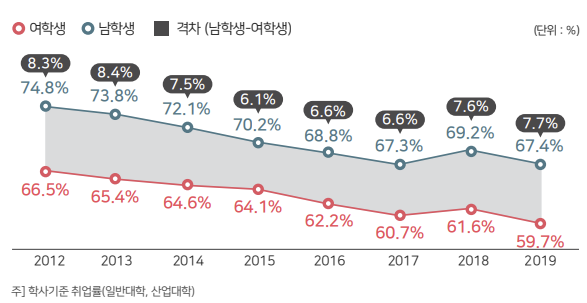 Trends in Employment Rates by Gender for Science and Engineering Students by Year / Source=Korea Foundation for the Advancement of Science and Creativity
Will the Gender Ratio Gap Narrow as Female Talent in Science and Engineering Increases?
The semiconductor industry believes that as the proportion of women in science and engineering fields increases, the gender ratio gap may narrow in the future. An industry insider said, “If you look separately at office and production jobs, some places are seeing an increase in the proportion of women in office jobs,” adding, “In the long term, the number of female employees could increase further.”
In fact, a December 2021 report by the Korea Foundation for the Advancement of Science and Creativity shows that the graduation rate of female students in science and engineering increased from 27.9% in 2011 to 28.9% in 2020, a 2 percentage point rise. The employment rate gap between male and female students in science and engineering also decreased from 8.3 percentage points in 2012 to 7.7 percentage points in 2019.
The Korea Foundation for the Advancement of Science and Creativity positively evaluated this situation but also stated that “a significant gap still exists.” It further added that “there is a leakage phenomenon in the pipeline between education and the labor market.” The implication is that improvements are needed.
© The Asia Business Daily(www.asiae.co.kr). All rights reserved.



















