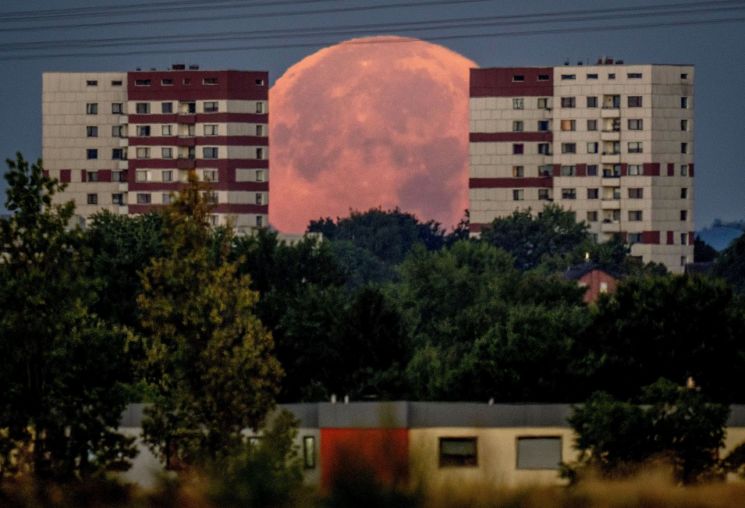
 On the 12th (local time), a supermoon is rising behind an apartment complex on the outskirts of Frankfurt, Germany.
 As Russia weaponizes energy, causing energy prices to soar, Germany's manufacturing sector, a powerhouse of production, is faltering.
According to foreign media on the 18th (local time), Russia, facing Western sanctions due to its invasion of Ukraine, has reduced pipeline natural gas (PNG) supplies, causing electricity and natural gas prices in Germany to more than double in just two months.
The European natural gas price for next month reached 241 euros (about 322,000 won) per megawatt-hour (MWh) on the day. This is an all-time high, approximately 11 times higher than the usual price at this time of year.
The German government has introduced measures to somewhat alleviate the energy bill burden on households, but companies remain fully exposed to rising energy prices.
As a result, companies are being forced either to pass the increased energy costs on to consumers or to shut down entirely.
Matthias Ruh, spokesperson for Evonik Industries, the world's second-largest chemical company with factories in 27 countries, said that companies with high energy consumption are feeling a significant burden from the soaring energy prices.
Ruh lamented that about 40% of the natural gas used in their German factories is being replaced with liquefied petroleum gas (LPG) and coal, yet the increased costs are still being passed on to some customers.
Germany's Aurubis, Europe's largest copper producer, is also minimizing natural gas usage while seeking to raise product prices.
German sugar producer S?dzucker is preparing an emergency plan in case of a complete halt in Russian natural gas supplies.
BMW is considering sourcing electricity from local power companies for its 37 factories in Germany and Austria, which have previously generated their own power using natural gas.
Packing company Delkeskamp plans to close one factory in Germany due to the inability to withstand high energy costs.
Ralph Stoppels, CEO of BIW, a producer of silicon parts used in automobiles and aircraft, said that energy prices are rising more sharply in Germany than anywhere else in the world, expressing concern about the gradual decline of German manufacturing.
Simone Tagliapietra, senior researcher at the European think tank Bruegel, predicted, "The continuous rise in energy prices could reshape Europe's economic landscape," adding, "Some industries will face significant pressure and reconsider production within Europe."
Last month, the International Monetary Fund (IMF) forecasted that "due to Germany's high dependence on Russian natural gas, its economy will perform the worst among the Group of Seven (G7) major economies this year."
© The Asia Business Daily(www.asiae.co.kr). All rights reserved.

















