Labor Costs Rise, Profitability Management in Crisis
[Asia Economy Reporter Moon Chaeseok] This year, the rapid surge in global raw material prices and sharp wage increases have significantly increased the cost burden for major companies in the first half of the year. Due to the impact of economic recession and inflation (price increases), consumer demand has decreased, leading to inventory accumulation, and profitability deterioration in the second half of the year is expected to be inevitable.
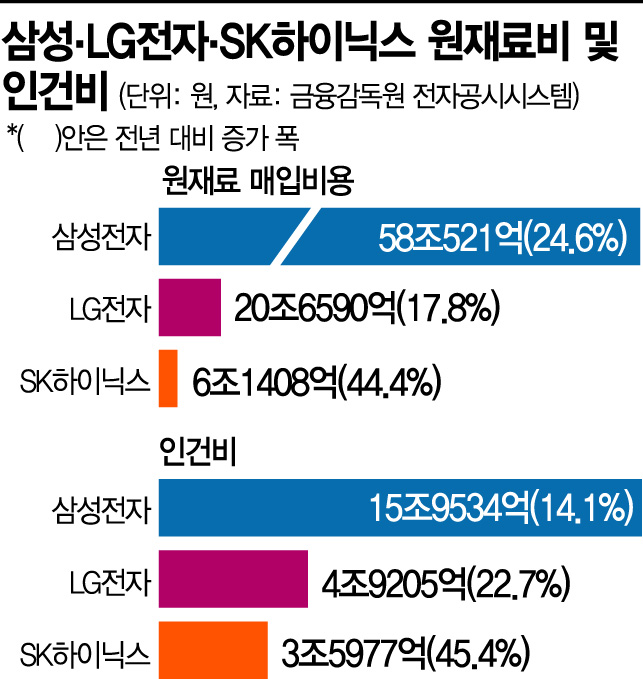
According to the half-year reports submitted by each company to the Financial Supervisory Service on the 19th, Samsung Electronics' raw material purchase costs as of the end of June amounted to 58.0521 trillion KRW, an increase of 24.6% (11.4482 trillion KRW) compared to the same period last year. Last year, it recorded an all-time high of 103.7 trillion KRW, and if this trend continues, it is expected to exceed that this year. Considering the past records of around 70 to 80 trillion KRW over the last decade, the 25% increase is seen by the industry as larger than expected.
Among major raw materials, the price of mobile APs (Application Processors) used in smartphones rose the most, by 58%. Camera modules (10%) and wafers (4%) also increased. In the home appliance sector, raw material market conditions for steel plates, plastics, and copper remain unstable.
LG Electronics also spent 20.659 trillion KRW on raw materials in the first half, a 17.8% (3.1179 trillion KRW) increase from the previous year. The price hikes in steel (22%), plastics (20.3%), and copper (40.2%) for home appliances had a significant impact. SK Hynix spent 6.1408 trillion KRW on raw material purchases, up 44.4% from the same period last year. The three companies' combined raw material costs in the first half of this year reached 85 trillion KRW.
The surge in labor costs due to record-high wage increases also contributed to the cost burden. Samsung Electronics' labor costs in the first half of this year were 15.9534 trillion KRW, up 14.1% (1.9762 trillion KRW) from the same period last year.
This reflects Samsung Electronics' implementation of an average 9% wage increase this year (5% base increase, 4% average performance increase) and the inclusion of performance bonuses for last year's strong results in this year's labor costs. The significant increase in Samsung Electronics' number of employees compared to last year also influenced the rise in labor costs. As of the end of June, Samsung Electronics had a total of 117,321 domestic employees, an increase of 6,240 from the same period last year, marking the largest scale ever.
During the same period, LG Electronics' labor costs rose 22.7% to 4.9205 trillion KRW, and SK Hynix's increased 45.4% to 3.5977 trillion KRW.
The problem is that finding a sharp solution is difficult. At least the home appliance sector has demand recovery 'factors' such as the World Cup and Black Friday, but the memory semiconductor market, including DRAM and NAND flash, is expected to remain sluggish for the time being. International political and economic issues beyond corporate control can erupt anytime and anywhere, making them unpredictable.
Ultimately, the answer is to focus on the 'basics' such as customer diversification, sales and administrative expense efficiency, and securing a high-quality new product portfolio, according to current corporate responses.
Still, there is cautious optimism in the home appliance industry that the second half of the year will be better than the first half. A home appliance industry official said, "It is clear that uncertainty is high, but the second half will be somewhat better than the first half," adding, "Various costs such as logistics fees move in line with oil prices, and recently, a trend of slight stabilization in oil prices has been detected."
Another industry official said, "It is hard to see the tens of percent increase in costs compared to last year as a natural result of sales growth," adding, "There is no choice but to break through head-on by expanding supply sources and securing a high-quality product portfolio."
© The Asia Business Daily(www.asiae.co.kr). All rights reserved.
![Clutching a Stolen Dior Bag, Saying "I Hate Being Poor but Real"... The Grotesque Con of a "Human Knockoff" [Slate]](https://cwcontent.asiae.co.kr/asiaresize/183/2026021902243444107_1771435474.jpg)

















