Won-Dollar Exchange Rate Hits Intraday Record High
Strong Dollar Intensifies After US FOMC Minutes Release
Exchange Rate Rise Worsens Short-Term External Debt Indicators
Uncertainty Grows Ahead of Next Week's Monetary Policy Meeting
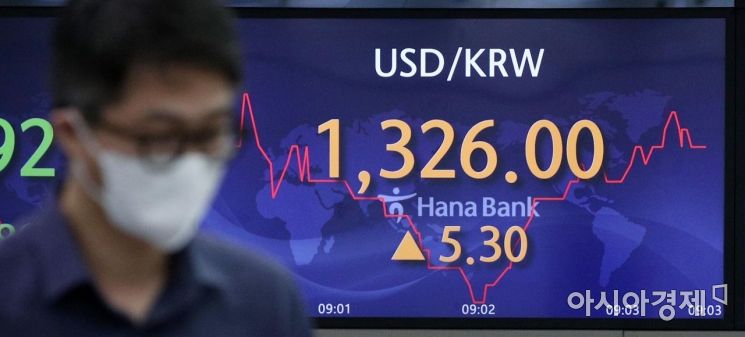
As the Bank of Korea's Monetary Policy Committee meeting approaches next week, uncertainty surrounding the pace of tightening by the U.S. Federal Reserve (Fed) and exchange rates is increasing. If the Fed slows the pace of interest rate hikes, the pressure on the Bank of Korea to raise rates may ease somewhat. However, since domestic inflation has yet to show signs of peaking and the won-dollar exchange rate has recently surged, there are analyses suggesting that the rate hike trend should continue.
According to the financial market on the 19th, opinions are somewhat divided over the pace of the Fed's rate hikes following the release of the minutes from the July Federal Open Market Committee (FOMC) meeting the previous day. While the Fed expressed its determination to continue tightening until inflation is controlled, it also mentioned the risks of excessive tightening, thus not providing clear guidance.
In particular, inconsistent remarks from Fed officials have further heightened domestic and international uncertainties. On that day, the won-dollar exchange rate opened at 1,326.0 won, up 5.3 won from the previous trading day, and rose to 1,328.7 won in the morning, hitting an intraday high not seen in a month. This was influenced by the dollar index, which measures the dollar's value against six major currencies, surpassing the 107 level again after about a month amid tightening concerns.
Recently, the U.S. July Consumer Price Index (CPI) rose 8.5% year-on-year, slowing compared to the previous month, and U.S. retail sales remained flat. These factors could reduce pressure on the Bank of Korea to raise rates, but the rising exchange rate trend could increase the necessity for rate hikes.
Especially in South Korea, frequent exchange rate defense using foreign exchange reserves has caused the short-term external debt ratio relative to foreign exchange reserves?a measure of external payment capacity?to rise to its highest level in 10 years, showing signs of instability. The Ministry of Economy and Finance reassured the market that the decrease in foreign exchange reserves and the increase in the short-term external debt ratio are still at manageable levels. However, experts warn that if the interest rate gap between Korea and the U.S. widens, leading to intensified capital outflows or further depreciation of the won, the economic burden will increase.
Despite significant economic uncertainties, the Bank of Korea is expected to raise the base interest rate by 0.25 percentage points at next week's Monetary Policy Committee meeting. Since Governor Lee Chang-yong stated after last month's meeting that the base rate of 2.25% has not yet reached a neutral level, the rate hike trend is likely to continue. However, considering household debt and economic slowdown, a gradual increase is expected.
The presence of factors pushing the exchange rate higher also supports this outlook. Kim Seung-hyuk, a researcher at NH Futures, said, "The first resistance level for the exchange rate is around 1,330 won, and a short-term peak exploration trend is expected to continue for the time being. If there is no concern about government intervention, the exchange rate could rise further, but there is resistance near 1,330 won, so after attempting to break through this level, it is expected to decline."
© The Asia Business Daily(www.asiae.co.kr). All rights reserved.
![Clutching a Stolen Dior Bag, Saying "I Hate Being Poor but Real"... The Grotesque Con of a "Human Knockoff" [Slate]](https://cwcontent.asiae.co.kr/asiaresize/183/2026021902243444107_1771435474.jpg)
















