Top 10 Net Purchase Stocks
Focus on Bond and High Dividend ETFs
[Asia Economy Reporter Minji Lee] The so-called ‘Seohak Ants,’ who actively invest in overseas stocks amid the fluctuating stock market, are also changing their shopping baskets. While ‘buying the dip’ was the keyword until now, ‘caution’ is the prevailing trend today. If investors were busy scooping up large growth stocks like Tesla, Apple, and Netflix, which were hit hard by the U.S. Federal Reserve’s (Fed) aggressive tightening stance, they now seem to be focusing on bonds, high-dividend stocks, and blue-chip stocks.
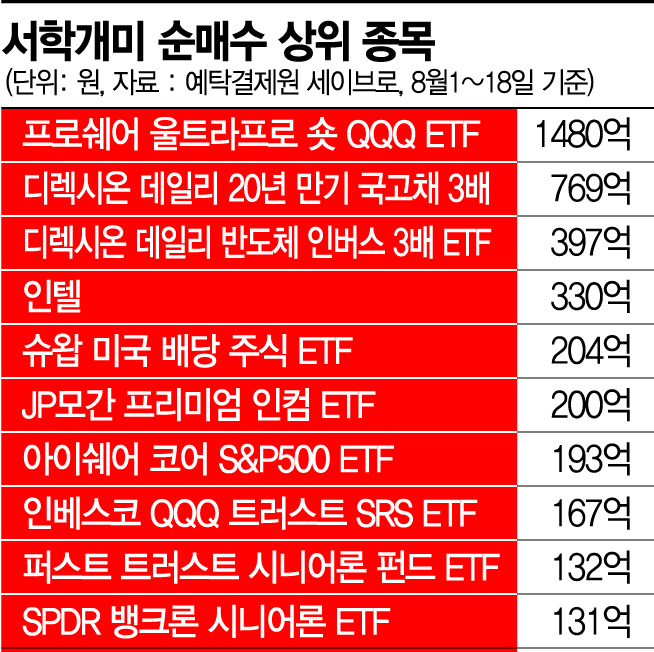
According to the Korea Securities Depository on the 19th, from the 1st to the 18th of this month, funds amounting to 20.4 billion KRW flowed into the Schwab US Dividend Equity ETF (SCHWAB US DIVIDEND EQUITY). This ranks fifth in terms of net purchase volume. This exchange-traded fund (ETF) is a representative high-dividend ETF in the U.S., with total fund assets reaching 39 billion USD. It is characterized by including stocks that have paid dividends for 10 years and have high dividend growth rates. Major holdings include high-dividend stocks such as consumer goods company Home Depot (4.37%), Pepsi (4.34%), IT companies Texas Instruments (4.27%), Cisco Systems (4.15%), and Coca-Cola (4.12%).
Investors also invested approximately 20 billion KRW and 19.3 billion KRW in the JP Morgan Premium Income ETF (JP MORGAN EQUITY PREMIUM INCOME ETF), which uses a ‘covered call’ strategy, and the iShares Core S&P 500 ETF (ISHARES CORE SP 500), which invests in blue-chip stocks within the S&P 500 index. A covered call involves trading stocks and options simultaneously; it reduces risk by holding stocks while selling call options at a somewhat higher price. Although returns may be lower during a rising market, it can reduce losses in a declining market, making it suitable for sideways or bearish markets.
Looking at the top 10 net purchased overseas stocks, seven ETFs employed bond, high-dividend, or senior loan (bank loan) strategies. This contrasts with the portfolios of Seohak Ants over the past three months (May to July), which included Tesla (cumulative 1.2588 trillion KRW), ProShares Nasdaq 3x Leveraged ETF (757.8 billion KRW), Apple (220.8 billion KRW), Tench Lithium (201 billion KRW), Direxion Daily Semiconductor 3x Leveraged ETF (199.6 billion KRW), and IonQ (99.3 billion KRW). Although the global stock market has recently shown signs of recovery due to easing tightening policies, increased uncertainty appears to have prompted changes in portfolios.
Currently, the global stock market has not provided a clear answer as to whether it is experiencing a bear market rally (a temporary rise in stock prices during a downtrend) or a trend reversal phase. Jaerhan Na, a researcher at Cape Investment & Securities, said, “The July FOMC minutes indicated that the rate hike stance will continue until inflation is meaningfully controlled, lowering expectations for entering a rate cut cycle. Also, the solid U.S. employment data in the short term suggests that the rate hike cycle could last longer than expected.”
Some investors are increasing their investment in senior loan ETFs to respond to the remaining rate hike period. The 9th and 10th largest net purchases by overseas stock investors were the First Trust Senior Loan Fund ETF (FIRST TRUST SENIOR LOAN FUND, 13.2 billion KRW) and the SPDR Blackstone Senior Loan ETF (SPDR BLACKSTONE SENIOR LOAN, 13.1 billion KRW). Senior loans refer to senior secured floating-rate loan bonds issued based on collateral received by financial institutions such as banks from speculative-grade (BBB-) borrowers. They are characterized by the ability to raise bond interest rates during rate hike periods and greater stability compared to investing in speculative-grade corporate bonds due to their senior secured status.
Junwoo Park, a researcher at KB Securities, said, “In a bear market caused by tightening policies, senior loans offer better defensive capabilities than speculative-grade corporate bonds and have favorable spread relative value. The steady issuance of collateralized loan obligations (CLOs), which can gauge corporate economic recovery, is also noteworthy.”
© The Asia Business Daily(www.asiae.co.kr). All rights reserved.
![Clutching a Stolen Dior Bag, Saying "I Hate Being Poor but Real"... The Grotesque Con of a "Human Knockoff" [Slate]](https://cwcontent.asiae.co.kr/asiaresize/183/2026021902243444107_1771435474.jpg)
















