IDMC "152 Patients Nearly Registered... Additional Interim Analysis Recommended"
With Patient Recruitment Almost Complete, Interim Evaluation Seems Meaningless
Safety Secured "No Difference in Adverse Reactions Between Groups"
Helixmith "Will Continue Clinical Trial"
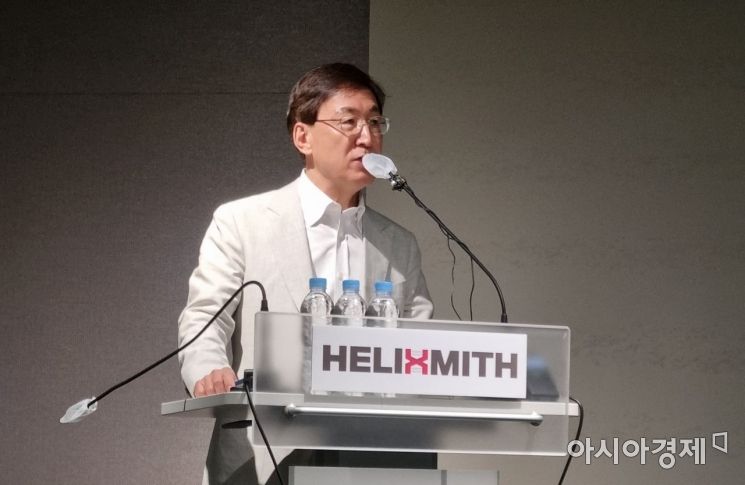 At a press conference held last June at Helixmith headquarters in Magok, Gangseo-gu, Seoul, Kim Sun-young, CEO of Helixmith, is speaking. / Photo by Lee Chun-hee
[Asia Economy Reporter Lee Chun-hee] The independent data monitoring committee (IDMC) has released the interim evaluation results of the Phase 3-2 clinical trial for Helixmith's key pipeline gene therapy 'Engensis (VM202)'. At the crossroads of continuing the trial, recruiting additional patients, or stopping the trial, the IDMC has deferred its decision.
Helixmith announced on the 18th that "the IDMC reviewed the first interim analysis data and a summary review of the measures Helixmith took to verify potential anomalies in the data," and "since enrollment of the minimum number of 152 patients is nearly complete and there is no difference in adverse reactions between groups, the IDMC recommended proceeding with the planned (additional) interim analysis."
The IDMC is an objective independent committee recommended by the U.S. Food and Drug Administration (FDA) to ensure safety and scientific validity in clinical trials. It consists of three members: one statistical expert and two physicians. They secure and analyze the data necessary for interim analysis, calculate the 'conditional power,' and recommend to the clinical trial sponsor whether to 'continue the trial,' 'modify the trial design,' or 'stop the trial.'
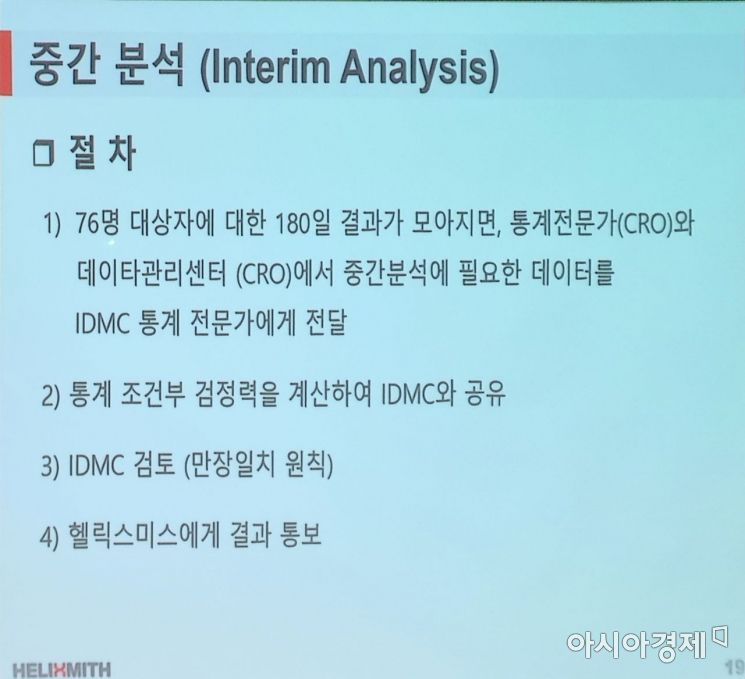
Accordingly, the IDMC's interim recommendation for Engensis was expected to be based on data observed for about six months after dosing 76 patients, which is half of the 152 patients set as the size for the Phase 3-2 trial. Therefore, the IDMC's recommendation was anticipated to be one of three options: 'continue the trial with 152 patients,' 'adjust patient size (up to 250 patients),' or 'stop the trial.'
However, the IDMC recommended "to proceed with the (additional) interim analysis as planned and provide the data so that the IDMC can decide whether to continue." This is closer to a deferral rather than one of the three recommendations.
The reason for this recommendation appears to be that since most of the planned patients have already been enrolled, conducting an interim analysis on just half, 76 patients, was deemed meaningless. Park Young-joo, Head of Clinical Development at Helixmith, explained, "More than 95% of the minimum 152 clinical trial participants have been enrolled." However, among the original 76 patients for interim analysis, 14 dropped out due to the COVID-19 pandemic, and since there are patients currently undergoing screening with signed informed consent who must be included, the final enrollment is expected to be around 160, with approximately 146 patients available for actual data analysis.
Regarding safety, the Data Safety Monitoring Board (DSMB) judged that there was no difference in adverse events between the clinical and control groups, deeming the treatment safe. The company also emphasized, "Engensis has shown high safety so far."

Helixmith plans to continue the clinical trial. The company stated, "Based on the IDMC's comments, we will continue recruiting clinical trial participants to complete the minimum enrollment," and "whether to proceed with additional interim analyses will be decided through discussions with the IDMC."
Since the IDMC recommended conducting an additional interim analysis on the already enrolled participants, if data analysis is performed on approximately 146 patients, this analysis is expected to be effectively the final analysis. A recommendation will likely be made to choose between terminating the trial based on success or failure or adjusting the patient size up to 250 to continue the trial further.
© The Asia Business Daily(www.asiae.co.kr). All rights reserved.
![Clutching a Stolen Dior Bag, Saying "I Hate Being Poor but Real"... The Grotesque Con of a "Human Knockoff" [Slate]](https://cwcontent.asiae.co.kr/asiaresize/183/2026021902243444107_1771435474.jpg)


















