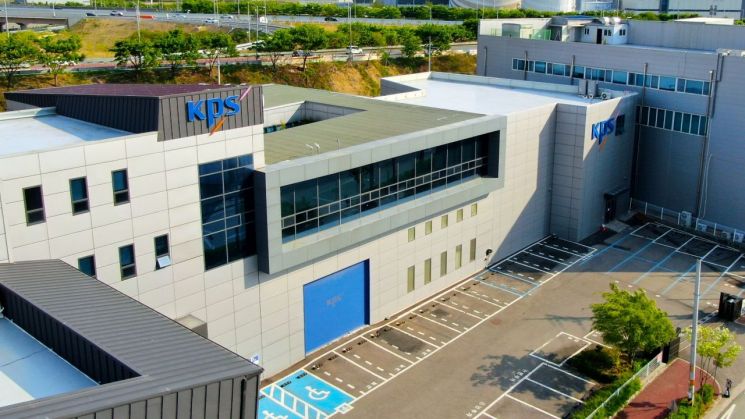
[Asia Economy Reporter Jang Hyowon] KPS has become the first in the industry to develop and deliver mass-production micro OLED FMM (Fine Metal Mask) tension equipment. Joining the rapidly growing VR, AR, XR, and other metaverse HMD (Head Mounted Display) value chains, expectations for future performance improvements are increasing.
On the 18th, KPS announced that it had completed delivery of the micro OLED display process equipment (Nano Mask Assembler), called OLEDoS, to APS Holdings. The two companies signed a development contract for the micro OLED FMM tension equipment in January of this year.
This equipment is a next-generation technology that directly deposits R (red), G (green), and B (blue) OLED pixels on semiconductor wafers, significantly enhancing resolution and image quality. It is regarded as an essential technology for micro OLED production to activate the metaverse industry.
According to market research firm Omdia, shipments of headset displays for VR (virtual reality), AR (augmented reality), and XR (extended reality) are expected to reach 25.3 million units this year, a 73.8% increase from the previous year. Furthermore, maintaining an average annual growth rate of 70%, shipments are projected to exceed 139 million units by 2028.
The global micro OLED supply chain includes Samsung Display, LG Display, APS Holdings, as well as China's BOE and Visionox, the US's eMagin, and Japan's Sony. Market research firm Emergen Research forecasts that the global metaverse market revenue will surpass $400 billion (approximately 520 trillion KRW) by 2026. In line with this, big tech companies such as Apple, Meta, Samsung Electronics, and LG Electronics are preparing new AR and VR products, which are metaverse utilization devices.
AR and VR devices, which require viewing small screens up close, demand a resolution of 3000 to 4000 ppi (pixels per inch) due to the short distance between the screen and the eyes. This is about 8 to 10 times higher than OLEDs used in smartphones. Currently available VR devices use existing OLED panels with about 600 ppi, causing users to frequently experience fatigue and dizziness. When viewed up close, the BM (Black Matrix), the gap between pixels, becomes prominent, resulting in the Screen Door Effect (SDE).
In contrast, micro OLED uses semiconductor wafers as substrates, allowing pixel sizes to be reduced to 4 to 20 μm (micrometers, one-millionth of a meter). The pixel size of conventional OLED panels is about 40 to 300 μm. This means the human eye cannot see the pixel gaps, and more OLED elements can be placed in the same area, enabling high-resolution implementation.
Kim Joobeom, Executive Director of KPS, said, "To achieve a resolution above 3000 ppi, mask alignment must be possible at a level below 300 nanometers (one-billionth of a meter)." He added, "We successfully developed new concept equipment and are encouraged to be the first in the industry to deliver mass-production micro OLED tension equipment."
He continued, "Starting this year, as the display industry accelerates investment in next-generation (8th generation) production lines for OLED panels used in IT devices such as tablets and laptops (with a total investment scale of about 120 trillion KRW, based on 6th generation production volume), KPS is expected to show performance improvements based on its diversified business portfolio."
© The Asia Business Daily(www.asiae.co.kr). All rights reserved.
![Clutching a Stolen Dior Bag, Saying "I Hate Being Poor but Real"... The Grotesque Con of a "Human Knockoff" [Slate]](https://cwcontent.asiae.co.kr/asiaresize/183/2026021902243444107_1771435474.jpg)











