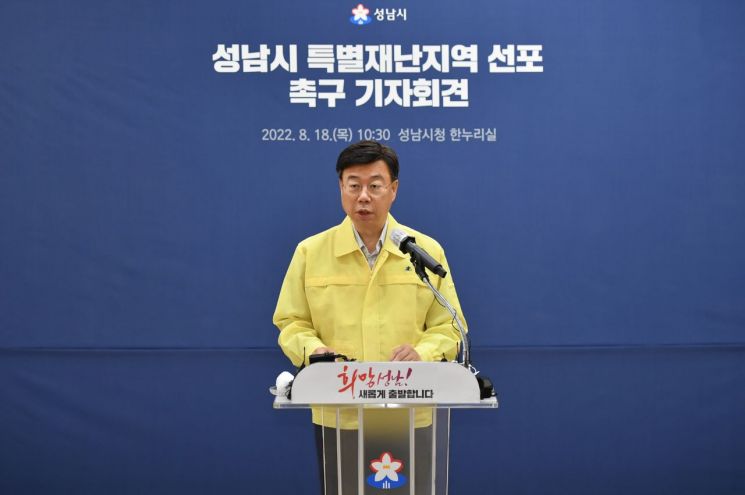
 Seongnam Mayor Shin Sang-jin is holding a press conference urging the declaration of a special disaster area at Seongnam City Hall on the 18th.
[Asia Economy (Suwon) = Reporter Lee Young-gyu] Following Yangpyeong-gun, Yeoju-si, and Gwangju-si in Gyeonggi Province, Yongin-si and Seongnam-si have also requested the government to declare them as 'Special Disaster Areas.'
On the 18th, Yongin-si requested the government to designate Dongcheon-dong in Suji-gu, where flood damage was concentrated due to the recent heavy rain, as a special disaster area.
In Yongin-si, a total of 488 cases of damage amounting to 5.2 billion KRW occurred due to the heavy rain from the 8th to the 15th. In particular, Dongcheon-dong, which recorded a cumulative rainfall of 534mm, suffered 134 cases of damage amounting to 3.3 billion KRW (63.5% of the city's total damage).
If Dongcheon-dong is declared a special disaster area, a certain percentage of the restoration construction costs and support funds for disaster victims can be subsidized by the national government.
Seongnam-si also held a press conference on the same day, where Mayor Shin Sang-jin personally requested that Seongnam-si be included in the special disaster areas.
Mayor Shin stated, "Citizens whose homes and workplaces across Seongnam-si have been flooded and who have lost their livelihoods due to landslides are urgently awaiting swift government support."
He added, "Seongnam-si is mobilizing all administrative resources to restore flood damage so that citizens can return to their daily lives as soon as possible. We will do our best not only to recover from the damage caused by this heavy rain but also to establish fundamental measures to prevent recurrence."
The damage amount criterion for designation as a special disaster area varies depending on the financial independence index of each local government. In the case of Seongnam-si, it is 10.5 billion KRW or more. According to the city's provisional tally, 622 facility damages occurred due to this heavy rain. The estimated restoration cost is 23.3 billion KRW. So far, 432 households and 1,116 people have been affected as disaster victims or temporarily evacuated residents, among whom 46 households and 108 people are still staying in four temporary housing facilities, including administrative welfare centers and comprehensive social welfare centers.
Previously, three regions?Yangpyeong-gun, Yeoju-si, and Gwangju-si?have already undergone preliminary investigations by the government to determine inclusion as special disaster areas.
In Yangpyeong-gun, a self-investigation tentatively counted 272 cases of damage to public facilities. The estimated damage amount was 26.7 billion KRW. The damage amount to public facilities alone, excluding private facilities whose tally is not yet complete, is 3.6 times the criterion for designation as a special disaster area.
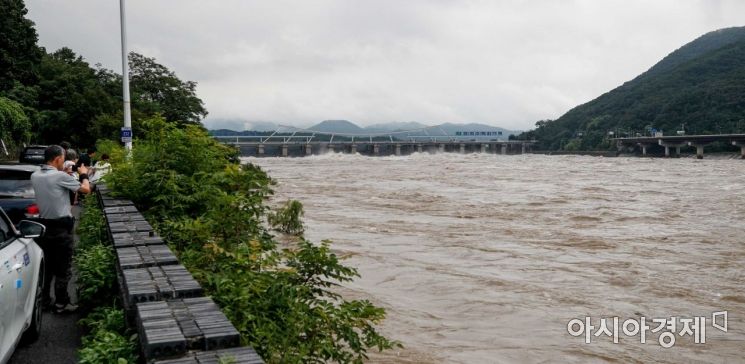 On the 11th, when the heavy rain that struck the Seoul metropolitan area entered a lull, water was being discharged from Paldang Dam in Namyangju, Gyeonggi Province. / Namyangju - Photo by Kang Jin-hyung aymsdream@
Gwangju-si also recorded damage to 528 public facilities and 251 private facilities. The damage amount alone exceeded twice the designation criterion of 10.5 billion KRW.
Yeoju-si reported damage to 108 public facilities and 111 private facilities, with the exact damage amount still being assessed. The flood damage in Yeoju was concentrated in Sanbuk-myeon, where the damage amount is estimated to be at least 1 billion KRW.
The designation of special disaster areas is decided through preliminary on-site investigations by officials from the Ministry of the Interior and Safety and deliberations by the Central Safety Management Committee. Once declared a special disaster area, depending on the financial independence of the local government, 50 to 80% of the restoration costs that would otherwise be borne by local funds are subsidized by the national treasury.
Additionally, residents who suffered damage such as destruction of houses and agricultural and fishery facilities receive disaster relief funds for livelihood support, reductions in public utility charges such as electricity and health insurance premiums, and benefits such as exemption from military mobilization and reserve forces training.
© The Asia Business Daily(www.asiae.co.kr). All rights reserved.


















