Annual 36 Billion KRW Funding Support for Dairy Farmers
Effectively Triggers Milk Price Increase Due to Raw Milk Price Hike
Concerns Over Price Increases for Bread, Snacks, Ice Cream, and Other Products
Government Continues Negotiations on Differential Pricing by Usage
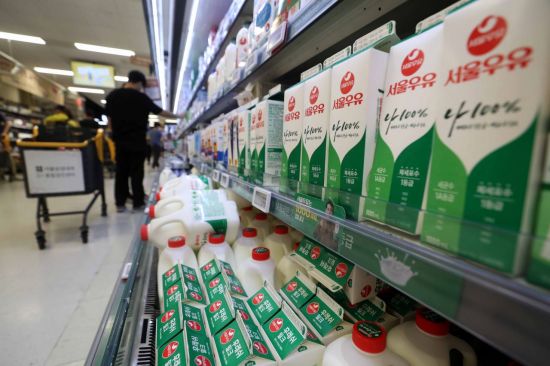 Seoul Milk Cooperative has decided to provide 36 billion won annually in farm management stabilization funds to dairy farmers, raising concerns that the increase in raw milk wholesale prices will consecutively drive up the prices of milk and dairy products, a phenomenon known as "milkflation." The photo shows a customer selecting products at a milk display in a large supermarket in Seoul. Photo by XXX
[Asia Economy Reporter Eunmo Koo] As Seoul Milk Cooperative, the largest dairy company in Korea, raises the wholesale price of raw milk, concerns about "milkflation" (a portmanteau of milk and inflation) are growing, with prices of not only milk but dairy products in general expected to rise in a chain reaction. The government, which is pushing for a restructuring of raw milk prices, plans to continue negotiations on the differentiated pricing system by usage regardless of Seoul Milk's recent decision.
According to the dairy industry on the 18th, Seoul Milk held a general assembly on the 16th and decided to provide 3 billion KRW per month, totaling 36 billion KRW annually, as farm management stabilization funds to dairy farmers. As the number one dairy company operated in the form of a livestock farmer cooperative, Seoul Milk explained that this support was decided to assist dairy farmers who are struggling with increased production costs due to soaring feed prices amid the Ukraine crisis, even though the raw milk price for this year has not yet been finalized.
Although this support fund is in the form of financial aid to raw milk supplying dairy farmers, the industry interprets it as effectively a raw milk purchase price increase. This decision is expected to result in an increase of 58 KRW per liter (L) in the raw milk purchase price. Other companies have expressed surprise at Seoul Milk's decision, given that the raw milk price for this year has not yet been set.
Seoul Milk's decision to provide support funds has raised concerns about a domino effect of price increases not only for milk but also related products. An immediate increase in milk prices is inevitable. Generally, consumer prices apply a multiplier of 10 times the raw milk price increase, so if Seoul Milk raised the price by 58 KRW per liter, consumer prices could rise by about 580 KRW per liter. When Seoul Milk raised the raw milk price from 926 KRW to 947 KRW per liter last August, it increased the price of plain milk by about 200 KRW. The industry is also voicing concerns about milkflation, where prices of other products using milk as an ingredient?such as bread, snacks, ice cream, and coffee?also rise. As of last year, the average domestic raw milk price was 1,094 KRW per liter. This year's price negotiation is expected to take place within the range of 47 to 58 KRW per liter.
While Seoul Milk has shaken the market with its sudden decision, the government, which is promoting the restructuring of raw milk prices, stated that it respects Seoul Milk's autonomous price determination but will continue the ongoing negotiations on the differentiated pricing system by usage without wavering. The Ministry of Agriculture, Food and Rural Affairs announced on the same day, "Even if the differentiated pricing system by usage is introduced, it will not be mandatorily applied to Seoul Milk," and added, "We plan to focus policy support on farms and dairy companies that voluntarily participate in the differentiated pricing system for the future of the dairy industry." The differentiated pricing system by usage is a system that currently only supplies raw milk based on drinking milk standards but will differentiate prices by dividing usage into drinking milk and processed milk.
Adjustments to raw milk prices are decided annually through negotiations by the "Raw Milk Base Price Adjustment Negotiation Committee," which includes dairy farmers, dairy companies, and academic experts. However, since the dairy industry is currently not participating in the negotiations, discussions on this year's raw milk price have not progressed. The dairy industry has stated that it will not participate in negotiations unless the dairy system reform, centered on the differentiated pricing system by usage, is a prerequisite. There is a consensus between the dairy industry and the government that the current system, which only allows raw milk purchases based on the most expensive drinking milk standard amid continuously declining demand for drinking milk, cannot enhance the competitiveness of domestic dairy products. However, the dairy farming sector opposes the introduction of this system, arguing that farmers' incomes may decrease, leading to a confrontation with the dairy industry.
© The Asia Business Daily(www.asiae.co.kr). All rights reserved.
![Clutching a Stolen Dior Bag, Saying "I Hate Being Poor but Real"... The Grotesque Con of a "Human Knockoff" [Slate]](https://cwcontent.asiae.co.kr/asiaresize/183/2026021902243444107_1771435474.jpg)
















