Market Reaction After the 8.16 Measures
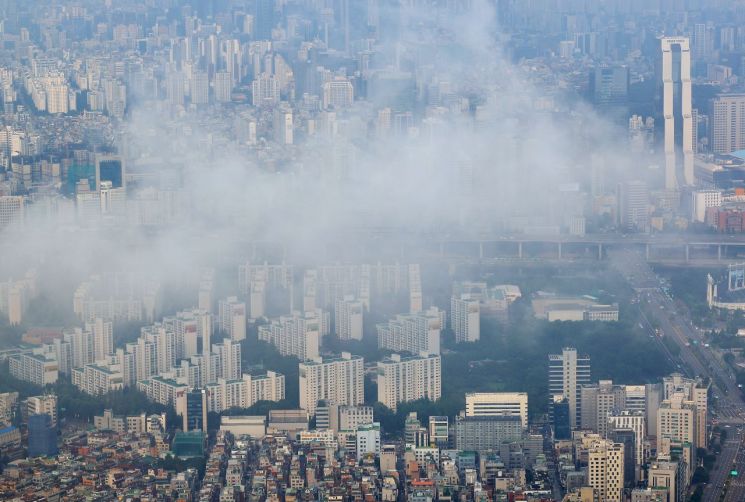
As the government announced regulatory easing on reconstruction burden charges and safety inspection systems through the '8·16 Measures,' areas expected to benefit, such as Yangcheon, Nowon, and Dobong districts, have remained relatively quiet for two days following the announcement. This is partly because expectations had already been priced in, and business risks remain due to rising raw material costs and interest rate hikes. Market reactions are expected to become clearer depending on the scope and extent of the regulatory easing that the government will concretize and release in the future.
According to the real estate big data platform Asil on the 18th, the number of apartment listings (sales) in Dobong-gu was 2,105 as of that day, a 4.6% increase from 2,011 on the 16th when the government measures were announced. Yangcheon-gu also rose 2.6% from 2,647 to 2,718, and Nowon-gu increased 2.5% from 4,839 to 4,963 during the same period. These areas are expected to benefit as the government has announced improvements to the safety inspection system, which has been identified as one of the biggest obstacles to reconstruction projects.
The government strengthened safety inspection regulations in 2018. The weighting for structural safety in the safety inspection evaluation criteria was raised from 20% to 50%. As a result, the number of projects receiving a D grade in detailed safety inspections and failing the appropriateness review by public institutions increased significantly. Over the four years following the strengthening of safety inspection regulations, only five projects in Seoul passed the safety inspection.
With the main policy goal of expanding urban housing supply, the government announced on the 16th a plan to improve the safety inspection system, which includes adjusting the structural safety weighting to a reasonable level (30-40%) and limiting the appropriateness review by public institutions. The industry expects an increase in safety inspection applications in areas with early reconstruction target complexes such as Mokdong and Changdong.
However, unlike past government announcements that caused market fluctuations, the market has not seen an immediate decrease in listings. A representative from a real estate agency in Mokdong, Yangcheon-gu, said, "Recently, it could be said that buyer inquiries have disappeared, but there doesn't seem to be much difference after the government announcement." He added, "Homeowners who listed their properties have been asking about the impact of the government measures, but there has been no adjustment in asking prices." Local real estate agencies say the situation in Nowon-gu and Dobong-gu, where apartment prices continue to decline, is not much different.
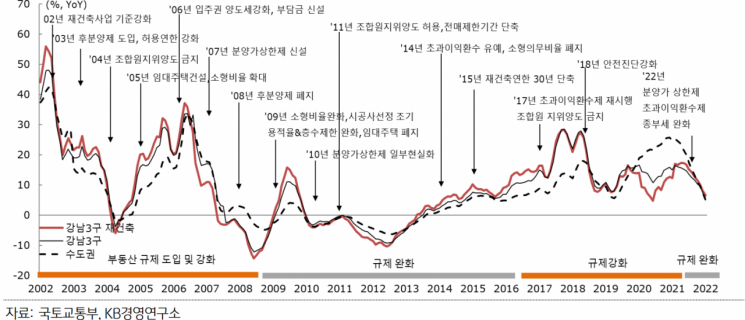 Apartment Price Trends Following Changes in Reconstruction-Related Policies
<Source: KB Management Research Institute>
Despite expectations for regulatory easing, various risks in reconstruction projects remain, and concerns about an economic downturn are significant, making a sharp turnaround in the real estate market unlikely. Notably, rising raw material costs and increased project expenses due to interest rate hikes are major risk factors.
Since the COVID-19 pandemic, the surge in raw material prices has sharply increased construction costs, significantly raising the cost burden for reconstruction associations and construction companies. Construction companies are reluctant to start projects due to concerns over rising construction and labor costs. Reconstruction associations in the process of selecting construction companies are facing difficulties in project advancement due to limited bids from construction firms.
In June, the government decided to reflect essential costs incurred during the maintenance project process in the calculation of sale prices and partially improved the high-priced sale price management system of the Housing and Urban Guarantee Corporation (HUG). However, opinions are divided on the impact of these measures. The first review site after the improvement of the high-priced sale price screening criteria was the general sale price of Busan Yangjeong 1 District, which was set at 17.55 million KRW per pyeong. This was about 10% higher than the general sale price approved in December last year but was considered below market expectations.
Along with easing reconstruction burden charges and safety inspection systems, there are calls for more aggressive deregulation of sale prices. Lee Kang-bae, a researcher at KB Financial Group Management Research Institute, said, "Considering the recently surged construction and financial costs, securing project revenue through raising general sale prices is essential to proceed with projects without increasing the burden on association members." He added, "Policy support to facilitate smooth supply is necessary to achieve the housing supply target of 2.7 million units," and "Until visible improvements in project profitability are confirmed, market participants are expected to maintain a wait-and-see stance."
© The Asia Business Daily(www.asiae.co.kr). All rights reserved.
![Clutching a Stolen Dior Bag, Saying "I Hate Being Poor but Real"... The Grotesque Con of a "Human Knockoff" [Slate]](https://cwcontent.asiae.co.kr/asiaresize/183/2026021902243444107_1771435474.jpg)

















