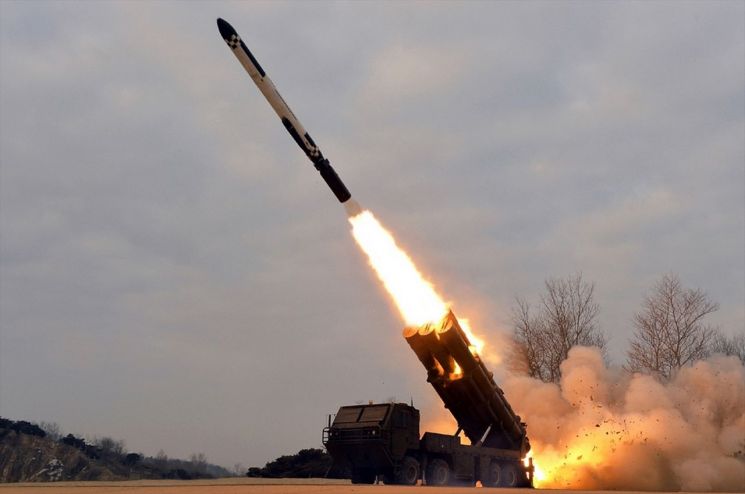
[Asia Economy Yang Nak-gyu, Military Specialist Reporter] On the 100th day of President Yoon Suk-yeol's inauguration, North Korea launched two cruise missiles on the 17th. This is the second cruise missile launch by North Korea this year, following January, and appears to be a strong reaction to the start of the preliminary exercises for the South Korea-U.S. joint exercise ‘Ulchi Freedom Shield’ (UFS).
According to military authorities on that day, North Korea fired two cruise missiles from Oncheon, South Pyongan Province, toward the West Sea in the early morning. South Korean and U.S. military authorities are analyzing detailed specifications such as flight distance.
Unlike ballistic missiles, cruise missiles do not violate United Nations Security Council resolutions, but they pose a significant threat due to their pinpoint long-range precision strike capability. North Korea has developed two types of medium- and long-range cruise missiles, which were revealed through the Defense Science Development Exhibition and military parades, and has also announced test launch results.
In September last year, North Korea also conducted a test launch of a new long-range cruise missile as a countermeasure to South Korea-U.S. joint exercises. North Korea’s consecutive cruise missile launches ahead of the joint exercises are interpreted as a ‘low-intensity provocation’ card to showcase their military power without greatly provoking the United States. Although the level of retaliation was low, it has been confirmed that these actions are part of the five-year weapons development plan, leading to expectations of continued missile provocations.
The UN Security Council prohibits any test launches of ballistic missiles capable of carrying nuclear weapons, but cruise missiles are not included in the sanctions scope because their speed is slower and range is not long, making their military threat relatively less significant.
A government official said, “There seem to be several reasons, including the intention to create a mood for easing sanctions against North Korea since cruise missiles do not violate UN resolutions, the 100th day of the Yoon Suk-yeol administration, and a reaction to the South Korea-U.S. joint exercises.”
© The Asia Business Daily(www.asiae.co.kr). All rights reserved.
![Clutching a Stolen Dior Bag, Saying "I Hate Being Poor but Real"... The Grotesque Con of a "Human Knockoff" [Slate]](https://cwcontent.asiae.co.kr/asiaresize/183/2026021902243444107_1771435474.jpg)
















