Currently in a "Technical Rally" Phase
"Box Range Sideways Market" vs "A Bigger Crash Is Coming"
Alternative Energy and Electric Vehicles Are Jointly Recommended Stocks
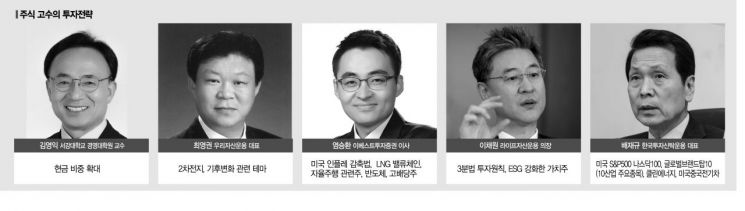
[Asia Economy Reporter Ji Yeon-jin] At minimum, an economic slowdown. While the KOSPI has been rebounding since last month and maintaining an upward trend, the stock market outlook for the second half of this year among domestic stock market experts is bleak. Although U.S. inflation, which has driven the market into fear since the beginning of the year, recently confirmed its peak, the unsettled Chinese economy has become another variable. Supply bottlenecks that stimulated global inflation and the Russia-Ukraine war are still ongoing, so volatility in the stock market in the second half of the year remains high. However, stock market experts advise that even in this foggy situation, one should not stop searching for hidden gems to grow their assets.
◇ "Sideways market with gradual rise" vs. "Prepare for a crash" = Asia Economy conducted in-depth interviews with five well-known stock market experts recently famous in the stock market, and all agreed that the recent market rebound is a ‘technical rebound.’ However, their views on when the rally will end varied. Lee Chae-won, chairman of Life Asset Management and known as a ‘first-generation value investing master,’ said, "Because the decline was significant, a strong rebound is expected in the second half of the year," adding, "Technically, after a 50-70% rebound, the market will move sideways while the market paradigm changes." Yeom Seung-hwan, an Ebest Investment & Securities director known as ‘Yeom-bly’ among individual investors, said, "A bear market rally requires breaking the low," and added, "Since the KOSPI already hit a low of 2280 in June, an autonomous rebound is possible from the KOSPI price-to-book ratio (PBR) of 1 at 2750 to 2800."
Professor Kim Young-ik of Sogang University Graduate School of Economics advised, "The U.S. and South Korea will enter a recession from the latter part of Q4 this year, and next year the whole world will fall into recession," adding, "Currently, this is not the bottom, and it is better not to buy new stocks until the end of this year." Professor Kim is known as Korea’s ‘Dr. Doom’ for forecasting the 2008 financial crisis.
The reason Professor Kim predicts a crash next year is due to the sharp narrowing of the yield spread between South Korea’s 1-year and 10-year government bonds since last month. He said, "The yield curve spread is a leading indicator of the economy by five months, signaling a worsening economy," adding, "We need to check U.S. consumer data this week, but disposable income and savings in the U.S. are already decreasing, so consumption?the main driver of the U.S. economy?may decline, leading to a recession." Since domestic companies are heavily influenced by U.S. demand, a decrease in exports will lead to a recession in South Korea. Professor Kim recommends buying stocks during the crash caused by the recession.
However, Choi Young-kwon, CEO of Woori Asset Management, said, "Major countries will not stand by during a recession," and added, "Smart money, which expects a slowdown rather than a recession, is already moving away from the dollar." Choi also forecasted that even if a recession phase comes, a rapid rise like the COVID-19 crash rebound is unlikely. He said, "The KOSPI is expected to move within the 2500 box range and gradually show an upward trend."
◇ What is the investment strategy for a ‘bear market rally’? = Lee, the chairman, shared an investment tip that in a volatile asset market, one should follow the ‘three-part investment principle.’ This means balancing investments evenly among real estate, stocks, and cash. Lee said, "Since everyone’s environment, fund size, and nature differ, there is no perfect product suitable for everyone," but advised, "In an inflationary environment, value stocks are more favorable than growth stocks, and it is good to pay attention to value stocks with steady assets, cash flow, and profits that have strengthened ESG (Environmental, Social, Governance) factors."
Bae Jae-gyu, CEO of Korea Investment Trust Management, recommended overseas diversification. He said, "It is best to maintain about 70% in the U.S., 30% combined in China and Korea, and invest 20-30% in themes," recommending ETFs such as the Standard & Poor’s (S&P) 500, Nasdaq 100, and Global Brand Top 10. The themes he pointed out were alternative energy and electric vehicles in the U.S. and China.
Director Yeom recommended actively changing portfolios based on corporate growth potential. He said, "During the COVID-19 bull market, anything bought rose, but such a market will not come for a while," adding, "When investing in stocks, if you think of yourself as the owner of the company rather than hoping for quick gains, your perspective changes completely." The sectors that must be included in Yeom’s portfolio are alternative energy such as wind and solar power, LNG value chain, and autonomous driving.
© The Asia Business Daily(www.asiae.co.kr). All rights reserved.
![Clutching a Stolen Dior Bag, Saying "I Hate Being Poor but Real"... The Grotesque Con of a "Human Knockoff" [Slate]](https://cwcontent.asiae.co.kr/asiaresize/183/2026021902243444107_1771435474.jpg)











