Trade Deficit Deepens Despite Goods Surplus
Han Deok-su Emphasizes Current Account Surplus, Positive Assessment
Exports and Foreign Exchange Are Strong, but Market and Experts Express Concerns
"Trade Deficit Indicates Poor Overseas Conditions... Significant Burden"
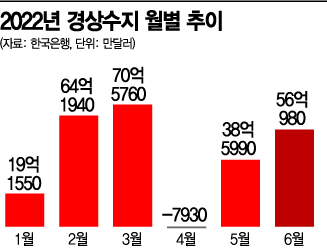
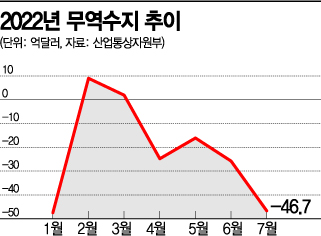
While the ‘goods balance,’ which represents the gap between exports and imports of goods within the current account, continues to show a surplus, another export indicator, the ‘trade balance,’ has seen a deepening deficit, leading to mixed evaluations of our export situation. The government emphasizes that the goods balance is still in surplus, maintaining that our economy and foreign exchange situation remain sound, but experts consider this to be only “half true.” Although a surplus in the goods balance is positive, since the trade balance is an indicator reflecting overseas export conditions, the approach that “the economic situation is still fine” is deemed incorrect.
According to the Bank of Korea and the Korea Customs Service on the 17th, the gap between the goods balance and the trade balance within the current account has widened significantly this year. As of June, the goods balance continued its surplus streak at $3.594 billion, but the trade balance showed deficits in June (-$2.487 billion) and July (-$4.805 billion), marking four consecutive months of negative figures. For the first half of the year, the goods balance recorded a surplus of $20.01 billion, while the trade balance showed a deficit of $15.253 billion.
Both the goods balance and the trade balance represent the difference between exports and imports of goods, so they are broadly similar. However, the goods balance announced by the Bank of Korea is based on the international balance of payments standard, while the trade balance is based on customs clearance data, resulting in differences in amounts. For example, the goods balance evaluates both export and import values on a Free On Board (FOB) basis, where the importer bears freight and insurance costs, whereas the trade balance calculates export values on an FOB basis but import values on a Cost, Insurance, and Freight (CIF) basis, where the exporter bears freight and insurance costs.
Additionally, the goods balance reflects exports when payments are received in installments for shipbuilding and similar exports, considering ownership transferred, but the trade balance only records exports after shipbuilding is fully completed and customs export declarations are made, leading to differences in the timing of export and import accounting. Due to these differences, the goods balance is generally recorded as larger than the trade balance.
Recently, the gap between the goods balance and the trade balance has been widening further, which the Bank of Korea attributes to the increasing overseas production of major export items. A Bank of Korea official explained, "As companies increase the proportion of production overseas where costs are cheaper and export from there, the trade balance, which does not capture these results, is recorded lower, while the goods balance is calculated higher," adding, "The gap is expected to widen further."
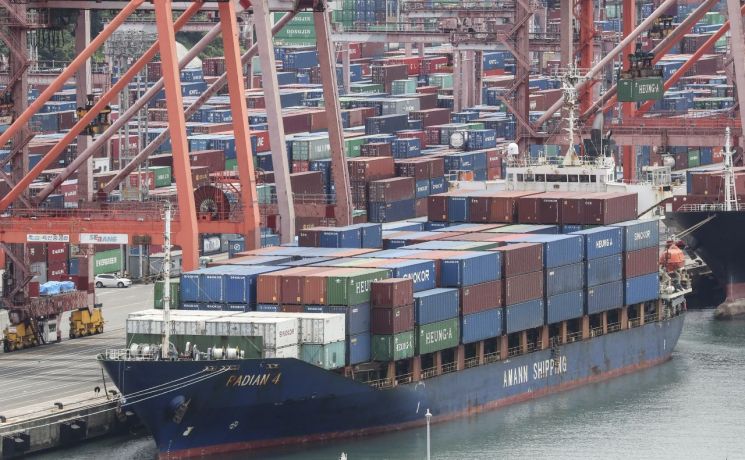 Container unloading operations are underway at Busan Port Sinsundae Pier. [Image source=Yonhap News]
The problem is that as the gap between these indicators widens, opinions on export evaluations diverge. Prime Minister Han Duck-soo emphasized again yesterday, following his statements on the 2nd and 5th, that the current account should be considered rather than the trade balance, and that it is not yet a stage to worry about a crisis. He said, "A trade deficit does not mean a shortage of foreign exchange," and added, "An excessive surplus in the balance of payments can also cause problems such as trade friction."
However, experts explain that the trade deficit should not be dismissed as a temporary phenomenon. Professor Sung Tae-yoon of Yonsei University’s Department of Economics pointed out, "A trade deficit means that overseas conditions and export situations are not favorable," and warned, "It could become a significant burden on the economy going forward." He added, "Since the deficit persists despite a significant depreciation of the won, the government should be aware of the problem."
It is explained that if the trade deficit continues to accumulate due to decreased exports to China and high oil prices, the current account surplus will inevitably decline, necessitating improvement measures. Especially with growing concerns about domestic and international economic recessions, the possibility of further deterioration in export conditions is also problematic. A Bank of Korea official said, "Until the first half of the year, goods exports seem relatively stable, but uncertainties are very high in the second half."
© The Asia Business Daily(www.asiae.co.kr). All rights reserved.
![Clutching a Stolen Dior Bag, Saying "I Hate Being Poor but Real"... The Grotesque Con of a "Human Knockoff" [Slate]](https://cwcontent.asiae.co.kr/asiaresize/183/2026021902243444107_1771435474.jpg)


















